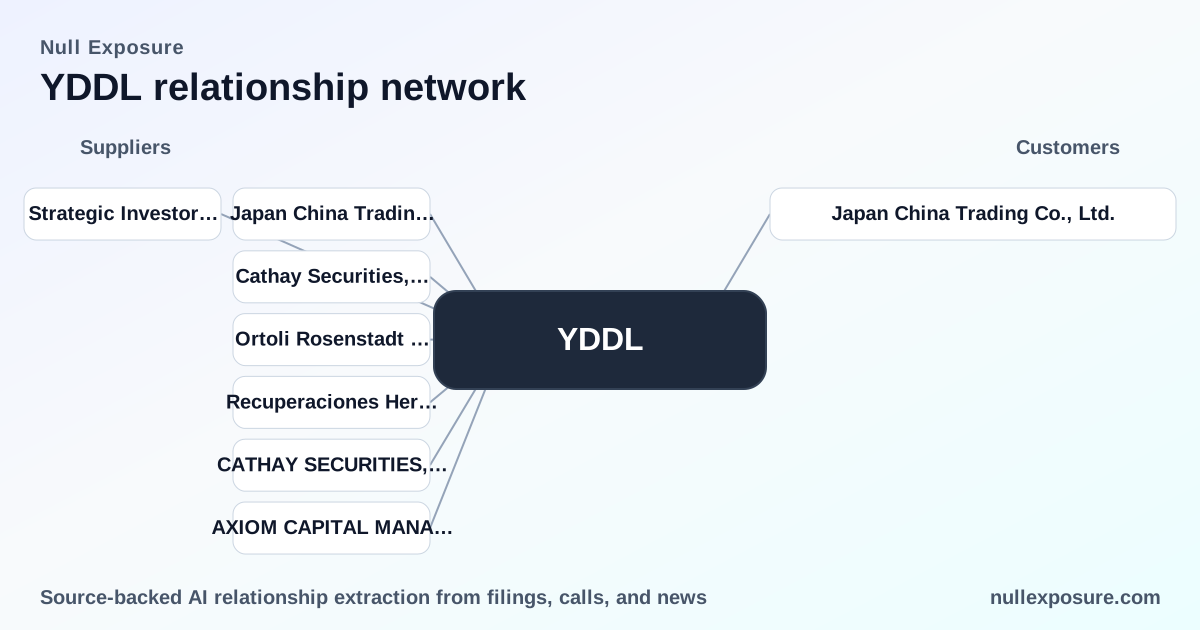
One and One Green Technologies (YDDL): Customer Relationship Profile and Strategic Implications
One and One Green Technologies operates as a Philippines-based hazardous-waste recycler that converts imported electronic assemblies and scrap into nonferrous metals and saleable commodities; the business monetizes through bulk sales to industrial materials buyers and structured purchase orders that convert processing throughput into near-term revenue. A recently disclosed purchase order from Japan China Trading shifts a material portion of throughput into contracted sales, improving revenue visibility while concentrating counterparty exposure. For a deeper view of related coverage and analytical workflows, visit https://nullexposure.com/.
Market positioning and monetization model One and One is a specialized waste-to-metals processor: it imports regulated hazardous waste streams, applies proprietary/authorized conversion processes, and sells refined nonferrous outputs to industrial purchasers. Revenue is driven by throughput and commodity realizations, and meaningful single orders can represent high-single-digit to double-digit percentages of annual revenue. The company’s NASDAQ listing (YDDL) and public disclosures make these purchase-level signals commercially significant for investors assessing revenue sustainability and operational risk.
Why the Japan China Trading order matters Japan China Trading Co., Ltd. has placed a purchase order for up to 16,000 metric tons of shredded electronic assemblies and scrap metal, valued at approximately $17 million. According to a GlobeNewswire press release (Feb 4, 2026) and corroborating coverage in Investing.com and other industry reports (May 2026), the order transforms a portion of One and One’s processing capacity into a contracted sale to an Osaka-based industrial materials supplier. This is a direct customer relationship where One and One supplies processed metal output to an external purchaser; the aggregate size of the order is material relative to One and One’s reported revenue.
Customer relationships recorded in the coverage Japan China Trading Co., Ltd.: One and One received a purchase order from Japan China Trading for up to 16,000 metric tons of shredded electronic assemblies and scrap metal, valued at roughly $17 million—publicized in One and One’s February 2026 press release and reported by Investing.com and other outlets in spring 2026. (GlobeNewswire, Feb 4, 2026; Investing.com, May 2026; SahmCapital commentary, Apr 2026.)
Operating-model constraints and company-level signals With no explicit constraint documents supplied, investor-relevant signals emerge from the company profile and the disclosed order:
- Concentration and revenue impact: The $17 million purchase order is a sizeable contract against reported trailing revenue of $65.8 million (TTM). That order represents roughly a quarter of trailing revenue on a simple comparison, indicating significant customer concentration risk if a limited number of large buyers underpin near-term sales.
- Contracting posture and delivery exposure: The relationship is commercial and transactional—One and One acts as a physical supplier fulfilling volumetric purchase orders. Contract terms such as payment timing, acceptance criteria, and logistics were not published with the PR; such absent terms create operational and working-capital uncertainty even when headline order value is attractive.
- Criticality and counterparty profile: The buyer is an Osaka-based industrial materials supplier; industrial intermediaries are typical of cross-border scrap demand. For One and One, a repeatable flow of such industrial buyers is critical to sustaining utilization and margins.
- Maturity and scale: One and One reports positive operating margins and profitability metrics (gross profit $15.76M, EBITDA $12.77M, operating margin ~16.3% on TTM figures). The company is commercially viable at current scale, but growth is dependent on converting ad hoc orders into repeatable, contract-backed revenue streams.
- Ownership and governance signal: High insider ownership (~77.6%) and minimal institutional ownership (~0.12%) indicate a governance posture where insiders control outcomes and strategic decisions, which has implications for minority investor oversight during rapid commercial scaling.
Operational and financial implications for investors The Japan China Trading order converts a portion of potential spot sales into contracted revenue, improving short-term revenue visibility and supporting near-term free cash flow if collection and delivery proceed as disclosed. However, investors must weigh three practical risks:
- Concentration risk: A single large order equivalent to a meaningful share of trailing revenue concentrates topline risk and magnifies the impact of any dispute, delay, or cancellation.
- Working-capital and logistics risk: Large-volume scrap shipments require upfront processing, staging, and transport; absent published payment and incoterms, One and One will carry receivables and logistic execution risk until buyers accept and settle.
- Commodity-price and quality tolerance: Refining margins depend on feedstock quality and global metal prices; contractual commitments to volumes reduce spot flexibility and can lock the company into margins that change with commodity moves.
Key takeaways for operators and investors
- This is a material customer win: the disclosed $17 million order from Japan China Trading materially beefs up One and One’s sales pipeline and converts processing capacity into realizable revenue in FY2026 (GlobeNewswire, Feb 4, 2026).
- Visibility improved, but concentration rises: the positive commercial validation comes with elevated single-buyer exposure relative to One and One’s reported revenue base.
- Execution—not headline value—is the determinant of investor outcomes: prompt fulfillment, clear payment terms, and tight quality control will translate the order into cash and earnings; failures will amplify downside given the order’s scale.
- Corporate control matters: the company’s high insider ownership structure accelerates decision-making but reduces independent oversight as the business scales.
Practical next steps for due diligence
- Request contract-level terms: payment schedule, incoterms, cancellation clauses, and quality specifications.
- Model collection timing under conservative assumptions and test working-capital sensitivity against a partial delay scenario.
- Monitor operational updates: shipment notices, acceptance certificates, and subsequent repeat orders from industrial buyers.
Conclusion and where to look next The Japan China Trading purchase order is an important commercial validation for One and One’s model: it converts capacity into contracted revenue while raising concentration and execution risk. Investors should value the order but insist on contract transparency and evidence of repeatable demand to justify multiple turns of valuation beyond current trading levels. For a focused view of customer signals and broader commercial relationships, see the coverage hub at https://nullexposure.com/.
Sources cited in this article include One and One’s public press release and market coverage: GlobeNewswire (Feb 4, 2026) announcing the $17M purchase order and corroborating reporting from Investing.com and related market commentary in spring 2026.