Yelp Inc: Customer relationships that reshape the revenue mix
Yelp operates a consumer-facing local search and review platform and monetizes primarily by selling performance-based advertising to businesses, supplemented by subscriptions and data licensing for third-party AI and search partners. Recent moves into high-margin data licensing deals with AI firms shift the revenue mix and change how investors should value Yelp’s customer relationships. For a quick look at how we track counterparty exposure and licensing trends, visit https://nullexposure.com/.
The business model in one paragraph for investors
Yelp’s core revenue engine is an auction-based advertising platform priced largely on a cost-per-click basis that serves small and multi-location businesses across the U.S.; advertising accounted for roughly 96% of revenue in the most recent fiscal year, while subscriptions and licensing are growing ancillary streams. Yelp now plays a dual role as seller of advertising and licensor of human-generated local content, converting its user-generated reviews and listings into a monetizable product for search and AI partners.
How Yelp contracts and who pays
Yelp’s contracting posture blends usage-based ad auctions, recurring subscription services, and multi-year licensing agreements for data access. Evidence from investor disclosures shows Yelp sells CPC advertising through both direct and online channels and operates subscription products like Yelp Guest Manager; the company also signs multi-year data licenses for Yelp Fusion and other data feeds. Yelp’s customers range from single-location SMBs to large multi-location brands, with a dedicated multi-location sales team for advertisers with 10+ locations. The company reports U.S.-centric revenue concentration and notes that no single customer accounted for 10% or more of consolidated revenue in recent years — signaling broad customer breadth but high dependency on advertising as the critical revenue segment.
Relationships at a glance — what every counterparty in the set tells investors
Below I cover every named counterparty that appears in the collected results and the public reporting that mentions them.
-
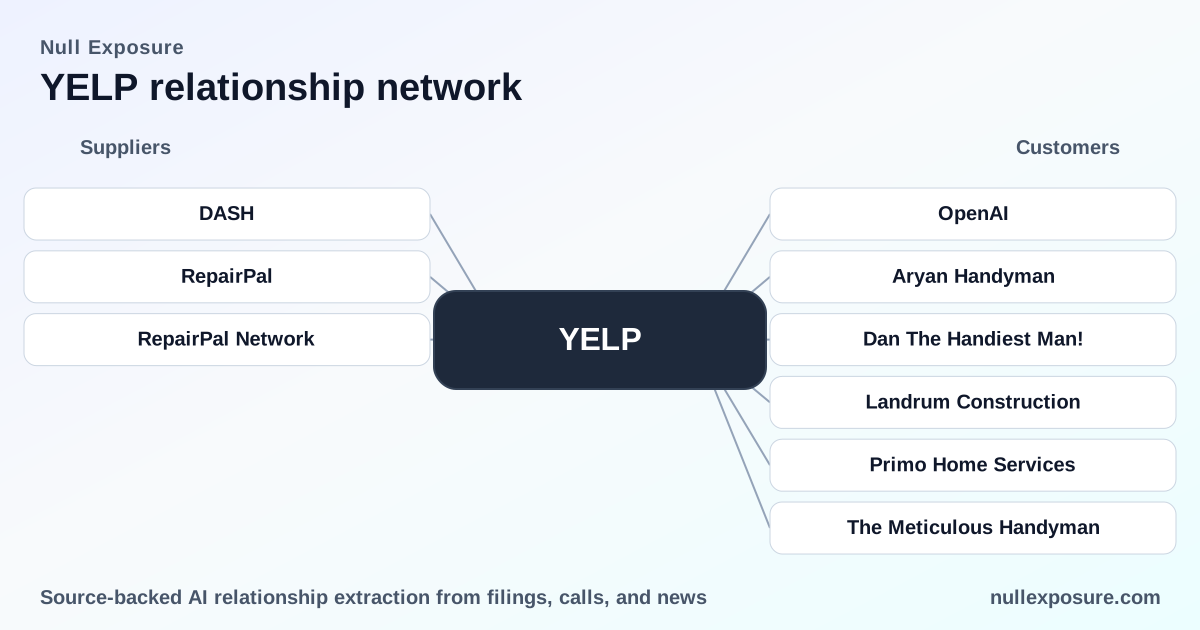
OpenAI — Yelp has signed a data licensing agreement to provide human-generated review content and other local data to OpenAI, accelerating Yelp’s data-licensing growth and expanding its reach into AI-driven search. — Coverage of Yelp’s Q4 2025 commentary and subsequent reporting, including The Globe and Mail/Motley Fool and Yahoo Finance (Mar 2026).
-
Google (GOOGL) — Google signed a two‑year licensing agreement to access Yelp’s reviews, a commercial arrangement that positions Yelp as a source of curated local content for a dominant search player. — Reporting from NBC Bay Area and NBC Chicago summarizing the licensing deal (May 2026).
-
Perplexity AI — Yelp expanded data licensing to include AI firms such as Perplexity, integrating Yelp content into Perplexity’s chatbot for local recommendations while reportedly restricting use for core model training in some deals. — Mentioned in Simply Wall St and TradingView/GuruFocus coverage of Yelp’s AI partnerships (May 2026).
-
Dan The Handiest Man! (Portland) — Named in Yelp’s community blog as one of the platform’s highest-rated handyman services, illustrating Yelp’s ongoing role as a discovery and reputation platform for local service SMBs. — Listed on Yelp’s community blog post highlighting top handymen (Mar 2026).
-
The Meticulous Handyman (San Francisco) — Featured by Yelp’s own community editorial as a high-rated service provider, reinforcing Yelp’s local listings utility for home services verticals. — Yelp Blog community post (Mar 2026).
-
Primo Home Services (New York) — Appears in Yelp editorial content as a top-rated local provider; these citations underscore the long tail of SMB customers that generate Yelp’s advertising and subscription demand. — Yelp Blog community post (Mar 2026).
-
Aryan Handyman (El Cerrito) — Cited in the same Yelp community feature, representing typical SMBs that rely on Yelp for discovery and lead generation. — Yelp Blog community post (Mar 2026).
-
Landrum Construction (Roseville) — Included among Yelp’s showcased service businesses, demonstrating Yelp’s penetration into both small trades and larger local contractors. — Yelp Blog community post (Mar 2026).
(Collectively, the editorial listings for local handymen and contractors illustrate the platform’s SMB footprint; the AI and search partner entries show an adjacent, higher-margin corporate customer base.)
What the constraints reveal about operating risk and optionality
The public constraints extracted from Yelp’s disclosures provide a coherent picture of how the company runs its customer relationships:
-
Contracting mix: Yelp operates a diversified contract set — auctioned CPC ads (usage-based), monthly subscriptions, and multi‑year licensing agreements. This gives Yelp revenue resilience but ties growth to both advertising demand and successful expansion of licensing terms.
-
Customer concentration: No single customer accounted for ≥10% of revenue recently, which signals low single-counterparty concentration at the customer level, but the company is highly concentrated by product, since advertising is critical (96% of revenue).
-
Counterparty profile: Customers span small businesses through very large enterprises, with a dedicated multi-location salesforce for larger clients. This distribution implies differing churn dynamics: SMB spend is volatile and cyclical, while larger advertisers and licensors offer steadier, higher-contract-value relationships.
-
Geography and scale: Yelp’s operations are U.S.-centric, with the majority of revenue sourced domestically; international operations are largely de-emphasized.
-
Role and materiality: Yelp acts both as a seller (advertising) and licensor (data), with advertising constituting the core product and services/home-services verticals showing notable growth. Data licensing is an emerging, high-margin growth engine but remains supplemental to ads.
Risks, catalysts and the investor checklist
- Risk: Heavy reliance on ad auctions leaves Yelp exposed to cyclical ad budgets and competition from large platforms that bundle local content. Advertising concentration is the primary risk despite customer-level diversification.
- Catalyst: Expansion of repeatable, long-term licensing contracts with AI and search partners (OpenAI, Google, Perplexity) can materially improve margins and diversify revenue away from CPC volatility.
- Operational constraint: U.S.-centric revenue and SMB-heavy sales imply sensitivity to domestic macro conditions and local economic cycles.
- Execution item: Convert one-off editorial/SMB engagement into higher retention subscription products and expand contractual licensing terms to improve revenue visibility.
Bottom line and next step for due diligence
Yelp remains an advertising-first business with an expanding licensing franchise that has the potential to shift margins and valuation multiples if management sustains multi-year deals with AI and search firms. For investors focused on customer counterparty risk, the company’s broad SMB base reduces single-customer concentration, while recent licensing agreements with OpenAI, Google, and Perplexity provide a compelling growth vector. For a structured review of counterparties and to monitor changes in licensing activity, see our platform at https://nullexposure.com/.
Bold takeaway: Yelp’s worth is now a two-part story — durable ad auctions plus nascent, high-margin licensing — and the balance between the two will determine sentiment and multiple expansion.