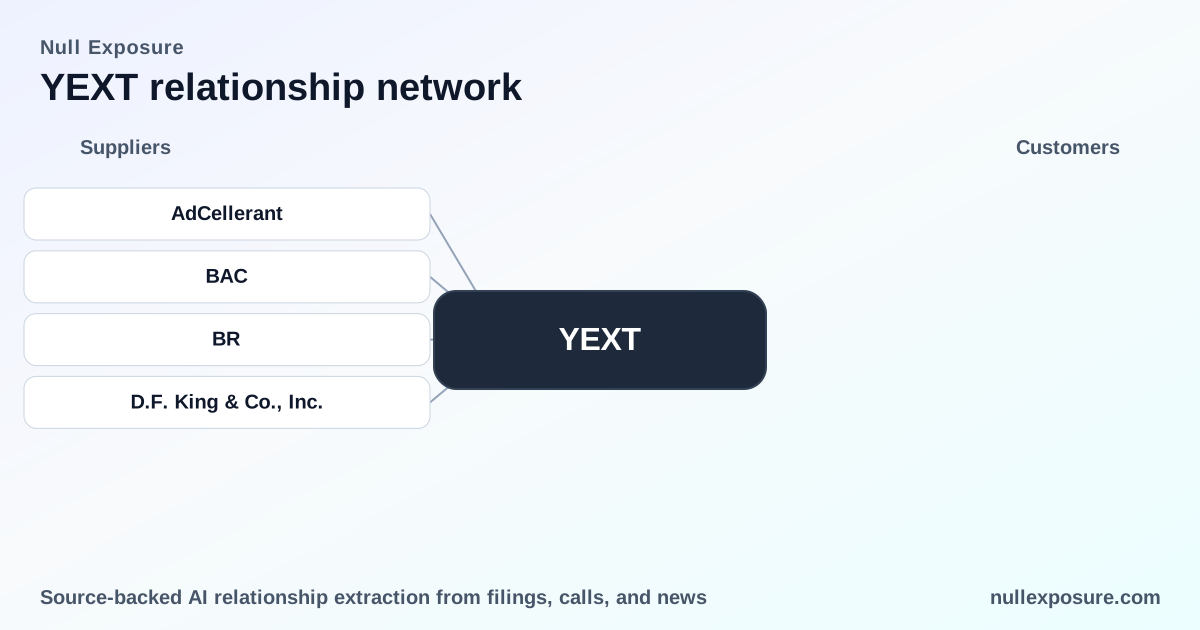
Yext’s publisher network: platform power, subscription economics, and what the customer list tells investors
Yext sells a subscription software platform that centralizes and syndicates business location, review, page and search data to third‑party publishers and consumer interfaces. The company monetizes primarily through annual and multi‑year subscriptions plus support, selling to enterprise, mid‑market and small business customers directly and through resellers, and then driving value by maintaining authoritative profiles across hundreds of publisher endpoints. For investors, the investment case is straightforward: recurring revenue with network effects from publisher reach, balanced against revenue concentration in the United States and dependence on integrations with a handful of dominant platforms. Learn more at https://nullexposure.com/.
How Yext actually operates and gets paid
Yext’s core is a SaaS listing and knowledge‑management platform that customers subscribe to on an annual or multi‑year basis. Subscription revenue and associated support are the primary revenue drivers, which produces predictable ARR and the typical SaaS contract posture (annual commitments, renewals and some multi‑year deals). The company sells to a diversified customer base—enterprise, mid‑market and small business, and also works through third‑party resellers where Yext is contractually the seller to the reseller rather than the reseller’s customers. According to the company’s disclosures, no single customer accounted for more than 10% of revenue, which supports the claim that individual customer concentration risk is low, even as overall revenue remains geographically concentrated: roughly 80% of revenue is U.S.‑based (fiscal years ended January 31, 2023–2025). These are company‑level signals drawn from Yext’s filings and investor materials; they define the operating constraints investors should weigh when valuing durable ARR against platform risk.
Publisher relationships: where the product delivers value
Yext’s commercial value is a function of the publishers and interfaces it feeds. The platform is reported to power Listings, Reviews, Pages and Search across 200+ publishers, and a short list of those endpoints recurs in recent commentary and filings. Below I cover each relationship captured in the public results and the sources that reference them.
Amazon Alexa
Yext lists Amazon Alexa among the publisher endpoints the platform distributes to, indicating direct syndication to voice and assistant surfaces that influence discovery and local answers. This was noted in a Roth Capital‑related market note cited by MarketScreener on May 4, 2026 (Roth Capital downgrade commentary). https://www.marketscreener.com/news/roth-capital-downgrades-yext-to-neutral-from-buy-adjusts-pt-to-6-from-9-50-ce7e5fdcdd8df223
Apple
Apple is identified as a publisher partner, reflecting Yext’s need to manage business presence in Apple Maps and related Apple search surfaces for customers’ location data and listings. This pairing is referenced in the same MarketScreener note (Roth Capital, May 4, 2026). https://www.marketscreener.com/news/roth-capital-downgrades-yext-to-neutral-from-buy-adjusts-pt-to-6-from-9-50-ce7e5fdcdd8df223
Facebook (Meta) is listed among the external publishers Yext distributes content to, providing social‑platform profile synchronization and review integration for customers. The mention comes from the MarketScreener piece relaying analyst commentary on Yext’s publisher set (May 4, 2026). https://www.marketscreener.com/news/roth-capital-downgrades-yext-to-neutral-from-buy-adjusts-pt-to-6-from-9-50-ce7e5fdcdd8df223
Google Business Profile
Google Business Profile is called out specifically as a primary publisher endpoint, underscoring that search‑engine visibility—via Google—is central to Yext’s product value proposition. That publisher listing appears in the Roth Capital commentary covered by MarketScreener (May 4, 2026). https://www.marketscreener.com/news/roth-capital-downgrades-yext-to-neutral-from-buy-adjusts-pt-to-6-from-9-50-ce7e5fdcdd8df223
Yelp
Yelp is included in the roster of publishers, reflecting review and local directory distribution that matters especially for hospitality, retail and services customers. The MarketScreener article that summarized analyst notes lists Yelp among the endpoints (May 4, 2026). https://www.marketscreener.com/news/roth-capital-downgrades-yext-to-neutral-from-buy-adjusts-pt-to-6-from-9-50-ce7e5fdcdd8df223
Bing
Bing (Microsoft) is named as a publisher endpoint, which speaks to Yext’s need to cover multiple search ecosystems and not rely exclusively on Google for discovery traffic. This claim is in the same MarketScreener‑quoted analyst note (May 4, 2026). https://www.marketscreener.com/news/roth-capital-downgrades-yext-to-neutral-from-buy-adjusts-pt-to-6-from-9-50-ce7e5fdcdd8df223
Amazon (marketplace / publisher)
Separately, TradingView’s recap of Yext’s 10‑K notes that the platform powers listings across publishers including Amazon (distinct from Alexa) — reflecting that ecommerce and marketplace presence is also part of Yext’s distribution universe. See TradingView coverage of Yext’s FY2026 10‑K summary (May 4, 2026). https://www.tradingview.com/news/tradingview:2f0c7c0b69272:0-yext-reports-446-6m-revenue-and-0-07-diluted-eps-in-10-k/
Google (general)
TradingView’s 10‑K summary reiterates Google’s centrality to Yext’s ecosystem, noting Google as one of the core publishers within the platform’s 200+ publisher network. This appears in the same TradingView report summarizing Yext’s FY2026 disclosures. https://www.tradingview.com/news/tradingview:2f0c7c0b69272:0-yext-reports-446-6m-revenue-and-0-07-diluted-eps-in-10-k/
OpenAI
Notably, TradingView’s summary of Yext’s filing lists OpenAI among publisher or interface endpoints, signaling the company’s integration into emergent AI answer surfaces and large‑language model interfaces that surface local facts. This was reported in the TradingView coverage of Yext’s FY2026 filings (May 4, 2026). https://www.tradingview.com/news/tradingview:2f0c7c0b69272:0-yext-reports-446-6m-revenue-and-0-07-diluted-eps-in-10-k/
What these relationships mean for valuation and downside
The publisher list confirms two critical investment inputs. First, Yext’s product is network‑driven: broad publisher reach increases switching costs and customer stickiness because customers want a single source of truth feeding many endpoints. Second, a small number of large platforms—Google, Amazon, Apple, Meta, Microsoft and emerging AI interfaces—drive the marginal value of the product; changes in those platforms’ policies, integrations or commercial terms are high‑impact events.
Counterbalancing this platform risk are structural strengths disclosed by the company: subscriptions dominate revenue, no single customer is over 10% of revenue, and the customer base spans enterprise to SMB with a reseller channel, which supports recurring cash flows. That said, revenue concentration by geography is material—roughly 80% U.S. revenue—which exposes Yext to U.S. macro cycles and competitive dynamics domestically. The company’s latest reported TTM revenue was roughly $446.6M with market capitalization near $412M, an EV/Revenue near 0.98 and EV/EBITDA around 5.2 based on the snapshot metrics issued for FY2026; these metrics should be judged against growth prospects and platform dependency disclosed above.
If you want a succinct, investor‑grade vendor map or a deeper playbook on how these publisher ties affect contract durability and churn, find resources and analytic notes at https://nullexposure.com/.
Bottom line
Yext’s value rests on subscription economics plus the strategic utility of broad publisher reach. The company’s disclosed customer and publisher relationships validate that proposition, while geographic concentration and dependence on a handful of large publishers are the principal strategic risks investors must price into the stock.