Yimutian (YMT): An agricultural B2B platform with RWA optionality and a narrow margin runway
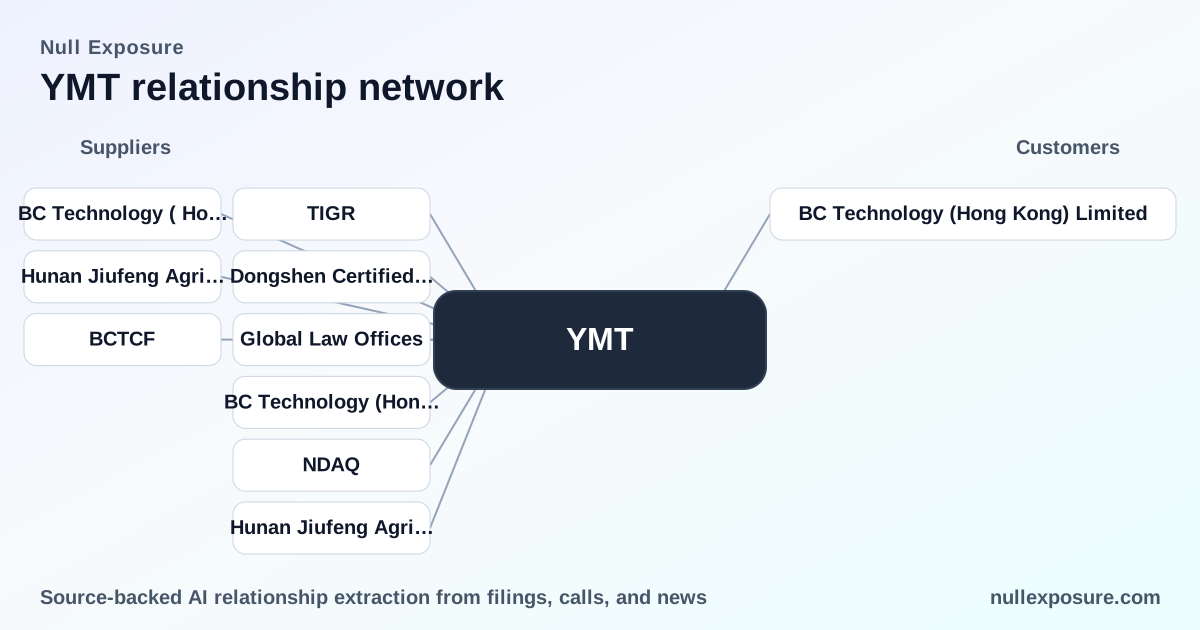
Yimutian operates an agricultural B2B marketplace that connects producers of agricultural products with institutional and commercial buyers in China, monetizing primarily through platform transaction services and adjacent value-added offerings. Investors should value YMT as a niche marketplace business with strong gross economics but persistent operating losses, whose strategic partnerships—most recently with BC Technology—introduce new product channels tied to real-world asset (RWA) financialization. For a concise view of platform exposures and customer ties, visit https://nullexposure.com/.
How the business makes money and what that implies for customers
Yimutian provides platform services that facilitate large-scale transactions in agricultural goods—everything from bulk commodity procurement to specialty inputs like rare medicinal materials. Revenue derives from transaction fees and platform services that leverage scale and product curation; gross margins are strong because the company acts as an intermediary rather than holding inventory. The critical commercial levers are buyer/supplier onboarding, trust and compliance services, and the ability to upsell financing, logistics or verification services to participants on the platform.
The platform posture is inherently B2B: contractual relationships are with agricultural suppliers, traders and institutional buyers, which concentrates the company’s exposure on a relatively small number of high-value customers rather than mass retail churn. That contracting posture drives both opportunity—high lifetime value per customer—and risk—customer concentration and long sales cycles.
Financial posture: scale is real, profitability is not
Yimutian reports meaningful top-line scale with Revenue TTM of $146.9 million and Gross Profit TTM of $124.6 million, indicating very high gross margins at the transaction level. At the same time, the company runs negative operating results: Operating Margin TTM is -37.1% and Profit Margin is -21.7%, with EBITDA of approximately -$30.3 million. Market capitalization is small at about $17.8 million, and Price-to-Sales is low at 0.12x.
- What this means for customers and partners: the platform is commercially viable at the transaction level but still requires operational scale and lower overhead to reach sustainable profitability. Customers rely on a platform that generates strong gross economics, but any long-term service guarantees or capital-intensive initiatives (for example, financing or RWA product support) will be constrained by the company’s positive gross profit but negative operating cash flow.
For investors focused on counterparty risk, these numbers indicate a dual reality: high-quality unit economics at the transaction level versus tight corporate liquidity and execution risk at the enterprise level.
The partnership that matters: BC Technology (Hong Kong) Limited
According to a March 2026 news report on QuiverQuant, Yimutian and BC Technology (Hong Kong) Limited entered a strategic partnership to develop RWA (real-world asset) financial products using YMT’s inventory of rare medicinal materials, spices and precious seedlings as underlying assets. BC Technology will provide technological and platform capabilities to design, review compliance and assess risk for these RWA offerings, while Yimutian will supply large-scale agricultural assets as the collateral base (reported March 10, 2026: https://www.quiverquant.com/news/Yimutian+Inc.+and+BC+Technology+Form+Strategic+Partnership+to+Drive+Agricultural+Digital+Transformation).
- Plain-English takeaway: Yimutian will feed agricultural supply as underlying collateral while BC Technology brings the financial product design and compliance functions, creating a channel to monetize inventory beyond spot transaction fees. (QuiverQuant, March 2026.)
Why this relationship matters for investors and operators
The BC Technology tie-up is an explicit attempt to convert inventory and trade flow into financial products—a clear expansion from transactional marketplace fees into structured-finance and productized financial services. For customers, this can increase liquidity options for suppliers (access to structured financing against inventory) and create new buyer tools for provenance and settlement. For the company, however, successfully commercializing RWA products requires regulatory rigor, trust in asset quality, and capital or partnerships that can underwrite or distribute the resulting securities.
Company-level constraints and operational signals
The constraints dataset for customer relationships contains no explicit excerpts; therefore the following are company-level operational signals derived from Yimutian’s business model and financials:
- Contracting posture: B2B platform contracts are likely longer-term and relationship-driven, with an emphasis on supplier verification, compliance and recurring transaction flow. This increases stickiness but raises onboarding cost per customer.
- Concentration: The business model concentrates exposure on a relatively small group of high-value trading partners rather than a diversified retail base, which amplifies counterparty and revenue concentration risk.
- Criticality: Yimutian’s platform sits at a critical junction for institutional agricultural sellers who need liquidity and market access; the platform’s failure would materially disrupt participants that rely on its distribution channels.
- Maturity: Financials show strong gross profit but persistent operating losses, signaling a mid-growth company that must scale overhead efficiency or add recurring service revenue to reach self-sustaining profitability.
These constraints imply that new product initiatives—like RWA financial products—will be judged by counterparties and investors on execution speed, regulatory compliance, and capital adequacy.
Investment implications and risk checklist
- Upside: The BC Technology partnership creates a new revenue vector that leverages YMT’s asset flow into structured products, potentially increasing take-rates and recurring revenue if distributed at scale. A functioning RWA channel could materially re-rate platform economics.
- Downside: Regulatory complexity around RWA products, the need for third-party underwriting or distribution partners, and YMT’s limited market capitalization create execution and liquidity risk.
- Operational focus: Investors should monitor customer retention, average transaction value, and rollout milestones for any RWA product. Operators should prioritize proof-of-concept pilots with clearly defined governance and compliance gates.
Bottom line for investors
Yimutian is a high-gross-margin agricultural B2B platform with a fragile profitability profile and a small-cap market valuation. The strategic relationship with BC Technology adds legitimate optionality by turning agricultural supply into investable RWA products, but the commercial impact depends on regulatory approvals, trust in asset quality, and the company’s ability to scale distribution without worsening operating losses. Track revenue conversion from platform services to productized financial offerings as the single highest-value signal for near-term upside.
For a deeper mapping of YMT’s customer relationships and their commercial implications, explore the full coverage at https://nullexposure.com/.