The York Water Company (YORW): Customer relationships confirm a classic regulated utility model with modest bolt-on growth
The York Water Company impounds, purifies and distributes drinking water and operates wastewater systems across a franchised territory in south‑central Pennsylvania, monetizing through usage‑based rates under utility tariffs, supplemented by optional subscription programs (service‑line protection) and recurring municipal billing arrangements. Recent small acquisitions expand customer counts incrementally while leaving revenue concentration and working capital profiles largely unchanged — an investor should view YORW as a low‑beta, regulated services play with predictable cash flow and modest growth through localized M&A. Read more about the underlying customer signals at https://nullexposure.com/.
Why customer wins and acquisitions matter for a utility-grade investment thesis
York’s customer relationships are not high‑volume commercial contracts but franchised retail utility commitments: each added housing development, retirement community, business park or municipal account increases base revenues and regulatory rate base incrementally. For investors this means growth is accretive but immaterial on a per‑deal basis, and operating leverage comes from steady demand and regulated rate increases rather than one‑off large contracts.
Recent customer additions — what investors should note
-
Pine Run Retirement Community (FY2026) — On March 30, 2026 York acquired the wastewater system serving Pine Run Retirement Community, adding 141 customers and consolidating water/wastewater supply to the campus. This acquisition establishes York as the sole provider of both water and wastewater services for the community (InsiderMonkey, May 4, 2026: https://www.insidermonkey.com/blog/the-york-water-company-yorw-acquires-wastewater-system-serving-pine-run-retirement-community-1741862/).
Takeaway: small, strategic bolt‑on that slightly expands recurring revenues and service territory. -
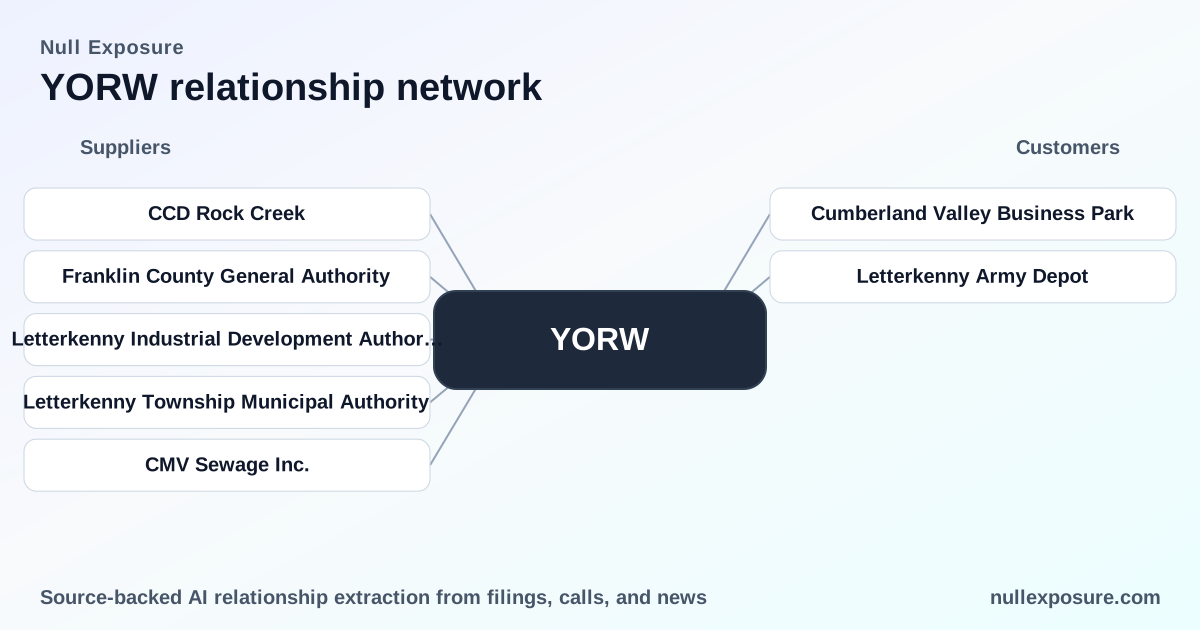
Cumberland Valley Business Park (FY2022) — York expanded into Franklin County by acquiring water/sewer assets that serve the Cumberland Valley Business Park as part of a broader purchase that also included FCGA customers and Letterkenny Army Depot service relationships (Public Opinion, Sept 2, 2022: https://www.publicopiniononline.com/story/news/local/2022/09/02/york-water-company-buys-franklin-county-water-sewer-systems-pennsylvania/65464239007/).
Takeaway: municipal and industrial park customers diversify the revenue mix toward commercial/industrial loads while remaining modest in scale. -
Letterkenny Army Depot (FY2022) — The same Franklin County transaction brought York into service arrangements that cover the Letterkenny Army Depot, representing a government counterparty within the company’s expanded footprint (Public Opinion, Sept 2, 2022: https://www.publicopiniononline.com/story/news/local/2022/09/02/york-water-company-buys-franklin-county-water-sewer-systems-pennsylvania/65464239007/).
Takeaway: adds a low‑risk government customer that supports revenue visibility but does not materially shift company concentration.
Company‑level operating constraints that shape revenue quality
The public filings and transaction disclosures reveal a consistent operating model and a set of constraints that determine how revenues are earned and how growth affects the business:
-
Usage‑based billing is core. Water and wastewater revenues are recognized on a per‑unit basis tied to metered flow, producing demand‑sensitive but predictable cash receipts under tariff structures. This underpins the company’s primary monetization mechanism.
-
Subscription revenue is incremental. York offers an optional service line protection program where customers pay a fixed monthly fee for repairs or replacements up to an annual cap; this creates a reliable, high‑margin subscription stream separate from commodity usage.
-
Government counterparties exist but do not dominate. The company has contracts to provide billing and revenue collection for municipalities and serves at least one major government account; municipal relationships are complementary to retail sales and provide billing and stability benefits.
-
Residential concentration is material but controlled. Residential customers produced 64% of operating revenue in 2024, indicating that individual household demand drives most top‑line volume; this increases sensitivity to weather and local economic conditions but also delivers low churn.
-
Geographic concentration within a franchised territory. York operates across portions of 57 municipalities within four counties in south‑central Pennsylvania: regional concentration reduces diversification but simplifies regulatory management and capital planning.
-
Acquisitions and individual deals are immaterial to consolidated results. The company explicitly classifies many small purchases as immaterial; growth is incremental and focused on durable ratemaking additions rather than transformational M&A.
-
Seller and service provider posture. York’s role is fundamentally as a seller of regulated utility services and operator/provider of water/wastewater, with service delivery a single, distinct performance obligation to each customer.
-
Low per‑customer spend profile. Balance sheet captions show other customers’ advances for construction in the tens of thousands, consistent with a business model where individual customer spend is generally below $100k.
Collectively, these characteristics define a mature, low‑growth, high‑quality regulated utility profile where revenue durability stems from essential service provision and rate regulation, not from large, lumpy commercial contracts.
Financial context and investor implications
York’s financials reinforce the customer signals. Market capitalization sits near $472 million, with Revenue TTM ~$77.5 million and EBITDA ~$42.5 million, delivering a trailing P/E of about 21x and a dividend yield near 3.0%. The company’s low beta (0.61) and steady margins (operating margin ~33.7%) reflect regulated pricing and stable demand. Analysts are conservative: current consensus positions a single hold rating with an analyst target price around $34.
Investment implications:
- Income investors will value the predictability and dividend, supported by regulated cash flows and subscription add‑ons.
- Growth investors should expect only modest expansion driven by small accretive acquisitions and rate case outcomes rather than rapid top‑line acceleration.
- Risk profile centers on regulatory decisions, regional drought/flood cycles and localized economic trends given geographic concentration.
Bottom line and next steps for due diligence
The York Water Company is a classic, well‑managed regional water utility that grows incrementally through localized acquisitions and strengthens recurring revenue via usage‑based tariffs and modest subscription offerings. Customer wins like Pine Run and the Franklin County purchases enhance local scale without altering the company’s immaterial‑per‑deal economics.
For a deeper read into customer relationships and how they map to revenue quality and counterparty risk, visit https://nullexposure.com/ for structured relationship intelligence and transaction context.
Key next steps for investors: review recent rate cases and regulatory filings, quantify the contribution of subscription revenue to EBITDA, and monitor municipal contract terms that could affect billing/collection obligations.