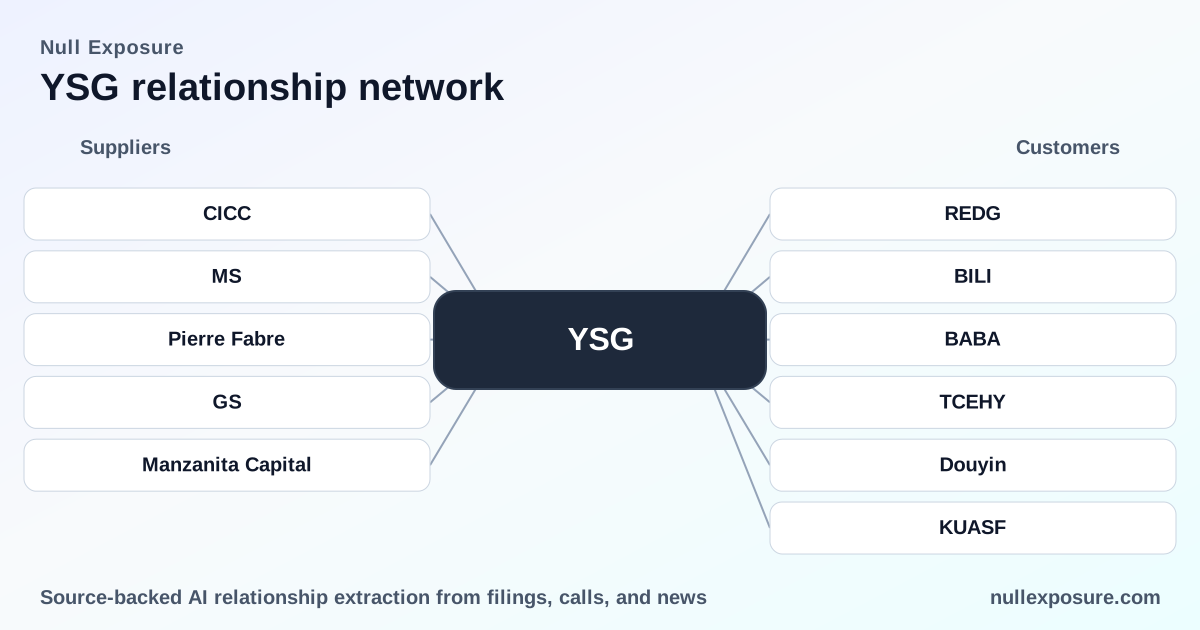
YSG: platform-driven revenue and the economics of third‑party channels
Thesis — YSG operates as a digitally native consumer brand that monetizes primarily through product sales on major Chinese e‑commerce marketplaces and social‑commerce channels, leveraging marketplace reach and owned storefronts to scale distribution and lower customer acquisition costs. For investors, the key levers are channel mix, promotional intensity on partner platforms, and exposure to a small set of dominant digital ecosystems that set fees, traffic allocation, and promotional mechanics. Explore deeper at https://nullexposure.com/.
Why distribution strategy is the investment story here
YSG’s revenue model is channel‑centric: product gross margins are earned at the point of sale, but net margins are driven by platform commissions, advertising spend, and the company’s ability to convert owned traffic. Platform dependence concentrates commercial risks — platform policy changes, commission shifts, or search‑ranking adjustments can swing unit economics quickly. At the same time, presence across multiple marketplaces and social channels provides reach and an omnichannel sales footprint that can accelerate scale. Investors should treat platform relationships as commercial counterparties whose terms and promotional calendars are material to quarterly performance.
Platform-by-platform read: who YSG sells through and what that means
Below I cover every customer relationship reported in the results and the source context investors should factor into diligence.
JD.com — large marketplace distribution (FY2026)
YSG sells products through JD.com as one of its leading e‑commerce partners, giving the company access to JD’s logistics network and buyer base; that presence supports broad online reach and order fulfilment options. This is documented in a MarketBeat earnings report on Yatsen Holding that lists JD.com among primary online channels (FY2026).
Source: MarketBeat earnings report on Yatsen Holding (FY2026).
Tmall — flagship marketplace exposure (FY2026 and FY2020 references)
Tmall is identified across multiple reports as a primary sales channel, cited both in a MarketBeat FY2026 earnings note and a KR‑Asia profile that referenced historical channel mix (FY2020); Tmall represents a strategic gateway to Alibaba’s consumer audience and promotional ecosystem, which substantially influences traffic and discounting behavior.
Sources: MarketBeat earnings report on Yatsen Holding (FY2026); KR‑Asia article on Perfect Diary (reporting channel use in FY2020).
RED (Xiaohongshu) — social commerce discovery (FY2020)
RED is listed among the social platforms YSG uses for product distribution and discovery, reflecting a social‑commerce layer where user content drives purchase intent; presence on RED supports brand storytelling and influencer‑led conversion for beauty SKUs. The KR‑Asia piece discussing Perfect Diary’s channel mix noted RED as a core channel in FY2020.
Source: KR‑Asia article on Perfect Diary (FY2020).
Alibaba (BABA) — platform parent dynamics (FY2020)
References to Alibaba (BABA) in the KR‑Asia coverage tie back to the company’s use of Alibaba’s ecosystem — principally Tmall — which implies exposure not just to marketplace mechanics but also to Alibaba’s broader promotional events and payment/fulfilment integrations. Alibaba’s platform policies and festival calendar materially affect promotional cadence and margin outcomes.
Source: KR‑Asia article on Perfect Diary (FY2020).
WeChat (Tencent/TCEHY) — social and direct‑to‑consumer channels (FY2020)
WeChat is reported as a sales and social‑commerce channel, which means YSG leverages Tencent’s social graph for direct marketing, mini‑program storefronts, and social distribution; this channel improves customer retention and owned traffic acquisition versus pure marketplace sales. The KR‑Asia report identified WeChat among the company’s channels in FY2020.
Source: KR‑Asia article on Perfect Diary (FY2020).
Bilibili — content‑driven audience platform (FY2020)
Bilibili appears in the channel list as a platform where content and community engagement feed product discovery, useful for reaching younger demographics and building brand affinity; content investments on Bilibili can shorten the funnel from discovery to purchase. KR‑Asia listed Bilibili in its FY2020 channel breakdown.
Source: KR‑Asia article on Perfect Diary (FY2020).
Douyin — short‑form commerce and live selling (FY2020)
Douyin is cited as a distribution touchpoint, reflecting the company’s use of short‑form video and live‑streaming commerce to drive high‑conversion bursts and rapid sell‑through during promotions; Douyin’s format amplifies promotional ROI when live‑streaming and influencer tie‑ins scale. The KR‑Asia article documented Douyin among channels in FY2020.
Source: KR‑Asia article on Perfect Diary (FY2020).
Kuaishou — alternative short‑video audience (FY2020)
Kuaishou rounds out the short‑form channel set, offering reach into different user cohorts and a parallel live‑commerce funnel; combining Kuaishou with Douyin diversifies live selling exposure and can moderate platform concentration risk. KR‑Asia’s coverage listed Kuaishou in the FY2020 channel mix.
Source: KR‑Asia article on Perfect Diary (FY2020).
Operating constraints and company‑level signals investors should parse
The provided results do not include explicit contractual constraints or vendor‑level agreements; treat that absence as a company‑level signal that YSG’s commercial exposure is driven more by platform economics than disclosed long‑term contracts. From an operating perspective:
- Concentration: Sales are concentrated through a handful of dominant ecosystems (Alibaba/Tmall and JD for marketplaces; Tencent/WeChat, Douyin, Kuaishou, Bilibili, RED for social commerce). Concentration makes revenue sensitive to platform rules and promotional algorithms.
- Contracting posture: The mix indicates marketplace listings and social storefronts rather than exclusive, long‑dated supply contracts; platform relationships are transactional and governed by platform terms and promotional mechanics rather than bilateral long‑term supply agreements.
- Criticality: Platforms are critical commercial counterparties — marketplace access, paid placement, and live‑streaming support directly affect revenue pacing and promotional ROI.
- Maturity: The channels cited are mature and well‑established in China’s consumer internet landscape; this reduces execution risk around distribution but amplifies competitive pressure and promotional intensity.
Because no explicit contractual data was supplied, investors should prioritize diligence on platform fee structures, historical traffic allocation, and promotional spend levels when forecasting margins and free cash flow.
What this means for valuation and risk
- Revenue upside is tied to channel growth and successful conversion on owned channels; increasing direct traffic via WeChat mini‑programs or owned e‑commerce reduces reliance on paid marketplace mechanics and improves long‑term margins.
- Short‑term volatility is governance by platform promotions and festival calendars; expect quarter‑to‑quarter swings driven by Alibaba and JD sales events and live‑streaming results on Douyin/Kuaishou.
- Diversified presence across marketplaces and social platforms is a risk‑mitigant, but the largest platforms retain pricing and traffic control, so platform concentration remains a valuation discount factor until more revenue shifts to owned channels.
Final investor takeaway: YSG is a channel‑first consumer business whose financial outcomes track platform economics more than product innovation alone; investors should focus due diligence on channel economics, promotional cadence, and the company’s ability to migrate sales toward higher‑margin owned channels. Learn more about how these channel relationships affect company exposure at https://nullexposure.com/.