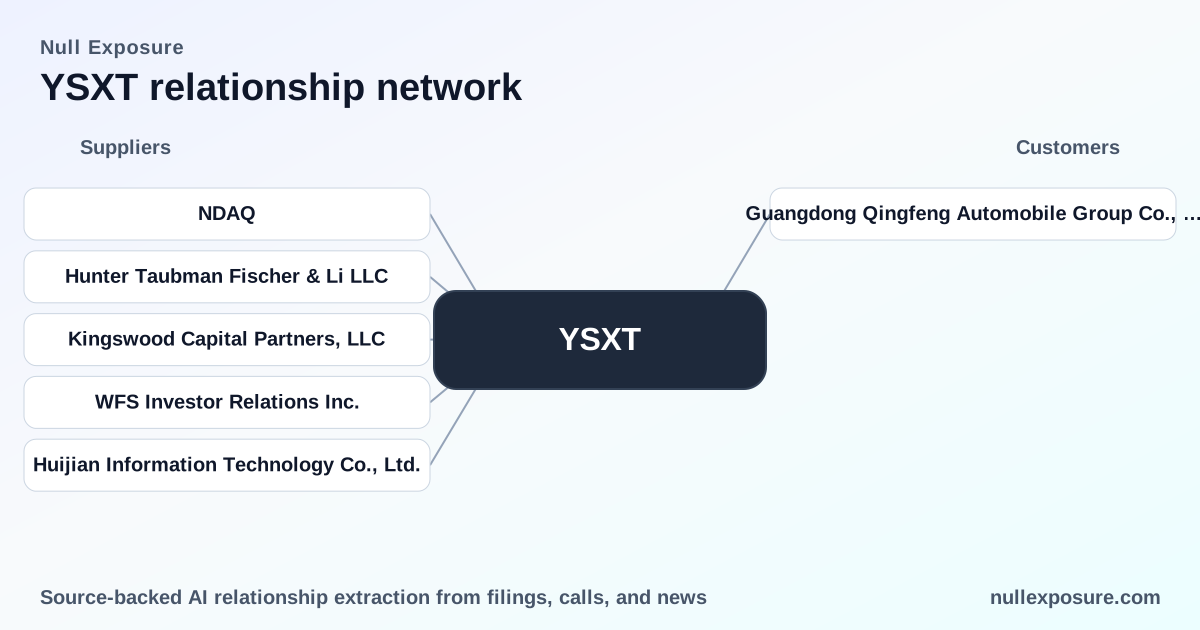
YSXT’s customer map: commercial partnerships that drive its auto-insurance and SaaS rollout
YSX Tech Co., Ltd. monetizes by selling digital insurance and automotive SaaS solutions—AI-driven claims tooling, evidence storage, and platform services—to offline distributors and insurance ecosystem participants. Revenue derives from B2B SaaS deployments, technical service agreements, and strategic platform integrations with large automotive and insurance partners, which together create recurring fees, implementation projects, and potential transaction-based income from ecosystem services. Learn more about relationship intelligence at https://nullexposure.com/.
Why these partnerships matter to investors
YSXT’s announced partners are not casual pilot customers; they are gateways into China’s physical automotive distribution and claims-processing channels. Each named relationship increases YSXT’s commercial reach into either vehicle retail/service footprints or loss-adjusting workflows—two high-volume vectors for digital insurance tooling. That combination supports scalable recurring revenue if deployments convert from MOUs and technical agreements into paying contracts.
Customer relationships and what they mean for growth
Guangdong Qingfeng Automobile Group Co., Ltd.
YSXT signed a non‑binding Memorandum of Understanding to integrate its digital platform and SaaS capabilities with Qingfeng’s extensive offline automotive sales and service network, positioning YSXT to digitize dealer operations and after‑sales insurance workflows. According to a GlobeNewswire release in December 2025, the MOU frames a long‑term collaboration to combine YSXT’s software with Qingfeng’s physical distribution channels; Yahoo Finance also reported the strategic MOU in March 2026. (GlobeNewswire, Dec 2025; Yahoo Finance, Mar 2026)
Guangzhou Hengzhun Insurance Appraisal Co., Ltd.
YSXT entered a Technical Services Cooperation Agreement to deploy AI image recognition, drone-based disaster assessment, and blockchain evidence storage into Hengzhun’s claims‑adjusting processes, signaling a direct route to insurance claims volumes and value‑added services. This agreement was reported by Investing.com in FY2026 and positions YSXT as a supplier of advanced claims automation to a regional appraisal firm. (Investing.com, FY2026)
Huijian Information Technology Co., Ltd.
YSXT announced a strategic alliance with Huijian focused on auto insurance and supply‑chain finance, suggesting combined offerings that link insurance workflow automation with trade finance or receivables solutions for dealers and parts suppliers. MarketBeat summarized the alliance in FY2025, highlighting cross‑sector cooperation aimed at expanding YSXT’s footprint into finance-adjacent services for automotive customers. (MarketBeat, FY2025)
How these relationships cluster into an operating strategy
- Channel-led distribution: The Qingfeng MOU shows deliberate channel expansion by partnering with a large, vertically integrated automotive distributor to access physical showrooms and service bays that generate claims and financing needs.
- Claims automation as a beachhead: The Hengzhun technical agreement targets claims operations, where AI, drones, and immutable evidence storage convert into measurable cost savings for insurers—an effective way to establish recurring service fees.
- Adjacency to finance: The Huijian alliance suggests YSXT will monetize not only through software licensing but also through embedded commercial finance products tied to the automotive supply chain.
Collectively, these relationships depict a two‑pronged GTM: embed software into insurance claims workflows and leverage dealer networks to scale usage and transactional revenue.
Contracting posture, concentration, criticality, and maturity (company-level signals)
There are no explicit third‑party contractual constraints reported in the available relationship data; instead the pattern of announcements provides the best signals for operational posture:
- Contracting posture: YSXT uses a mix of non‑binding MOUs and technical service agreements, indicating a staged commercial approach—initial strategic alignment followed by technical deployment.
- Customer concentration: The announced partners include one large distributor and two specialized firms; this is early-stage concentration where a few named partners could drive disproportionate near-term revenue if deployments scale.
- Criticality: The technology sold—claims automation, drone assessment, blockchain evidence—addresses core insurer and dealer pain points (speed, fraud reduction, documentation). For customers that adopt these tools, YSXT’s services are functionally critical to operations and cost reduction, increasing switching costs over time.
- Maturity: Public announcements are dominated by MOUs and technical cooperation agreements rather than long-term enterprise contracts, indicating commercial proof-of-concept phase rather than full enterprise maturity.
These signals together imply a company that is commercializing proven technologies through strategic partners but remains in the conversion stage from partnership announcements to broad, repeatable revenue streams.
Risks that investors should weight
- Execution risk on MOUs: The Qingfeng relationship is non‑binding; transitioning MOUs into paid, scalable contracts is the primary execution hurdle. (GlobeNewswire, Dec 2025)
- Customer concentration: Early reliance on a handful of partners could amplify revenue volatility if one partnership stalls.
- Integration and regulatory risk: Deploying drone-based assessment and blockchain evidence storage requires integration with insurer processes and local regulatory acceptance for electronic evidence; this can slow monetization despite technical capabilities.
- Commercialization of finance adjacencies: The Huijian collaboration extends YSXT into supply‑chain finance; success here requires cross-selling and compliance execution beyond core software delivery. (MarketBeat, FY2025)
Investment takeaway and practical next steps
YSXT’s public partner set shows a clear strategy to monetize SaaS and claims automation via physical automotive channels and specialized insurance appraisal firms. The company is positioned to capture recurring software revenue plus transaction-based services if it converts MOUs and technical agreements into enterprise deployments at scale. Investors should prioritize monitoring:
- Conversion milestones from MOU to paid contracts with Qingfeng (deployment schedules and pricing);
- Pilot outcomes and KPIs from the Hengzhun claims automation project (cycle time and loss‑adjustment cost wins); and
- Progress on any supply‑chain finance pilots with Huijian that would widen monetization vectors.
For more context on how customer relationship intelligence informs valuation and risk models, visit https://nullexposure.com/.
Closing assessment
YSXT’s partnerships are strategically aligned with commercial levers that create recurring, high‑frequency revenue opportunities—claims volumes from insurers and continuous service demand from dealer networks. The company’s near‑term valuation upside depends on execution across a small number of high‑impact partners, with the transition from proofs-of-concept to broad rollouts serving as the decisive catalyst for sustainable growth.