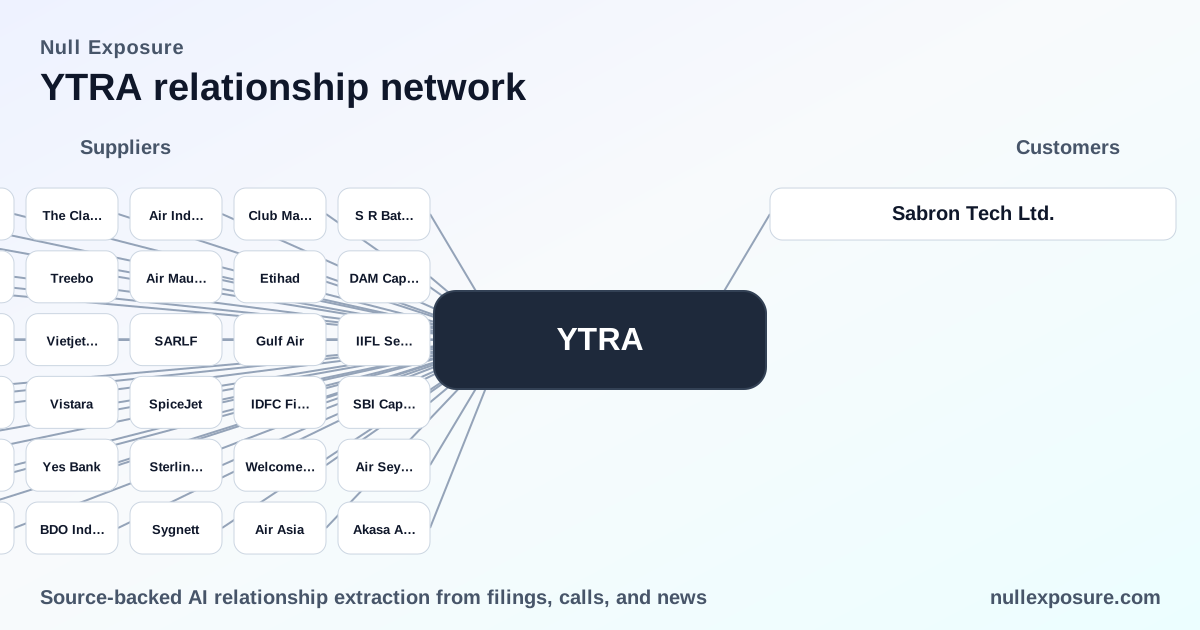
YTRA: Partner-led SaaS expansion into Africa sharpens commercial optionality
Yatra operates a corporate travel software platform through its Indian subsidiary, licensing white‑label SaaS and channel partnerships to distributors and travel‑tech integrators; it monetizes via licensing fees, partner commissions, and platform services sold through a Corporate Platform Partner (CPP) program that accelerates geographic reach without heavy direct‑sales investment. For investors, the Sabron Tech Ltd. agreement is a clear demonstration of a partner-centric go‑to‑market that trades upfront scale for distributed execution and lower capex.
Want continuous monitoring of YTRA customer moves and partner signings? Visit https://nullexposure.com/ for a consolidated feed of these relationship signals.
What the Sabron agreement concretely changes about Yatra's market access
Yatra’s CPP program is being deployed as a distribution multiplier: rather than building a direct sales organization in East and Central Africa, Yatra licensed its corporate travel SaaS to Sabron Tech Ltd., a Sabre partner and regional distributor. This is an execution‑efficient route to revenue, converting platform IP into recurring license streams while leveraging local sales and compliance capabilities. According to a Newsfile Corp. press release dated March 10, 2026 (FY2025), Yatra’s Indian subsidiary entered into this license agreement with Sabron to cover the African region.
The commercial logic is straightforward: partner to scale faster, reduce market entry cost, and capture annuity pricing from corporate customers sold by local partners. For shareholders, the deal improves addressable market exposure with limited incremental sales overhead.
The relationship: Sabron Tech Ltd.
Yatra’s Indian subsidiary licensed its corporate travel SaaS to Sabron Tech Ltd., a Sabre partner and distributor, to serve East and Central African markets as the second partner under the CPP program, according to a Newsfile Corp. release on March 10, 2026 (FY2025). This positions Sabron as both a customer and a regional reseller that will operationalize platform adoption across Africa.
How this contract style defines Yatra’s operating posture
Yatra’s partner licensing model shapes four persistent operational characteristics investors should internalize:
- Contracting posture: partner‑centric licensing agreements — Yatra reduces fixed selling costs and transfers front‑line market execution to local entities; contracts will prioritize license terms, service level definitions, and revenue share mechanics over direct customer acquisition clauses.
- Concentration and diversification — using partners spreads geographic concentration risk, but introduces counterparty concentration risk when a limited number of partners control local distribution in large regions.
- Criticality to buyers and partners — as a corporate travel SaaS provider, Yatra becomes a critical platform for partners’ client propositions; this strengthens stickiness but also raises implementation and support obligations that partners will rely on Yatra to fulfill.
- Program maturity and scalability — the CPP program is an early programmatic initiative; the Sabron deal is a validation point but also signals the program is still scaling and will require governance, partner enablement, and local compliance resources.
These characteristics do not reflect conjecture; they follow directly from a licensing, partner distribution model as disclosed in the FY2025 press reporting.
Constraints and disclosure signals investors should note
The dataset for these customer relationship signals did not include any contractual constraints or exceptions tied to individual relationships. At the company level, no constraint excerpts were recorded in this feed, which is itself an informative signal: Yatra’s public relationship disclosures in this set are limited to deal announcements without granular contractual caveats or financial commitments disclosed alongside the partner signings. Investors should therefore treat public partner announcements as strategic signaling rather than granular financial disclosures.
Risk and reward: what this relationship ups and downscales
The Sabron partnership enhances upside and introduces manageable but real execution risks:
- Upside: rapid geographic expansion with low incremental SG&A, faster route to recurring license revenue in underpenetrated African corporate travel markets, and the potential to cross‑sell ancillary services (billing, reporting, fare automation).
- Risk: partner execution risk, revenue attribution opacity, and potential margin compression from revenue share arrangements; success depends on partner performance and Yatra’s ability to ensure consistent platform delivery and compliance in multiple jurisdictions.
A disciplined investor thesis will track partner activation metrics and revenue recognition tied to partner channels rather than assuming linear ARPU growth from headline partner additions.
Want deeper visibility into Yatra’s partner pipeline and activation rates? Learn more at https://nullexposure.com/.
What to monitor next — practical investor checklist
- Partner activation: number of corporate clients onboarded through each CPP partner and time‑to‑first‑revenue after signing.
- Financial disclosure: any segment or partner‑channel revenue reporting in quarterly filings that allocates revenue to partner programs.
- Contract terms: future announcements that include licensing duration, minimum guarantees, or revenue‑share mechanics.
- Operational support: evidence of local implementation teams, SLAs, or escalation processes that indicate Yatra’s readiness to support partner scale.
- Concentration: the share of partner‑channel revenue coming from the largest one or two partners to assess counterparty risk.
Bottom line
The Sabron Tech Ltd. agreement is a clear strategic lever: Yatra is monetizing its corporate travel platform through partner licensing to accelerate entry into underpenetrated regions while conserving capital. For investors, this model delivers attractive scalability but requires active monitoring of partner activation, revenue attribution, and contract economics to convert partnership announcements into predictable revenue growth. The deal validates the CPP approach; the next signals investors need are activation metrics and transparent partner‑channel revenue reporting.