Yum China (YUMC) — Customer Relationships and Commercial Constraints
Yum China operates, franchises and supplies fast‑casual brands across China, monetizing through restaurant sales, franchise fees and centrally procured goods and services. The business model is a hybrid of operator, franchisor and distributor: company‑owned restaurants generate retail revenue while franchisees pay upfront fees, royalties and buy centrally sourced food and paper products. Investors should value YUMC not only as an operator of 16,395 restaurants in China (FY2024) but as a centralized commercial engine that controls procurement and loyalty monetization. For a direct look at the platform and data underlying these assessments, visit https://nullexposure.com/.
Quick investor thesis: scale + control, China concentration, delivery dependency
Yum China’s scale gives it negotiating leverage in upstream purchasing and loyalty monetization, converting broad consumer reach into recurring revenue streams. Concentration in the PRC and a material reliance on delivery (39% of sales in 2024) create both operational leverage and single‑market risk. Loyalty memberships and subscription-style privilege programs are explicit revenue levers that increase frequency and spend at its brands.
What the filings reveal about how customers are structured
Yum China disclosed multiple operating and commercial patterns in its FY2024 filing that define customer relationships:
- Subscription and loyalty monetization is strategic. The company explicitly states it monetizes its membership base through “privilege membership subscription programs” that drive frequency and spending.
- Counterparties are predominantly individuals. Yum China reported over 490 million KFC loyalty members and over 180 million Pizza Hut members as of December 31, 2024, indicating direct consumer relationships dominate the revenue base.
- Operations are almost entirely China‑centric (APAC). Substantially all revenue and long‑lived assets are located in the PRC, making China the sole economic market of consequence for the business.
- Delivery is an essential revenue channel. Delivery accounted for approximately 39% of company sales in 2024, making third‑party and in‑house delivery services critical components of the operating model.
- Yum China functions as seller, licensor and distributor. It recognizes revenue from company‑owned restaurants, collects franchise fees and royalties, and centrally purchases food and paper products for resale to franchisees.
- Corporate procurement and distribution are meaningful. The central procurement model—where the company centrally purchases and then sells and delivers to restaurants—creates an internal distribution role that contributes to corporate revenues and margins.
- Scale of operations is material. Yum China reported $11.3 billion of revenues in 2024 and reflects a corporate revenue footprint consistent with large counterparty spend bands.
These items are drawn directly from Yum China’s FY2024 annual reporting and related disclosures in the company’s Form 10‑K.
Relationship inventory: all disclosed customer counterparties
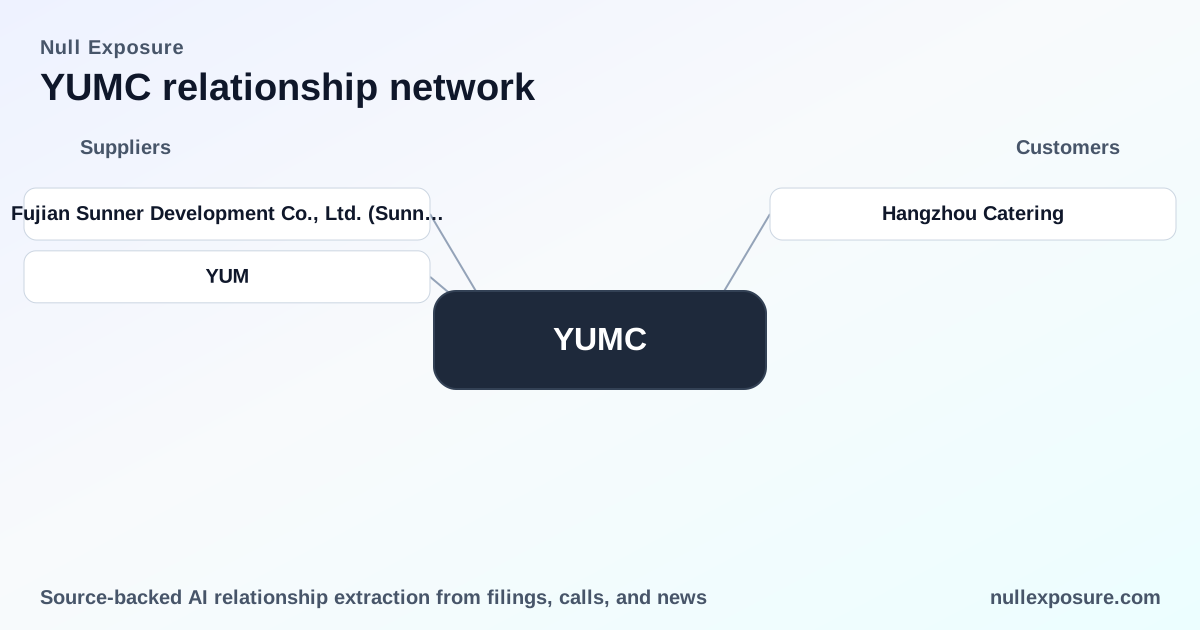
Hangzhou Catering
Yum China purchased inventories of $4 million in 2024 and $6 million in 2023 from Hangzhou Catering, indicating an active supplier/customer trading relationship for consumable inventory. This disclosure appears in Yum China’s FY2024 Form 10‑K reporting on purchases of inventory. (Source: Yum China FY2024 Form 10‑K, filed December 31, 2024.)
How these relationships and constraints translate into investment considerations
Several constraint-driven signals in the filings translate directly into investor-relevant operating characteristics:
- Contracting posture: centralized and recurring. The company’s revenue mix includes ongoing franchise royalties, subscription-style membership revenue and repeated inventory resale to franchisees—indicating long‑lived, repeat contractual flows rather than one‑off transactions.
- Concentration risk: single-market exposure. With substantially all revenue and assets in mainland China, geopolitical and macro‑economic shocks in that single market have elevated enterprise risk.
- Revenue criticality and channel concentration. Delivery’s contribution of ~39% to sales makes the company operationally dependent on logistics, last‑mile economics, and delivery partner relationships; service interruptions or margin pressure in delivery materially affect sales and profitability.
- Commercial maturity and bargaining leverage. Scale (16,395 restaurants; $11.3B revenue) and a central procurement model give Yum China bargaining power with suppliers and the ability to capture distribution margin, but this also concentrates supplier counterparty exposure into procurement pipelines.
- Customer mix: retail consumers dominate. Loyalty program size (hundreds of millions of members) signals that individual consumers are the primary revenue drivers, while franchisees are important commercial customers for distribution and services.
- Relationship lifecycle: active and transactional. Disclosures show ongoing sales to franchisees and persistent loyalty engagement, reflecting mature, operationally active relationships rather than experimental or dormant arrangements.
Risks and watchpoints for operators and investors
- Market concentration is a direct risk factor. Any regulatory change, consumer slowdown, or supply‑chain disruption in China will have immediate consequences for revenues and asset utilization.
- Delivery economics require monitoring. With nearly 40% of sales delivered, margin compression in delivery or regulatory changes to platform economics could compress profits quickly.
- Supplier and procurement exposure. Centralized purchasing concentrates counterparty risk: a failure in a key supplier node could force short‑term procurement at higher cost or with quality impacts.
- Monetization of loyalty is a growth lever and a dependency. Privilege membership and subscription programs are explicit revenue strategies; their retention and ARPU performance will be key metrics to track.
Practical takeaways for portfolio managers
- Underwrite China‑specific risk premia. Given the company’s single‑market footprint, portfolio allocation should reflect higher idiosyncratic country risk and policy sensitivity.
- Monitor channel mix and delivery margins. Quarterly disclosures on delivery penetration and unit economics will be leading indicators of near‑term margin shifts.
- Evaluate supplier concentration metrics in diligence. Central procurement gives control and margin opportunities but also concentrates operational exposure to a narrower set of counterparties.
For a structured view of Yum China’s counterparty map and to track updates to customer relationships and constraints, visit https://nullexposure.com/.
Conclusion
Yum China is a vertically integrated restaurant platform in China that converts scale into procurement leverage, franchise income and loyalty monetization. Key strengths are scale and centralized procurement; primary risks are China concentration and delivery dependence. For investors and operators assessing customer relationships, the FY2024 disclosures make clear where the company derives both its commercial power and its vulnerabilities.