YXT.COM Group: Customer relationships and what they mean for investors
YXT.COM Group monetizes a hybrid model of digital content, e‑commerce and enterprise AI services: the company drives top line through platform transactions and content monetization while selling bespoke AI and training projects to corporate customers. For investors, the relevant investment thesis is simple and direct — YXT leverages proprietary technology and AI-driven services to extract fees from consumer engagement and one‑off enterprise implementations, but profitability remains under pressure as scale investments continue. For faster access to the full issuer profile and relationship tracking, visit https://nullexposure.com/.
Where the company stands: scale, margins and capitalization
YXT generated roughly $340.2 million of revenue (TTM) and $232.5 million of gross profit, a clear sign that the core product offering achieves healthy unit economics before overhead. That said, EBITDA is negative $127.7 million and operating margin is deeply negative at -40.9%, signaling that the business is still investing heavily in growth or absorbing structural costs that compress free cash flow. Market capitalization sits near $32.5 million, producing a low Price/Sales multiple (about 0.095x) and an EV/Revenue of 0.759 — valuations consistent with either deep discounting or significant execution risk.
Ownership composition is informative for risk appetite: insider ownership is low (0.84%) and institutions hold roughly 7.0%, which implies limited institutional oversight relative to many listed peers. These financial signals frame the customer analysis: revenue scale exists, but margins and capitalization create heightened sensitivity to customer churn, concentration and contract terms.
How YXT actually wins business: project work plus platform volume
Available evidence shows YXT executes both platform-driven monetization (content and e‑commerce) and project-based client work, especially in AI services. The single documented customer engagement in our feed highlights YXT’s active role as a service provider — delivering an AI Role‑Play Training engagement for a corporate client. That project orientation implies a contracting posture that includes bespoke, scope‑defined agreements rather than pure subscription SaaS contracts.
From a business-model standpoint this creates four practical constraints for operators and investors:
- Concentration sensitivity — bespoke projects can drive outsized revenue for short periods but create renewal and pipeline risk when projects end.
- Commercial criticality — enterprise AI projects can be mission‑critical for clients, which increases switching costs if implementations are embedded, but also raises reputational exposure if outcomes underdeliver.
- Maturity mix — the coexistence of platform revenue and custom AI projects suggests the company is transitioning to higher‑margin recurring products while still relying on lower‑visibility project income.
- Disclosure opacity — no contract‑level constraints were returned in the available customer relationship feed, which is a company‑level signal investors should treat as a prompt for direct diligence on contract terms, renewal cadence and payment security.
What we found: documented customer relationships
Below is every customer relationship identified in the current results set. Each entry is summarized in clear, plain English.
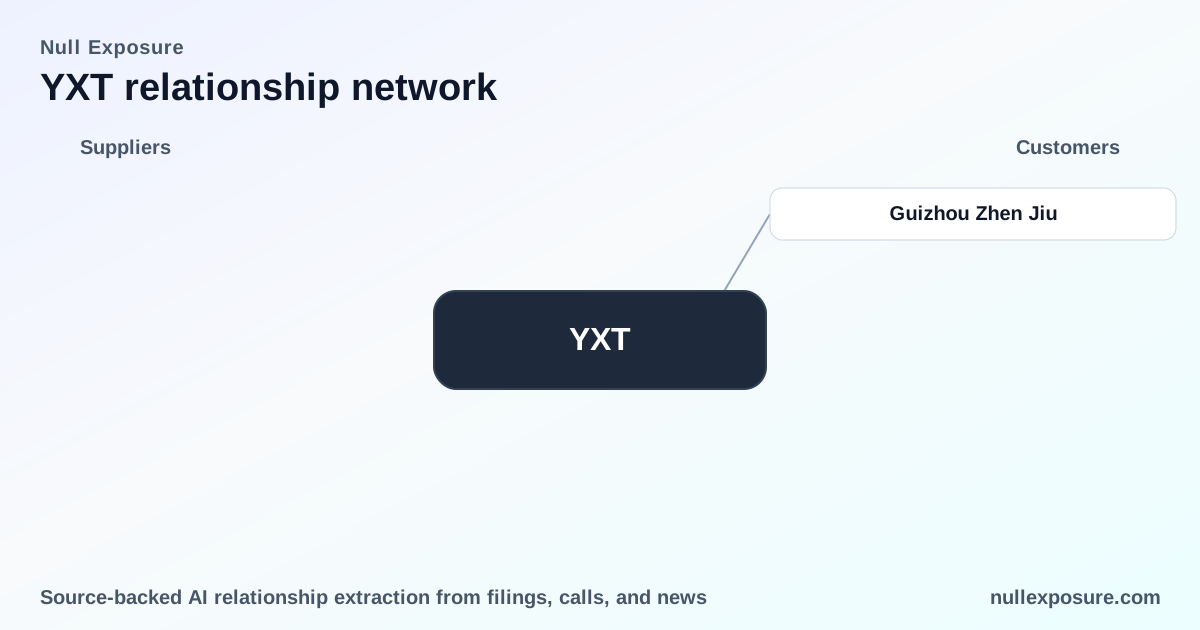
- Guizhou Zhen Jiu — YXT supplied an AI Role‑Play Training project used as the representative case for a recognition submitted by YXT in FY2026; the engagement demonstrates YXT’s capability to deliver client‑facing AI training solutions. According to a Yahoo Finance article dated March 10, 2026, YXT cited this project in its press materials for the recognition. (Yahoo Finance, March 10, 2026)
That single, published case is the only customer engagement surfaced in the review period. The FY2026 timestamp underscores this is a recent, showcased client relationship rather than legacy activity.
Why the Guizhou Zhen Jiu engagement matters to investors
The Guizhou Zhen Jiu case is valuable for two reasons. First, it confirms YXT’s go‑to‑market capability in enterprise AI services, establishing a concrete example of how the company monetizes non‑consumer revenue. Second, because this is a highlighted, representative project used for external recognition, it signals the company is actively marketing enterprise work as part of its strategic narrative. The public mention in March 2026 helps validate the business line from a signaling perspective. (Yahoo Finance, March 10, 2026)
Operational and commercial implications for diligence
Investors and operators should convert these signals into targeted diligence steps:
- Contract clarity — obtain representative statements of work, pricing schedules, renewal and maintenance clauses for AI projects to assess revenue visibility and margin sustainability.
- Customer mix and concentration — because only one external client engagement is documented publicly, verify the breadth of enterprise clients and repeat business rates to measure concentration risk.
- Delivery and SLA risk — for AI training projects, confirm post‑delivery support, performance guarantees, and escalation paths, since underperformance could convert into revenue clawbacks or reputational damage.
- Monetization cadence — reconcile platform economics (transaction and content revenue) with project revenue to build a blended margin forecast and cash‑flow runway.
For a deeper relationship-level feed and structured customer tracking, see https://nullexposure.com/ — the front page consolidates issuer profiles and relationship signals.
Key takeaways for investors and operators
- YXT combines platform revenue with bespoke AI services; the Guizhou Zhen Jiu engagement is an explicit example of enterprise project work.
- Revenue scale is material but profitability is weak: $340M revenue versus negative EBITDA highlights execution and margin risk.
- Commercial disclosure is limited: only one documented customer engagement surfaced and no contract constraints were extracted from the feed, which increases the premium on direct diligence.
- Decision points are contract, concentration and renewal: investors should prioritize access to contract terms, customer roster, and recurring revenue proportions before scaling conviction.
This customer snapshot provides a clear, actionable lens into YXT’s commercial model: the company is monetizing AI services at the enterprise level while sustaining platform economics on the consumer side. The core investment question for 2026 is whether recurring platform revenue can be scaled to absorb investment drag, while enterprise projects convert into predictable, repeatable revenue.