YYAI (Connexa Sports Technologies): Customer relationships, licensing posture, and platform exposure
Connexa Sports Technologies (YYAI) operates as a B2B licensor of AI-driven sports and matchmaking technology and a developer of short-form social content, monetizing primarily through licensing fees and royalty income from regional partners and performance-based content agreements on major social platforms. The company licenses intellectual property through regional licensees (YYEM and others), recognizes royalty income over the term of agreements, and supplements that licensing revenue with agency-style content work for platforms such as TikTok. For investors, the combination of licensing royalties and performance-based platform contracts creates differentiated revenue streams but concentrates commercial risk in a small set of partners. For further diligence, see https://nullexposure.com/.
How YYAI makes money and what that means for contract risk
Connexa’s operating model is license-first: the company generates the bulk of revenue through recurring license fees and royalties tied to use of its intellectual property. Company disclosures state that royalty income is recognized over time as partners use the technology rights, and that the firm intends to grow licensing revenue through development or acquisition of additional patents. This is a contracting posture focused on IP rights rather than one-off services.
Key business-model characteristics:
- Contracting posture—licensing and royalties. Revenue flows are governed by multi-period license agreements where the company recognizes income over the contract term rather than exclusively at invoicing.
- Concentration—high customer dependence. The company reports that three major customers accounted for approximately 100% and 66% of accounts receivable and 100% and 63% of revenues for fiscal years ended April 30, 2025 and April 30, 2024 respectively, making customer retention a critical financial driver.
- Criticality—customer relationships are material. Disclosures label this concentration as critical; licensing revenues constituted substantially all revenue for the year ended April 30, 2025.
- Geographic licensing coverage. YYAI, through YYEM, operates a tri-regional license structure with licensees covering APAC (including Hong Kong, Japan, South Korea), EMEA (UK/Europe), and North America (with rights extending to Sub-Saharan Africa), which provides geographic reach but relies on a few regional partners for market execution.
- Maturity—active licensees and ongoing recognition. Agreements are classified as active and revenue recognition occurs over time as rights are used, indicating live commercial enforcement rather than dormant IP holdings.
- Product focus—software and AI matching. The company positions its IP as an AI-powered matchmaking platform licensed to partners to create localized experiences.
These characteristics translate to predictable, contract-driven revenue when partners retain rights, but acute downside if one of the major licensees or platform partners ceases activity or renegotiates terms.
Customer relationships reported in filings and press
Below are the reported customer interactions captured in recent news excerpts; each entry is reported with its source and filing context.
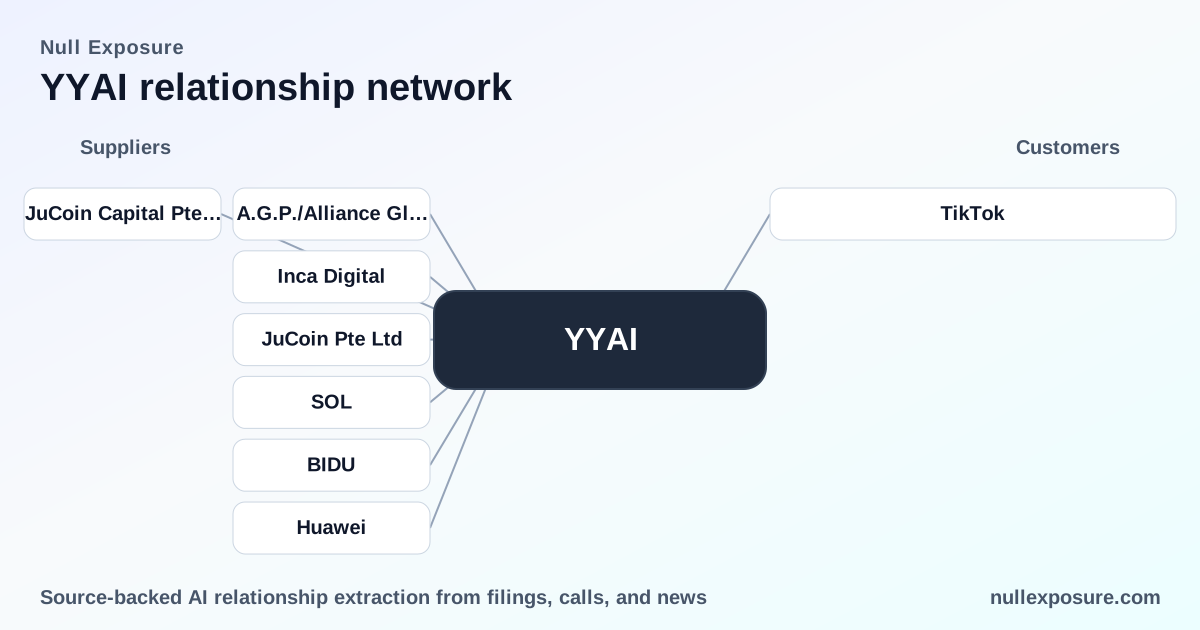
TikTok — social content vertical for platform distribution (TradingView news, May 4, 2026)
TradingView reported that Connexa announced a social networking vertical in January 2025 designed to produce content for TikTok and similar platforms, with monetization expected to be performance-based rather than flat licensing fees. (TradingView news report, May 4, 2026.)
TikTok — agency agreement via YYEM to serve MENA using Twitch (TradingView news, March 10, 2026)
TradingView reported that in February 2025 YYEM entered an agency agreement to develop content for TikTok across the MENA region, leveraging Twitch-hosted live-streaming focused on sports, gaming, and lifestyle categories. This is a regional, agency-style arrangement executed through the company’s licensee network. (TradingView news report, March 10, 2026.)
What these relationships imply for revenue profile and operational execution
The two TradingView items together show a dual commercial approach to platform exposure: direct content creation that is performance-based for short-form platforms, and agency arrangements executed via regional licensees (YYEM) using existing streaming channels like Twitch. That structure has several investor implications:
- Revenue mix complexity. Licensing and royalty income form the backbone of revenue, but the company is layering on performance-based content work tied to platform metrics. Performance-based contracts can amplify upside during viral success and compress revenue if engagement underperforms.
- Platform dependency. Engagements tied to TikTok and Twitch change the commercial vector from pure licensing toward content distribution economics, exposing YYAI to platform algorithms, CPM dynamics, and shifting content policies.
- Geographic execution through licensees. The use of regional licensees (APAC/EMEA/NA) gives market access but concentrates delivery risk in a few third parties whose performance and creditworthiness are material to YYAI’s cash flows.
Financial context and risk/reward framing
YYAI’s trailing revenue is reported at $15.97 million with gross profit of $7.16 million; operating margin is negative at -22.5% and profit margin sits at -3.54%, while EBITDA registers a positive $4.24 million. Market capitalization stands near $29.7 million, with insider ownership at roughly 14% and institutional ownership low at 2.3%—indicative of a small-cap, closely held equity base.
- Upside: The licensing model yields recurring royalty streams; adding performance-based content for major platforms creates cross-selling possibilities and new monetization levers in high-growth short-form video markets.
- Downside: Very high customer concentration (three customers driving nearly all receivables and revenues) and platform exposure are the principal risks. Contract terms that shift revenue from guaranteed licensing fees to variable, performance-based payouts increase earnings volatility.
Bottom line for investors evaluating YYAI customer relationships
YYAI runs a license-centric business that is actively expanding into content production and platform partnerships. The combination of recurring license royalties and performance-based platform revenue offers asymmetric growth potential, but is materially concentrated in a small number of partners and regions. Investors should weight the potential for outsized returns from platform hits against the concentration and execution risk inherent in a license-plus-agency revenue mix.
For a concise dossier on customer-level exposure and contract signals, visit https://nullexposure.com/.
H2/H3 headings and the body above summarize every customer relationship referenced in the source material and translate contract-level constraints into investment-relevant conclusions.