Zhibao Technology (ZBAO) — customer relationships that scale distribution, not risk
Zhibao Technology operates as a digital insurance broker and MGU in China, monetizing primarily through service fees on policy placement, platform transaction fees from event and sports partners, and MGU underwriting economics. Recent corporate moves — a medical JV (Zhibao Yingshi), a Labuan reinsurance vehicle and targeted vertical products (sports, drones) — position the company to convert distribution reach into recurring service revenue rather than large underwriting exposure. For investors focused on customer relationships, the story is about breadth of channel partners and product specialization rather than concentration in a handful of corporate clients. Explore full company coverage at https://nullexposure.com/.
How Zhibao actually makes money and why relationships matter
Zhibao is a broker-centric platform that sells insurance through a growing B-channel partner network and specialized MGUs. Revenue flows from service fees on policies placed, platform commissions, and planned limited reinsurance via a Labuan vehicle to capture upstream economics. The company reported its first revenue from the medical JV (Zhibao Yingshi) in November 2025, reflecting a move from product development into fee realization (Newsfile, Mar 10, 2026). The operating model is oriented toward rapid partner acquisition rather than large single-account concentration: a broad B2B distribution posture reduces client concentration risk while increasing the operational burden of partner management.
For a deeper look at aggregated data and relationships, visit https://nullexposure.com/.
What the relationship map tells investors
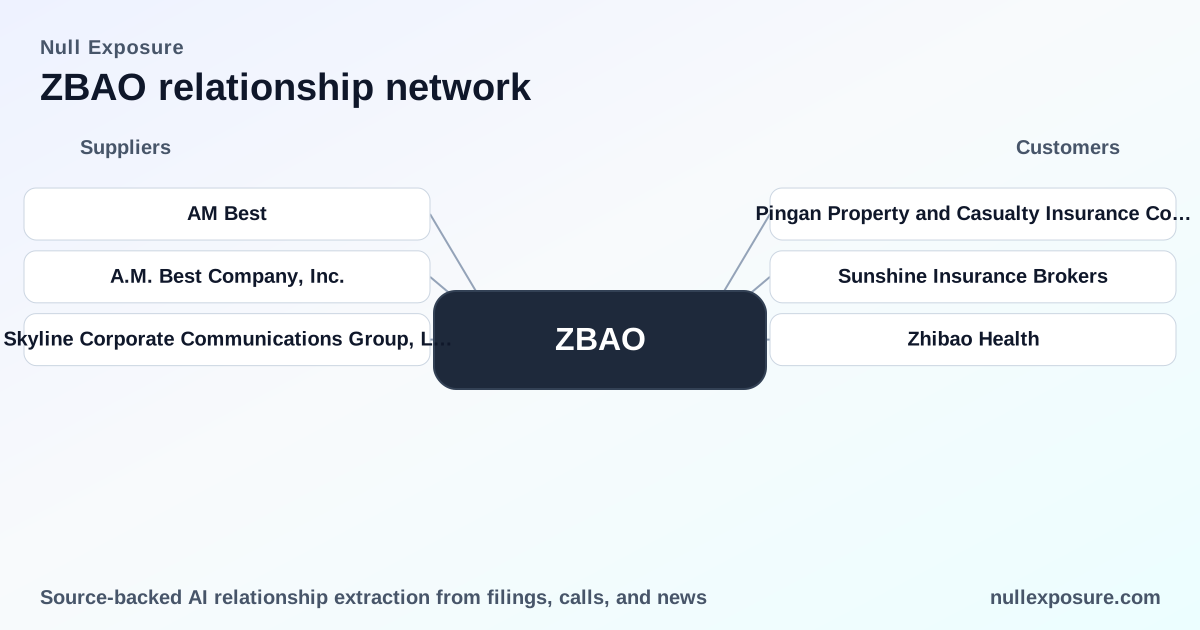
Zhibao’s customer relationships cluster into three strategic buckets: (1) event and sports insurance (high-volume, low-premium per participant); (2) institutional partners and associations (channel partners that drive scale); and (3) product partners and insurers (MGU, medical JV and reinsurance linkage). This architecture signals a contracting posture that is distribution-heavy, low single-client concentration, and early-stage maturity for several product lines (medical JV revenue only recorded in late 2025; Labuan reinsurance unit formed in 2026).
Relationship catalogue — plain-English summaries and sources
- 2025 SCO Kunming Marathon — Zhibao provided event insurance coverage for the SCO Kunming Marathon as part of a broader sports insurance program covering tens of thousands of participants in 2025 (Markets FinancialContent / Newsfile, Mar 17, 2026).
- 2025 Chilechuan Grassland Half Marathon — Zhibao covered the Chilechuan Grassland Half Marathon under its sports insurance platform that served 17,569 events in 2025 (Markets FinancialContent / Newsfile, Mar 17, 2026).
- 2025 Heyuan Wanlv Lake Marathon — Heyuan Wanlv Lake Marathon was insured through Zhibao’s sports platform, reflecting the company’s focus on regional running events (Markets FinancialContent / Newsfile, Mar 17, 2026).
- 2025 Leshan Double Heritage Marathon — Zhibao’s event coverage extended to the Leshan Double Heritage Marathon as part of its sports portfolio for 2025 (Markets FinancialContent / Newsfile, Mar 17, 2026).
- 2025 Liaocheng Half Marathon — Zhibao provided insurance services for the Liaocheng Half Marathon, one of several mass-participation events on its platform in 2025 (Markets FinancialContent / Newsfile, Mar 17, 2026).
- Pingan Property and Casualty Insurance Company — Zhibao recorded first revenue from Zhibao Yingshi primarily through service fees on mid- and high-end medical policies issued by Pingan branches; this underpins the medical JV’s early monetization (Yahoo Finance & Newsfile release, Mar 10, 2026).
- Ganzhou Ruishi — Zhibao provided specialized protection for Ganzhou Ruishi as part of its program covering professional and lower-division football clubs (Markets FinancialContent / Newsfile, Mar 17, 2026).
- Guangdong Mingtu — Guangdong Mingtu received club-level insurance protection from Zhibao under its sports club program (Markets FinancialContent / Newsfile, Mar 17, 2026).
- Guangzhou Dandelion — Guangzhou Dandelion is listed among professional clubs insured by Zhibao’s sports solutions (Markets FinancialContent / Newsfile, Mar 17, 2026).
- Meizhou Hakka — Meizhou Hakka was covered by Zhibao’s professional-sports insurance program, reflecting penetration into China’s club market (Markets FinancialContent / Newsfile, Mar 17, 2026).
- Shaanxi Union — Zhibao provided tailored insurance for Shaanxi Union within its league-and-club offerings (Markets FinancialContent / Newsfile, Mar 17, 2026).
- Shenzhen Peng City — Shenzhen Peng City, a Chinese Super League club, is a named client for Zhibao’s specialized team protection products (Markets FinancialContent / Newsfile, Mar 17, 2026).
- Sichuan Fanmo Technology Co., Ltd. (F+More) — Zhibao partnered with F+More to launch a drone insurance product aimed at individual operators, representing a vertical product expansion into China’s low-altitude economy (Newsfile / SUAS News / The Globe and Mail, Mar 2026).
- Guangdong Football Association — The Guangdong FA is one of the sports associations in Zhibao’s B-channel partner network, which expanded to 732 partners by end-2025 (Newsfile release, Mar 2026).
- Hainan Street Dance Association — Zhibao counts the Hainan Street Dance Association among its 214 sports-association partners that feed event and participant volume (Newsfile release, Mar 2026).
- Hohhot Basketball Association — The Hohhot Basketball Association is included in Zhibao’s association-level partnerships that expand distribution into grassroots sports (Newsfile release, Mar 2026).
- Hubei Fishing Association — The Hubei Fishing Association is listed as a partner within Zhibao’s broad sports and activity association network (Newsfile release, Mar 2026).
- Jiangsu Basketball Association — Jiangsu Basketball Association is a named partner in Zhibao’s B-channel network supporting event insurance distribution (Newsfile release, Mar 2026).
- Jiangxi Winter Swimming Sports Association — The Jiangxi Winter Swimming Sports Association appears in Zhibao’s association roster that diversifies event types on the platform (Newsfile release, Mar 2026).
- Sunshine Insurance Brokers — Zhibao announced the intent for its Labuan reinsurance unit to eventually reinsure a limited portion of premiums generated by Sunshine Insurance Brokers, indicating a vertical integration strategy to capture upstream economics (Insurance Business Magazine, Mar 10, 2026).
- Zhibao Health — Zhibao Health is an upstream subsidiary whose premiums are intended to be partially reinsured by the Labuan vehicle as the company expands MGU and brokerage scale (Insurance Business Magazine, Mar 10, 2026).
Operating-model constraints and company-level signals
There are no explicit constraints reported in the relationship payload. As a company-level signal, the absence of constraints in the provided data suggests no regulatory, contractual, or partner-specific blocking issues captured in these sources, but it does not eliminate external regulatory or capital constraints that governance filings would disclose. Operationally, Zhibao shows a low client concentration profile (hundreds of event organizers and 732 B-channel partners) and a contracting posture favoring distribution agreements and MGUs, with recent steps to internalize reinsurance economics via a Labuan entity.
Investment implications — what relationships mean for risk and upside
- Upside: Wide B-channel reach and vertical products (sports, drone, medical JV) create scalable fee revenue if platform engagement and cross-sell persist. The Labuan reinsurance plan and Zhibao Yingshi revenue recognition in late 2025 signal pathways to capture margin beyond pure brokerage.
- Key risks: Execution risk in partner activation and claims performance on high-frequency event lines; limited public institutional ownership and negative profitability metrics heighten sensitivity to growth execution. Financial disclosures show negative EPS and modest market cap, so revenue diversification from these relationships is critical to valuation uplift.
Final read for investors
Zhibao’s relationships reflect a deliberate strategy: build distribution density across niche verticals, monetize through fees and constrained reinsurance, and leverage partnerships to scale without large single-client exposure. For investors evaluating customer credit and operational counterparty risk, the company’s partner map strengthens the thesis of diversified distribution but requires monitoring of revenue conversion and claims experience as product lines mature. For more granular relationship mapping and alerts, visit https://nullexposure.com/.