Zenas BioPharma (ZBIO): Partnered development plus market financing — a concentrated, milestone-driven model
Zenas BioPharma operates as a clinical-stage immunology-focused biopharmaceutical company that monetizes through partnered development, licensing royalties and periodic equity capital raises. The company advances obexelimab and related candidates through late-stage trials, delegates ex‑US commercialization in key APAC markets to strategic partners, and supplements funding with underwritten offerings and royalty financings. Investors should value Zenas on milestone realization and partner execution rather than recurring product sales today.
For background and further relationship analytics, visit https://nullexposure.com/.
How Zenas makes money and where value will crystallize
Zenas builds value by developing clinical-stage assets until they reach de‑risking, registrational inflection points and then captures value through licensing, royalties and selective equity financings. The company’s commercial leverage is concentrated: major geographic commercialization rights are assigned to large pharma partners in APAC, while non‑dilutive cash can come from royalty monetizations. This is a milestone‑dependent, capital‑intensive model: success hinges on trial outcomes, partner commercialization and the ability to access the capital markets on acceptable terms.
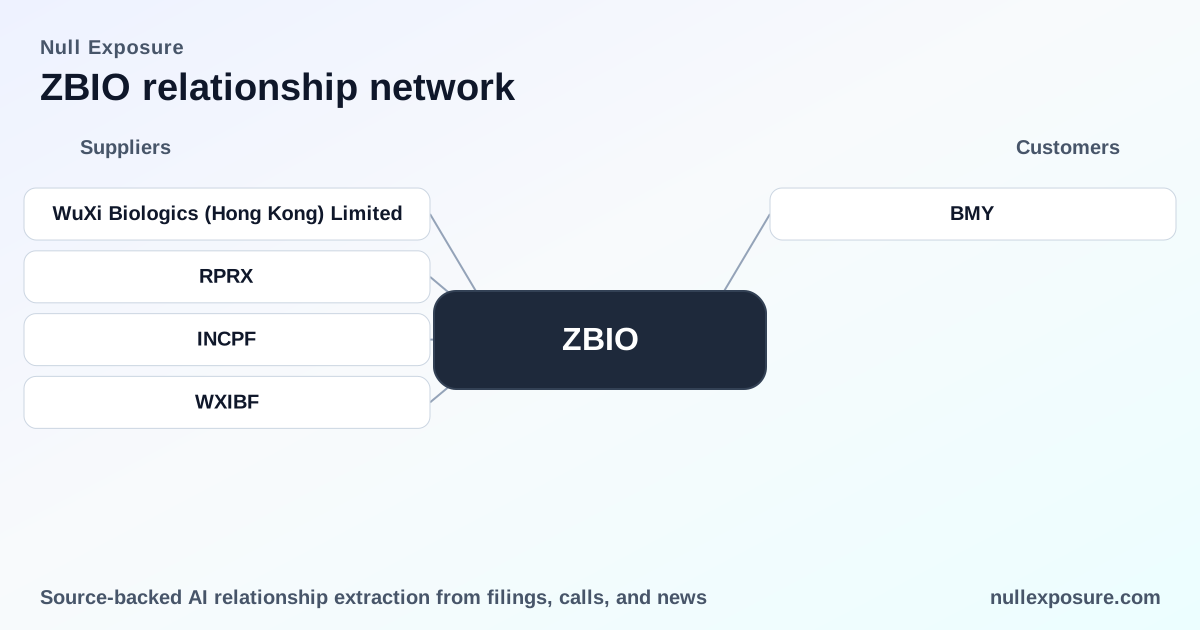
The strategic partner that matters: Bristol Myers Squibb
Bristol Myers Squibb holds exclusive development and commercialization rights for obexelimab across multiple APAC territories (Japan, South Korea, Taiwan, Hong Kong, Singapore and Australia), positioning BMY as the primary commercial driver for those markets should obexelimab be approved. This arrangement materially shifts commercialization risk and execution for Zenas toward its partner in the Asia‑Pacific region. (GlobeNewswire press release, Jan 5, 2026.)
Royalty financing that supplies runway: Royalty Pharma (RPRX)
Royalty Pharma committed up to $300 million in exchange for a 5.5% royalty on obexelimab, creating a substantial non‑dilutive financing line tied to the asset’s future sales. That commitment significantly reduces near‑term funding pressure and aligns Royalty Pharma’s interests with commercial upside. (Market commentary on TradingView / MarketBeat, FY2025 disclosure.)
Recent capital markets syndicate: who underwrote the offering
Zenas tapped a multi‑bank syndicate in a recent equity offering; the Form 424B5 lists specific allocations by bookrunners and managers. These banks provide distribution capacity and market access when Zenas elects to raise equity.
- Citigroup Global Markets Inc. — allocated 1,050,000 shares in the offering, serving as a material distribution participant. (Form 424B5 filing reported on StreetInsider, May 4, 2026.)
- Evercore Group L.L.C. — allocated 1,200,000 shares, indicating lead advisory or significant placement involvement. (Form 424B5 filing reported on StreetInsider, May 4, 2026.)
- Guggenheim Securities, LLC — allocated 650,000 shares as part of the syndicate. (Form 424B5 filing reported on StreetInsider, May 4, 2026.)
- Jefferies LLC — allocated 1,800,000 shares, the largest single allocation listed and a principal distribution channel. (Form 424B5 filing reported on StreetInsider, May 4, 2026.)
- Wedbush Securities Inc. — allocated 300,000 shares, contributing additional distribution reach. (Form 424B5 filing reported on StreetInsider, May 4, 2026.)
Each allocation in the prospectus reflects the banks’ role in supporting Zenas’ access to public capital and sets the practical market plumbing for future raises.
(If you want consolidated access to relationship mappings and filing references, see https://nullexposure.com/.)
What the relationship map implies for investors
- Concentration of commercialization risk: With Bristol Myers Squibb holding APAC commercialization rights, Zenas’ cash flows from those markets are contingent on BMY’s execution and obexelimab’s regulatory success. That reduces Zenas’ operational burden but transfers commercial concentration risk to a partner.
- Non‑dilutive runway via royalties: The Royalty Pharma arrangement provides meaningful funding tied to asset upside, which de‑risks near‑term balance sheet pressure without immediate equity dilution.
- Dependence on capital markets and syndicate depth: The presence of major investment banks on the 424B5 underscores reliance on periodic equity supply, and the spread of allocations shows sufficient market distribution capability if Zenas elects further raises.
- Maturity and criticality: Relationships reflect a company in a late clinical to pre‑commercial phase — partnerships are critical (commercial rights and royalties), but the company remains immature from a revenue generation perspective, relying on partners and financings for cash flow.
Geographic footprint signals to factor into valuation
Company disclosures attribute revenue differently across reporting years — revenue was attributed to Zenas’ China entity in 2024 and to its U.S. entity in 2023, signaling that legal/licensing arrangements and regional income allocation are active levers in the company’s commercial structure. This supports the reading that Zenas manages a dual‑jurisdiction commercialization and licensing posture, with particular emphasis on APAC operationalization through partners. (Company revenue attribution disclosures as of Dec 31, 2024 and 2023.)
Risk and opportunity checklist
- Key upside: Successful regulatory outcomes and commercial launches via Bristol Myers Squibb in APAC; realization of Royalty Pharma milestones translates directly into liquidity and de‑risked valuation.
- Key risks: Clinical failure, partner execution shortfalls in APAC, and any repricing of access to capital if market conditions tighten — underwritings show the company can access capital, but pricing risk remains.
- Catalysts to watch: Regulatory filings and approvals for obexelimab, milestone payments tied to Royalty Pharma, and any change in syndicate composition or further Form 424 disclosures.
Bottom line — what investors should take away
Zenas BioPharma is a partner‑centric, milestone‑driven biotech: commercial upside is concentrated through Bristol Myers Squibb in APAC, funding is supplemented via a large Royalty Pharma commitment, and capital markets access is supported by a credible bank syndicate. Investors should value ZBIO on a binary regulatory/commercial path for obexelimab, adjusted for partner execution and the company’s ability to convert announced financings into realized cash without unfavorable dilution.
For an integrated view of Zenas’ partner and capital relationships, and to track further filings and press releases, visit https://nullexposure.com/.