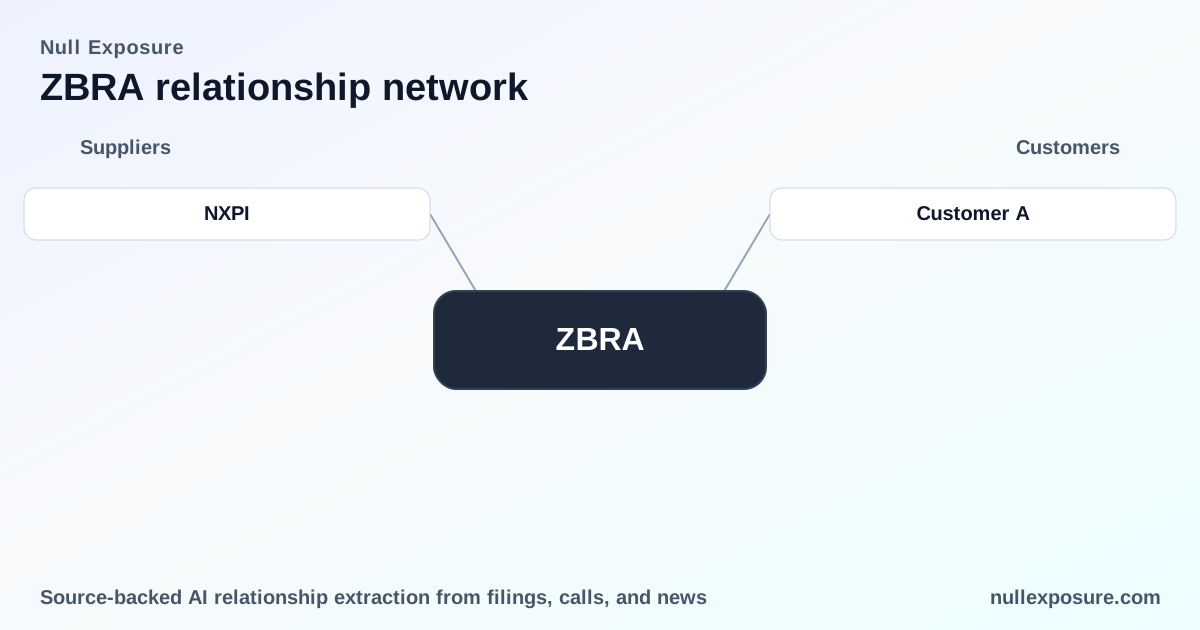
Zebra Technologies (ZBRA): Customer Map, Concentration, and Contracting Signals
Zebra Technologies monetizes a blended hardware-software-services portfolio: it sells barcode and RFID printers, mobile computers, scanners and consumables while layering multi-year maintenance, managed services and cloud software subscriptions that capture recurring revenue and drive aftermarket consumable purchases. Revenue is concentrated in tangible products but increasingly supplemented by subscription and services contracts that create longer revenue visibility and attach rates for hardware. For a concise company-level view and relationship insights, visit https://nullexposure.com/.
The investor thesis up front
Zebra’s commercial model is built on large channel partners and distributors that resell high-volume hardware into supply chain, retail and healthcare customers, and on long-duration service and software contracts that stick customers to Zebra’s ecosystem. That duality — high-margin recurring software/services layered on high-dollar hardware sales through a small set of large distributors — is the core driver of profitability and the principal source of concentration risk. Investors should value recurring revenue growth while monitoring distributor dependency and renewal dynamics.
Distributor concentration is real and material
Zebra discloses that three distributor customers individually exceeded 10% of net sales across FY2023–FY2025, which establishes a clear concentration dynamic in the channel. In FY2025 those three distributors together accounted for a meaningful share of revenue, with one listed as “Customer A” representing 29% of total net sales across segments in 2025 (16% CF, 13% AVA, total 29%). This is a top-line structural feature investors must underwrite when modeling downside scenarios. (Source: Zebra FY2025 Form 10‑K, disclosure for year ended December 31, 2025.)
Channel mentions outside the filing: ScanSource shows up in partner conversations
Channel players still name Zebra among primary vendors. A CRN profile of ScanSource’s new specialty technologies president quotes ScanSource executives listing “Zebra” among their primary vendors alongside Cisco and Poly, underscoring Zebra’s continued role as a key vendor for value-added distributors and resellers. (Source: CRN, May 2026.)
Contracting posture: multi-year, subscription-heavy, service-oriented
Zebra’s customer contracts show a distinct tilt toward longevity and service bundling:
- The company reports that the average life of an initial repair and maintenance service contract is approximately three years, with one-year renewals thereafter, and that professional and managed services support deployment and ongoing device management.
- Zebra explicitly sells cloud-based software subscriptions and managed services that are often contracted through multi-year service agreements, creating recurring revenue streams and higher lifetime value per customer.
These disclosures (Zebra FY2025 Form 10‑K) imply meaningful revenue visibility via multi-year service contracts and subscription renewals, but also obligate Zebra to deliver ongoing service quality and support infrastructure.
Where Zebra sells and what it sells — geography and segment implications
Zebra is a global operator: FY2025 net sales show North America ~$2.695B, EMEA ~$1.724B, Asia‑Pacific ~$613M, and Latin America ~$364M, reflecting a heavy North American and EMEA footprint but true global scale. The company also sells through an extensive channel network of over 10,000 partners across 179 countries, which amplifies reach but concentrates strategic decision-making with a small set of top distributors. (Source: Zebra FY2025 Form 10‑K.)
On product mix, Zebra reports roughly $4.418B in tangible product (hardware) sales alongside growing software and service lines, confirming a core hardware business complemented by services and cloud subscriptions that leverage AI and analytics for enterprise workflows. (Source: Zebra FY2025 Form 10‑K.)
Implication: Hardware drives near-term cash and consumables revenue; software/services drive margin expansion and revenue stickiness over time.
Operational constraints and business-model signals investors should weight
The filings and excerpts point to a few high-confidence company-level characteristics investors must bake into forecasts:
- Concentration risk: Three distributors each >10% of net sales is a structural concentration that elevates counterparty and channel execution risk.
- Contract maturity and renewal importance: Multi-year maintenance contracts and subscriptions create recurring revenue, increasing predictability but exposing Zebra to renewal pricing pressure and service delivery risk.
- Global footprint with regional concentration: North America and EMEA dominate revenue; geopolitical or trade disruptions in those regions have outsized P&L impact.
- Segment mix heterogeneity: Hardware remains the largest line, so supply-chain and component-cycle volatility will continue to affect top-line swings even as software margins expand.
- Service role: Zebra operates both as a seller of goods and as a service provider (maintenance, managed services), which increases operational complexity but supports higher lifetime value.
All of the above are drawn directly from Zebra’s FY2025 public filings and related channel reporting and should be treated as company-level signals rather than tied to any single named partner unless the filing explicitly names that partner. (Source: Zebra FY2025 Form 10‑K; CRN reporting, May 2026.)
For readers who want a structured, searchable view of these partner dynamics, visit https://nullexposure.com/ for additional context and comparative relationship maps.
Relationship-by-relationship précis
-
Customer A — A distributor that accounted for 29% of Zebra’s total net sales in FY2025, split across segments (16% CF, 13% AVA). This single distributor is material to revenue and exemplifies the company’s concentrated channel exposure. (Source: Zebra FY2025 Form 10‑K, disclosure for year ended December 31, 2025.)
-
SCSC — In CRN coverage of ScanSource’s leadership commentary (May 2026), ScanSource (ticker SCSC) listed Zebra among their primary vendors, indicating an active reseller relationship and continued vendor status within ScanSource’s specialty technologies portfolio. (Source: CRN article, May 2026.)
-
ScanSource — The same CRN piece quotes ScanSource executives saying “Zebra” is a primary vendor alongside Cisco and Poly, confirming ScanSource’s use of Zebra products in its channel solutions mix. This public statement reinforces Zebra’s role in the distributor ecosystem. (Source: CRN article, May 2026.)
What investors should watch next quarter-by-quarter
- Track disclosure of sales to the three large distributors and any reshuffling of their contribution percentages; a 1–2 quarter shift in distributor ordering patterns will materially change top-line guidance.
- Monitor software and subscription growth as a percentage of revenue — sustained growth there will improve forward gross margins and reduce sensitivity to hardware cycles.
- Watch renewal rates and average contract duration for managed services and maintenance; these metrics drive revenue durability and valuation multiple expansion.
Bottom line
Zebra operates a two-pronged commercial engine: high-volume hardware sold through concentrated distributor relationships, and growing multi‑year software and service contracts that provide recurring revenue and margin upside. That combination supports solid cash generation but embeds concentration risk tied to a few large distributors — a risk that must be actively modeled by investors. For deeper relationship analytics and comparable customer maps, explore https://nullexposure.com/.