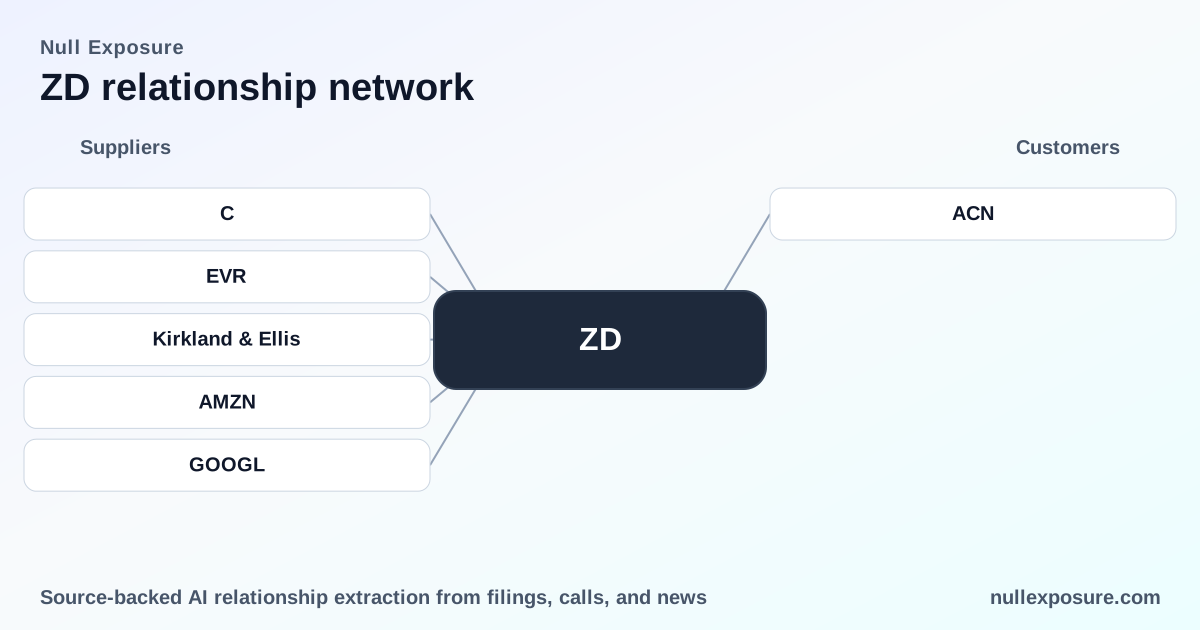
Ziff Davis (ZD): Connectivity divestiture reframes the customer and revenue profile
Ziff Davis is a digital media and cloud-services company that monetizes through advertising, subscription and licensing revenues across consumer and business verticals; the company operates a mix of short-term contracts and recurring subscriptions, plus licensing and usage-based fees tied to its data and software assets. The March–May 2026 announcements that Ziff Davis is selling its Connectivity division to Accenture for $1.2 billion substantially alters the company’s customer composition and cash-generation profile and creates a near-term cash inflow while concentrating the remaining business on digital media and cybersecurity/MarTech subscriptions. For a concise tracker of customer-side signals and implications, see Null Exposure’s research hub: https://nullexposure.com/.
Strategic investors should view ZD as a subscription-led media operator that still relies materially on advertiser fees, but now with a windfall from an asset sale that changes operating margins and reported operations going forward.
What changed: a high‑value divestiture that crystallizes value
Ziff Davis announced a definitive agreement to sell the Connectivity division — the unit that includes Ookla brands such as Speedtest and Downdetector — to Accenture for $1.2 billion in cash. That transaction prompted ZD to reclassify Connectivity’s results as discontinued operations starting in Q1 FY2026, and drove a sharp market reaction to the company’s share price in March 2026. Multiple business media outlets documented the sale and its immediate market impact, underscoring both the cash benefit to ZD and Accenture’s strategic intent to bolster its network intelligence capabilities (Finviz, Engadget, Yahoo Finance, March–May 2026).
Key takeaway: The sale converts an operating asset into cash and reduces ZD’s exposure to the Connectivity vertical, while the buyer (Accenture) buys commercial data and network-intelligence capabilities that integrate with consulting and systems work.
The Accenture relationship — concise coverage of the evidence
Accenture (ACN) is the counterparty to Ziff Davis’s sale of the Connectivity division; the agreement is an all-cash transaction valued at $1.2 billion and was widely reported in March 2026. (Finviz, March 10, 2026 — https://finviz.com/news/320591/why-ziff-davis-zd-shares-are-plunging-today)
Ziff Davis publicly stated the Connectivity unit will be treated as discontinued operations from Q1 FY2026 following the deal with Accenture. (Yahoo Finance press release, May 2026 — https://uk.finance.yahoo.com/news/ziff-davis-announce-first-quarter-110000307.html)
Industry press noted the transaction positions Accenture to add Ookla’s Speedtest and Downdetector to its network intelligence and consulting portfolio, with implications for communications service providers and enterprise network teams. (Technology Magazine, May 2026 — https://technologymagazine.com/news/what-ookla-adds-to-accenture-following-ziff-davis-deal)
Multiple outlets reiterated the $1.2 billion cash consideration and the brands included in the sale, highlighting the deal’s visibility and its contribution to market moves in ZD shares. (Pulse2, March 2026 — https://pulse2.com/ziff-davis-1-2-billion-sale-of-connectivity-division-to-accenture/; Engadget, March 2026 — https://www.engadget.com/cybersecurity/downdetector-and-speedtest-have-been-sold-for-over-1-billion-201741894.html)
Market reaction commentary tied the divestiture to Q4/FY2025 earnings context and investor reassessment of ZD’s growth profile after a revenue miss earlier in the cycle. (SimplyWall.st and MarketScreener coverage, March–May 2026 — https://simplywall.st/stocks/us/media/nasdaq-zd/ziff-davis; https://www.marketscreener.com/news/earnings-flash-zd-ziff-davis-inc-reports-q4-revenue-406-7m-vs-factset-est-of-416-7m-ce7e5dd3da88f625)
Executive summary for investors: Accenture is the buyer of Ziff Davis’s Connectivity assets for $1.2 billion cash; Ziff Davis will report those assets as discontinued operations beginning Q1 FY2026, and the market has reacted strongly to the transaction and the surrounding earnings context (March–May 2026 reporting).
You can access an analytical index of these customer signals at Null Exposure: https://nullexposure.com/.
How this sale interacts with Ziff Davis’s contracting and revenue characteristics
The company-level constraints in public disclosures describe a mixed contracting posture that affects customer risk and revenue predictability:
- Short-term and subscription mix: ZD’s revenue base includes a material share of contracts of one year or less alongside cloud-based subscription services. That combination implies quicker renewal volatility but also an underlying recurring cash stream from subscribers.
- Licensing and usage fees: The business licenses proprietary technology, data and IP, generating licensing revenues and variable, usage-based revenue components; this supports high-margin, scalable income where data products retain value independent of volume.
- Spot and non-recurring sales: Hardware and one-off sales exist but are subordinate; these revenues are recognized at a point in time and add episodic noise to reported quarterly results.
- Counterparty breadth: Customers range from individual consumers and SMBs to mid-market enterprises and government/regulatory bodies (particularly for Ookla solutions). That breadth reduces single-counterparty concentration but increases go-to-market complexity and the need for differentiated sales motions.
- Global reach and materiality: The company operates globally and derives significant advertising revenue; digital media advertising and vertical advertising (e.g., healthcare) are material revenue drivers and therefore a key sensitivity to macro and sectoral ad demand.
Taken together, these signals show a company with recurring subscription strength tempered by advertiser cyclicality and a non-trivial licensing/usage component that produces high incremental margins.
Operating implications for customers and partners
- Contract maturity and renewal risk: A sizeable portion of contracts are short-term, which drives faster revenue reversion when market demand softens; however, subscription licensing provides predictable baseline cash flow and higher lifetime value from retained customers.
- Role and economics: ZD functions both as a principal seller of ad inventory and a licensor/service provider for software and data — a hybrid that supports gross-revenue recognition but requires careful assessment of channel economics when resellers are involved.
- Regulatory & sensitivity considerations: The presence of government customers and healthcare advertising concentration in some verticals introduces regulatory sensitivity and exposure to industry-specific spending cycles.
Investment implications and risk checklist
- Balance-sheet and capital allocation: The $1.2 billion sale materially increases ZD’s liquidity and optionality; investors should track how proceeds are deployed (deleveraging, buybacks, M&A or dividends).
- Earnings profile: With Connectivity moved to discontinued operations, forward operating margins and growth rates will reflect a narrowed business mix focused on digital media and cybersecurity/MarTech subscriptions.
- Revenue volatility: Short-term contracting and advertising dependence preserve downside risk in weak ad cycles; subscription and licensing revenues are the key stabilizer.
- Strategic concentration: The sale reduces ZD’s product diversity but increases capital flexibility — a trade-off between operational scale and financial optionality.
Bottom line: Ziff Davis is transitioning from a broader media-plus-connectivity operator into a more focused subscription and advertising-led business with a cleaner balance sheet after the Accenture transaction; investors should prize cash deployment plans and subscription retention metrics as primary forward indicators.
For a practical, investor-friendly view of customer relationships and their structural implications, visit Null Exposure: https://nullexposure.com/.