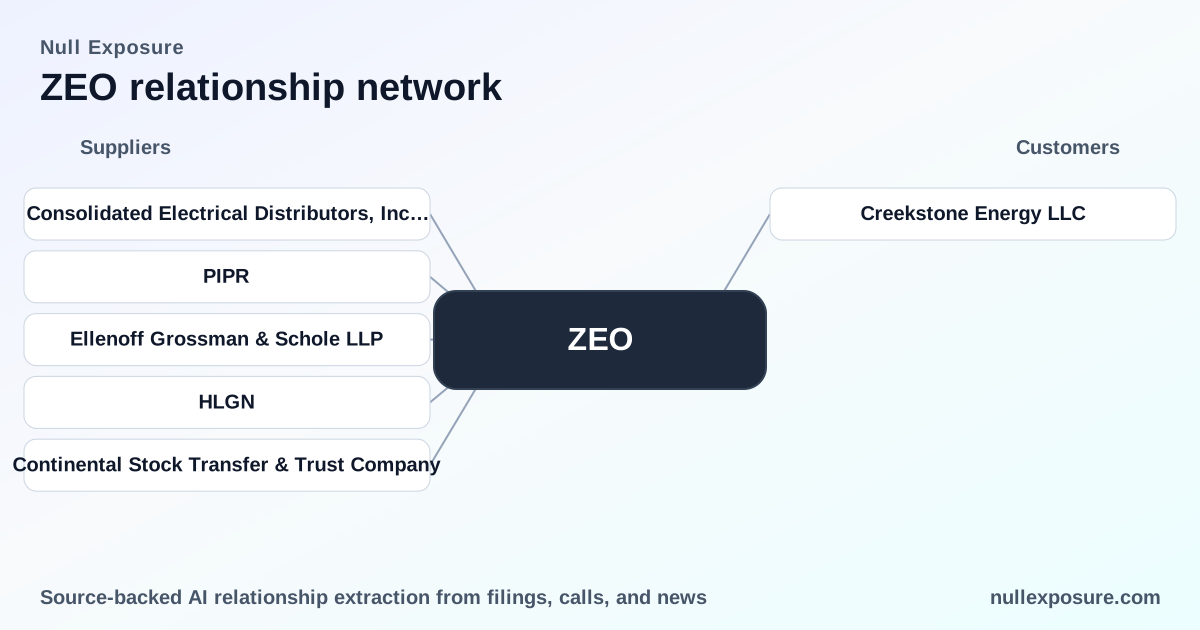
Zeo Energy: Customer relationships that reframe growth beyond rooftop solar
Zeo Energy sells, installs and maintains residential solar systems while also developing commercial long‑duration storage and baseload generation projects; the company monetizes through one‑time system sales, installation and recurring maintenance services, third‑party leased systems financed by long‑term capital providers, and project development agreements for large commercial customers. Recent customer agreements and financing lines materially shift Zeo’s risk profile from pure residential sales toward capital‑intensive commercial projects and equity dilution mitigation. For a concise marketplace view, visit https://nullexposure.com/.
Why investors should re‑price Zeo’s customer base now
Zeo’s core economics come from selling and installing residential systems and capturing maintenance and service revenue over decades, but two developments change the forward outlook: a memorandum of understanding to develop industrial‑scale baseload and long‑duration storage for a major data‑center developer, and a flexible equity purchase agreement that supplies optional liquidity. Together they point to a hybrid business model: residential recurring services plus project development and capital market flexibility.
Creekstone Energy — a 280 MW MOU that converts Zeo into a utility‑scale developer
Zeo signed a memorandum of understanding with Creekstone Energy to develop approximately 280 megawatts of baseload generation and long‑duration energy storage to support a data‑center campus under construction in Millard County, Utah. This is a development‑stage commercial engagement that positions Zeo as an engineering and project partner for large energy consumers rather than only a residential installer (company press release, Feb 18, 2026; public filings and newswire coverage, Q1 2026).
White Lion Capital — optional equity that extends the balance‑sheet runway
Zeo entered into a common stock purchase agreement with White Lion Capital that gives Zeo the right, but not the obligation, to sell up to $30 million of newly issued Class A common shares through January 27, 2029, subject to customary conditions and registration. This provides a flexible capacity to raise equity without committing to immediate dilution, supporting growth projects and working capital in the near term (company disclosure summarized on The Globe and Mail and related press releases, Jan 27, 2026).
How the relationships map to Zeo’s operating characteristics
The disclosed relationships reveal a mix of commercial and capital partnerships that change contract tenor, counterparty composition and credit risk.
- Contracting posture: Zeo operates with a blended posture. Long‑term economics are driven by 25‑year lease structures used by third‑party lessors that finance residential systems, while a minority of sales are spot cash transactions (approximately 5% of sales), indicating a steady baseline of long‑dated revenue exposure alongside transactional business.
- Counterparty mix and concentration: The company’s primary customers are individual homeowners across multiple U.S. states, but Zeo also sells sizable volumes to third‑party leasing companies and now engages enterprise customers through project development. Leasing partners account for multi‑million dollar purchases (company disclosures), signaling commercial concentration with financing partners.
- Criticality of Zeo’s role: For leased systems Zeo is both seller and obligated maintenance provider, which makes it operationally critical to lessors and leaseholders for system uptime and warranty performance.
- Maturity and segmentation: Residential solar and roofing are mature, recurring revenue segments for Zeo; commercial development and long‑duration storage remain early and capital‑intensive, implying longer lead times, higher working capital needs and different project risk profiles.
Constraints and company‑level signals investors should track
Several public excerpts illuminate Zeo’s commercial profile and near‑term constraints:
- Zeo confirms a mixed contract model: most revenue is financed via leases and long‑term lenders, but roughly 5% of sales are immediate cash transactions, indicating some transactional revenue (company disclosures).
- Residential installations are Zeo’s core product, supplemented by services (installation and maintenance) and adjacent roofing services where the company or subcontractors operate (company descriptions of operations).
- Geographically, Zeo’s customer base is U.S.‑centric with concentration in Florida, Texas and several Midwest and Western states, and an expanding presence in Utah and other markets (company filings).
- Spend bands show that third‑party leasing companies managed by White Horse Energy purchased approximately $19.0M (FY2023) and $20.6M (FY2024) of systems from Zeo, with an additional roughly $4.2M in lease commitments pending installation; these amounts highlight meaningful institutional buyer volume and potential concentration risk tied to large lessors (company disclosures referencing White Horse Energy).
These constraints constitute company‑level signals about Zeo’s contracting, counterparty concentration and capital intensity. Investors should monitor whether leasing partners and capital providers escalate or diversify over time.
Risks and upside from the current relationship set
- Upside: The Creekstone MOU exposes Zeo to large enterprise contracts with attractive scale economics if converted into firm offtake or EPC agreements; successful execution on a 280 MW project would materially increase Zeo’s project pipeline and credibility in utility‑scale long‑duration storage. The White Lion facility provides contingent capital to underwrite development activity or cover working capital during project ramp.
- Risk: The Creekstone arrangement is currently a memorandum of understanding, so development, permitting and financing risk remain. The White Lion agreement, while providing optional liquidity, carries dilution risk if exercised and could pressure the share count. Concentration in sales to leasing companies—evidenced by multi‑million purchases from named lessors—creates counterparty exposure that could affect revenue visibility if leasing demand softens.
Practical signals for quarters ahead
- Watch for firm EPC or power‑purchase contracts that convert the Creekstone MOU into binding revenue and for any financing syndication for the Utah Gigasite.
- Track draws under the White Lion purchase agreement and accompanying registration statements; draws indicate reliance on equity rather than project finance.
- Monitor purchases and backlog from large leasing partners (e.g., White Horse Energy disclosures) to gauge installed‑system growth and near‑term revenue recognition.
For investors and operators evaluating Zeo’s customer relationships, the balance between residential recurring cashflows and nascent but scalable commercial project development is the central theme. Zeo’s evolution into project developer and storage provider increases upside but requires clear milestones on contract conversion and prudent capital management.
If you want a deeper commercial‑credit read on Zeo’s customer counterparties and financing levers, see more analysis at https://nullexposure.com/.
Key takeaways:
- Zeo is transitioning from predominantly residential installer to a hybrid developer/operator with enterprise projects and maintenance obligations.
- Creekstone represents large‑scale upside but is development‑stage; contract conversion is the key catalyst.
- White Lion gives optional equity runway but introduces dilution risk if used.