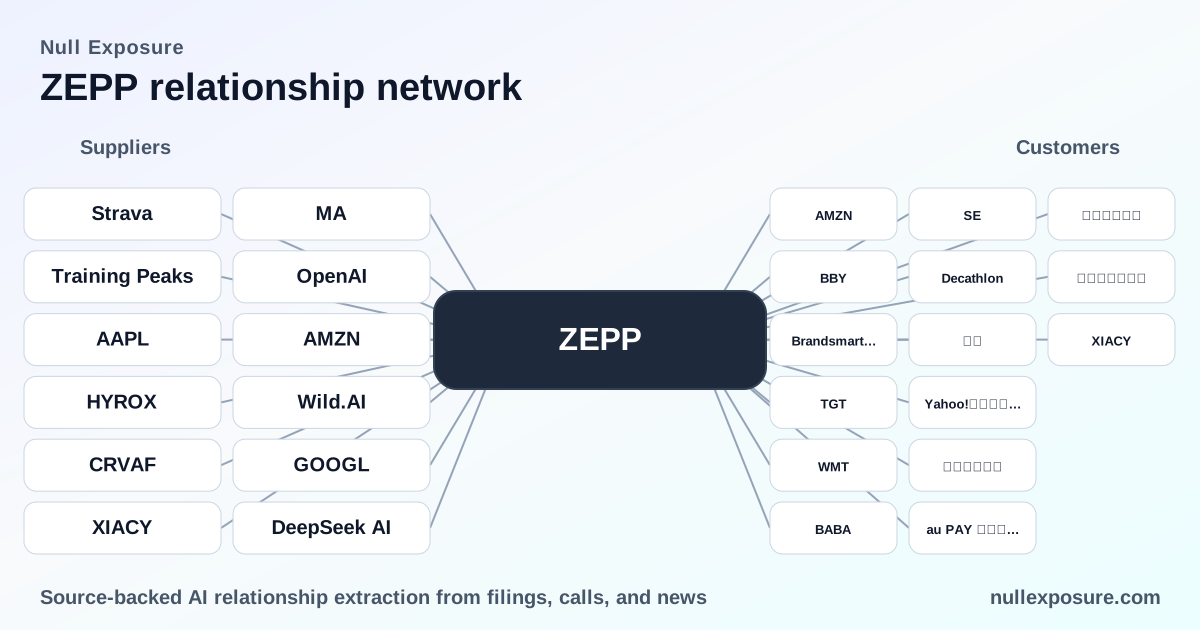
Zepp Health (ZEPP) — Distribution partnerships are the growth lever, e-commerce is the profit conduit
Zepp Health manufactures and sells Amazfit-branded smart wearables and monetizes primarily through device sales routed across direct e-commerce, global e-tail marketplaces and large mass-market retailers. The company’s operating economics depend on channel placement, co-marketing with platform partners, and scale in high-margin online listings, while brick-and-mortar distribution supports reach in select markets.
Learn more about channel risk and partner analysis at https://nullexposure.com/.
Why channel partners matter more than ever for a device company
Zepp’s product line is commodity-adjacent: hardware, firmware and a brand that competes on price, features and distribution. That structure produces three investment-relevant dynamics:
- Concentration of monetization through a few large retail platforms increases revenue volatility if placement or promotional terms shift.
- Online-first go-to-market shifts customer acquisition cost and inventory dynamics away from traditional retail margins toward platform-driven traffic and reviews.
- Retailer co-marketing and placement are value drivers: favorable placement on Amazon or major U.S. retailers translates directly into higher unit velocity and lower customer acquisition spend.
Operationally, this implies a contracting posture that is channel-dependent and partner-focused, commercial maturity that is retail-market ready, and a moderate concentration risk around leading marketplaces and big-box retailers.
Customer relationships — what the public record shows (FY2022–FY2026)
This section walks through every counterparty identified in the dataset and gives a short, source-backed read on the business relationship.
Amazon / AMZN / Amazon.co.jp
Zepp sells Amazfit devices widely through Amazon globally, and management cites Amazon as a key sales and promotional channel driving online growth and placement. Company earnings transcripts and product announcements across FY2025–FY2026 repeatedly reference Amazon for higher order volumes, better placement and co-marketing support (Investing.com earnings transcript, May 2026; Yahoo Finance Q3 report, May 2026; product launches March 2026).
Source: Investing.com earnings transcript (Q3 2025, published May 2026); Yahoo Finance (Q3 2025 report, May 2026); Betanews (product launch, March 2026).
Best Buy (BBY)
Best Buy is listed as a U.S. retail partner where Zepp places products after prioritizing online visibility; management frames Best Buy as a downstream channel following online promotion (Investing.com Q3 2025 earnings transcript, May 2026).
Source: Investing.com earnings transcript (Q3 2025, May 2026).
Target (TGT)
Target is a nationwide point-of-sale for Amazfit in the U.S.; Zepp management includes Target in the roster of mass-market retailers used for broader physical distribution following online rollout (Investing.com Q3 2025 earnings transcript, May 2026).
Source: Investing.com earnings transcript (Q3 2025, May 2026).
Walmart.com (WMT)
Walmart.com is named alongside Amazon and Target as a major online/offline distribution point for Zepp devices in the U.S., supporting the company’s omnichannel footprint (SGBOnline, FY2025 coverage).
Source: SGB Online executive commentary (FY2025 report).
Brandsmart USA
Brandsmart USA is identified as one of the U.S. specialty retail partners carrying Amazfit devices, contributing to Zepp’s brick-and-mortar presence in North America (SGB Online, FY2025).
Source: SGB Online executive commentary (FY2025 report).
Lazada (BABA)
Zepp lists Lazada as an e-commerce partner for Amazfit in Southeast Asia, with product landing pages and campaign links confirming platform availability (ACN Newswire product release, FY2023).
Source: ACN Newswire press release (Amazfit Cheetah launch, FY2023).
Shopee / SE
Shopee is likewise a regional e-commerce partner in Southeast Asia with product pages and local campaigns driving sales in those markets (ACN Newswire product release, FY2023).
Source: ACN Newswire press release (Amazfit Cheetah launch, FY2023).
Decathlon
Zepp reports a deepened partnership with Decathlon in France as part of its European retail expansion, indicating targeted relationships with sports retailers to reach athletic consumers (SGB Online, FY2024 report).
Source: SGB Online (FY2024 coverage).
Xiaomi / XIACY
Xiaomi appears in Zepp’s financial commentary as a source of comparative or OEM-related sales; reduced sales of Xiaomi wearable products are cited as a driver of a modest revenue decrease in a reporting period (Finance Yahoo, FY2025).
Source: Yahoo Finance earnings summary (FY2025).
Rakuten (楽天)
In Japan, Zepp lists Rakuten as one of several e-commerce channels where Amazfit products are sold, supporting multi-channel Japanese distribution (PR Times local market release, FY2022).
Source: PR Times Japan (Amazfit Japan channel announcement, FY2022).
Yahoo!ショッピング
Yahoo!ショッピング is included among the Japanese EC platforms carrying Amazfit, reflecting Zepp’s broader e-commerce strategy in Japan (PR Times Japan, FY2022).
Source: PR Times Japan (FY2022).
au PAY マーケット
Zepp identifies au PAY マーケット as a local Japanese marketplace partner, contributing to coverage across ~900 retail and online points in Japan (PR Times Japan, FY2022).
Source: PR Times Japan (FY2022).
ヨドバシカメラ (Yodobashi Camera)
Yodobashi Camera is listed among major Japanese electronics chains selling Amazfit devices, providing in-store visibility for the brand (PR Times Japan, FY2022).
Source: PR Times Japan (FY2022).
ビックカメラ (Bic Camera)
Bic Camera is named alongside other large Japanese electronics retailers in Zepp’s channel roster, reinforcing physical retail penetration in Japan (PR Times Japan, FY2022).
Source: PR Times Japan (FY2022).
ヤマダデンキ (Yamada Denki)
Yamada Denki is also listed as a Japanese electronics retail partner, broadening Amazfit’s in-country retail footprint (PR Times Japan, FY2022).
Source: PR Times Japan (FY2022).
Constraints and company-level operating signals
There are no explicit contractual constraints or partner-level limitations provided in the source set; as a company-level signal, this absence implies that reported partner relationships are standard commercial distribution arrangements rather than exclusive or highly-prescriptive contracts. From the relationship evidence, Zepp’s operating model is channel-centric, commercially mature in e-commerce, and reliant on a small set of large platforms (Amazon, major U.S. retailers, regional marketplaces) — a concentration risk that can amplify both upside in promotions and downside if platform terms shift.
Investment implications and risk checklist
- Positive: Strong online placement and high Amazon rankings translate into low-friction customer acquisition and scalable sales growth; regional marketplace partnerships support international expansion.
- Negative: Revenue concentration around marketplaces and large retailers creates outsized exposure to platform algorithm changes, stocking decisions and promotional term negotiations.
- Watchlist: Monitor Amazon placement metrics, Best Buy/Target stocking decisions, and regional marketplace promotional cadence; any loss of placement would be immediately observable in public commentary and product availability.
If you want a focused channel-risk scorecard or a partner-concentration heat map tailored to institutional diligence, visit https://nullexposure.com/ for analyst modules and deeper partner-level signals.
Bold takeaway: Zepp’s commercial trajectory is driven by e-commerce placement and large-retailer distribution; investor returns will follow how well management monetizes scale on those platforms while managing concentration risk.