Zeta Global: Customer Relationships and Commercial Signals Investors Need
Zeta Global (ZETA) operates an AI-driven, omnichannel marketing cloud that sells software and data-enabled services to large enterprises via a mix of licensing, subscription and usage-based fees, with professional services layered on top; the company monetizes by extracting recurring platform fees from scaled customers and expanding wallet share through additional channels and integrations. Investors should read Zeta as a recurring-revenue software operator with enterprise clients, concentrated revenue in scaled accounts but no single customer over 10% of revenue, and an operating model that rewards multi-year adoption and increasing marketing budget allocation to the platform. For more company-level signals and relationship analytics, visit https://nullexposure.com/.
Why customers matter to Zeta’s valuation
Zeta’s commercial model is defined by recurring, contract-driven economics. Public disclosures describe revenue as generated primarily through subscription fees, volume-based utilization charges, and professional services, with licensing options for the Agile Intelligence suite that can include incremental usage fees. The company reports that a large share of revenue comes from “scaled customers” (527 scaled customers represented 98% of 2024 revenue), and a substantial cohort of “super-scaled” clients have multi-year tenure—evidence of entrenched enterprise relationships that sustain ARR and expand lifetime value.
Key commercial characteristics embedded in Zeta’s disclosures:
- Contracting posture: Mix of quarterly and annual subscriptions plus long-term customer incentives that encourage multi-year commitments.
- Monetization levers: Licensing, subscription, and usage-based fees alongside professional services and integrations.
- Counterparty profile: Focus on large and very large enterprises across retail, financial services, telecom and other verticals.
- Geographic bias: Heavy North American revenue base with targeted investment in EMEA and global operations.
- Materiality: Revenue concentrated in scaled customers (critical to revenue), yet no single customer accounted for more than 10% of total revenues in 2023–2024—diversified concentration, but high dependency on a cohort of large accounts.
- Maturity: A notable portion of high-value customers have 3+ year tenures, implying lower churn and higher switching costs for clients.
These structural features explain why Zeta trades with a software-like revenue multiple profile, despite negative EPS: investors value durable recurring revenue from enterprise clients and the platform’s ability to upsell services and channels.
Relationship inventory: what our sources captured
Below are every relationship mention captured in the supplied results, presented with concise, investor-ready summaries and source citations.
FinWise Bancorp — GlobeNewswire press release (multiple captures)
- The company stated that a card sponsorship program originated “through Zeta, card processor,” indicating FinWise is expanding partnership activity that began via Zeta’s card-processing channel. This language frames Zeta as a channel or partner in issuer/processor introductions. Source: GlobeNewswire, April 14, 2026 — https://www.globenewswire.com/de/news-release/2026/04/14/3273910/0/en/finwise-bancorp-announces-bin-sponsorship-agreement-with-vera-inc-to-launch-unsecured-consumer-credit-card-program-for-prime-and-near-prime-u-s-consumers.html
FinWise Bancorp — GlobeNewswire (duplicate capture)
- A second capture of the same GlobeNewswire release reiterates that the FinWise–Vera launch originated through Zeta and confirms ongoing expansion of that partnership, underscoring Zeta’s role in payments and card program origination channels. Source: GlobeNewswire, April 14, 2026 — https://www.globenewswire.com/news-release/2026/04/14/3273910/0/en/finwise-bancorp-announces-bin-sponsorship-agreement-with-vera-inc-to-launch-unsecured-consumer-credit-card-program-for-prime-and-near-prime-u-s-consumers.html
FinWise Bancorp — Q1 2026 earnings call transcript (InsiderMonkey)
- In FinWise’s Q1 2026 remarks, management explicitly credited an introduction to Vera as originating “through Zeta, a card processing partner of the bank,” and expressed encouragement about developing the relationship with both Vera and Zeta over the long term. This confirms Zeta’s functional role in payments-connected partnerships that extend beyond pure marketing services. Source: InsiderMonkey earnings call transcript, Q1 2026 — https://www.insidermonkey.com/blog/finwise-bancorp-nasdaqfinw-q1-2026-earnings-call-transcript-1752531/
FinWise Bancorp — The Globe and Mail press release summary
- A Globe and Mail press-release aggregation repeats the core disclosure: the relationship between FinWise and Vera originated through Zeta, which the bank continues to leverage as a partner—further evidence across multiple outlets that Zeta participates in card-program origination channels. Source: The Globe and Mail press release (April 2026) — https://www.theglobeandmail.com/investing/markets/stocks/FINW-Q/pressreleases/1305322/finwise-bancorp-announces-bin-sponsorship-agreement-with-vera-inc-to-launch-unsecured-consumer-credit-card-program-for-prime-and-nearprime-u-s-consumers/
LiveIntent — Zeta earnings call highlights (The Globe and Mail)
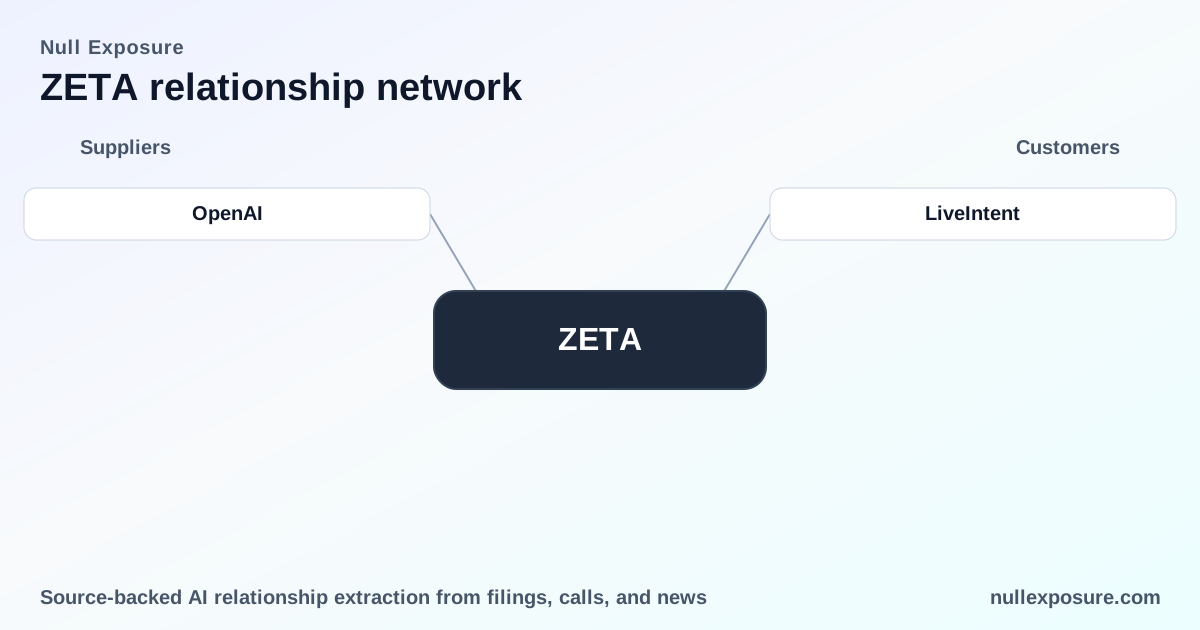
- Zeta’s own earnings call highlighted weaker revenue from LiveIntent and political candidates, but characterized those segments as not significant portions of total business, signaling limited material exposure to that counterparty or segment. Source: The Globe and Mail summary of Zeta earnings call, March 2026 — https://www.theglobeandmail.com/investing/markets/stocks/ZETA/pressreleases/32311423/zeta-globals-earnings-call-highlights-strong-growth/
What these relationships imply for investors and operators
The FinWise references indicate that Zeta’s platform and partnerships extend into payments and card-sponsorship workflows, a commercial adjacency that increases both revenue diversification and operational complexity. The repeated acknowledgment by FinWise across press releases and earnings transcripts signals real, ongoing partner engagement rather than a one-off mention.
The LiveIntent mention, flagged as a weaker but immaterial revenue line on Zeta’s call, supports the disclosure that Zeta’s revenue mix includes small, episodic channels but remains dominated by scaled enterprise clients.
Operationally, Zeta’s contract mix (licensing + subscriptions + usage-based fees) and its long-tenor customer base create predictable revenue profiles and high customer lifetime values; however, investors should weigh the following risks and dynamics:
- Concentration risk in cohorts: No single customer exceeds 10% revenue, yet 98% of revenue comes from 527 scaled customers—loss of a super-scaled account would be meaningful to growth trajectory.
- Cross-product complexity: Engagements that span marketing, data, and payments increase revenue upside but also expand compliance, partner-integration, and credit risk considerations.
- Geographic focus: Heavy U.S. revenue bias with selective EMEA expansion limits immediate global diversification but concentrates go-to-market efficiency where Zeta has scale.
Bottom line for portfolio and operations teams
Zeta’s commercial footprint is enterprise-centric, contract-driven, and increasingly adjacent to payments partnerships. For investors, the stock reflects an expectation of continued ARR expansion and wallet-share gains across scaled customers; for operators, the strategic challenge is to monetize partnerships like the FinWise channel without overextending integration and compliance resources. For a deeper view of Zeta’s relationship signals and enterprise exposures, visit https://nullexposure.com/.
Bold takeaways:
- Recurring revenue and long-tenor relationships underpin valuation.
- Zeta is participating in payments/card-program channels, expanding commercial scope.
- Revenue concentration in scaled customers is both a strength (stickiness) and a source of loss severity risk.
For more relationship-level intelligence and investor-focused analysis, see https://nullexposure.com/.