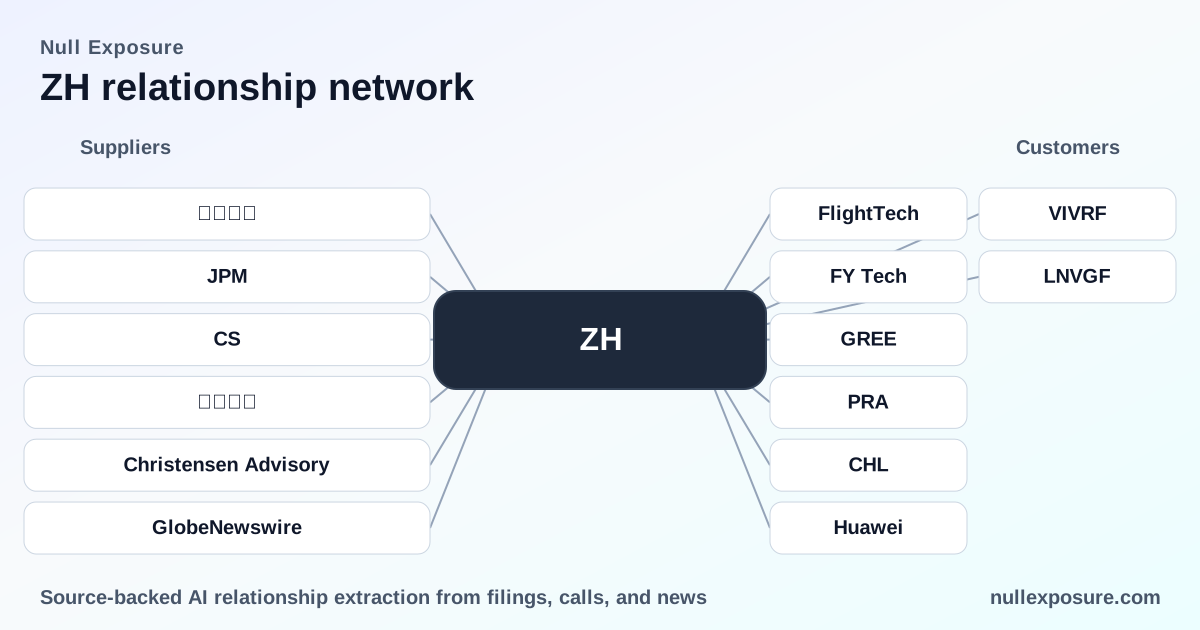
Zhihu (ZH): Enterprise clients validate a brand-marketing revenue engine, but margins and growth remain the key watchpoints
Zhihu operates a user-driven content platform in China that monetizes primarily through advertising, branded content and marketing services, plus subscriptions and value-added services to its community. Management frames the platform as both a discovery engine for users and a high-value channel for large corporate advertisers; that positioning underpins Zhihu’s revenue mix and determines contract length and pricing leverage with enterprise customers. For investors, the critical questions are how durable enterprise marketing revenues are, whether client concentration or campaign seasonality creates volatility, and how those revenues reconcile with the company’s negative operating margins and recent revenue contraction.
For a deeper look at the signal set behind these relationships, visit https://nullexposure.com/.
Why enterprise clients matter to Zhihu’s economics
Zhihu’s public financials show FY TTM revenue of roughly RMB 2.75 billion with gross profit around RMB 1.65 billion, but negative operating and EBITDA margins. That profile—meaningful top-line scale, positive gross margins, and negative operating leverage—fits a model where advertising and brand partnerships cover variable costs while fixed investment in product and moderation drives losses. Management’s disclosure of a roster of large technology and consumer brands confirms that a non-trivial portion of the revenue base is driven by B2B marketing relationships rather than pure consumer monetization.
No constraints excerpts were included in the source package for this analysis, so operating-model inferences here are company-level signals derived from public financials and management commentary rather than contract-level constraint data.
What management disclosed on the 2025 Q3 earnings call
Management used the 2025 Q3 call to highlight “leading technology clients” and brand partnerships that leverage Zhihu to strengthen product positioning and innovation narratives. Below I list every relationship mentioned in the call transcript deliverable and summarize the implication for investors.
FlightTech
Management cited FlightTech among “leading technology clients” that have used Zhihu for brand engagement, indicating FlightTech runs or ran campaign-level activity on the platform. According to Zhihu’s 2025 Q3 earnings call (reported March 2026), FlightTech is presented as one of several enterprise advertisers leveraging the site.
FY Tech
Zhihu said FY Tech used the platform to strengthen brand positioning around technological innovation and product excellence, signaling enterprise marketing use rather than product integration. This came from the 2025 Q3 earnings call commentary on corporate brand partners.
Gree (first mention)
Management listed Gree as a corporate partner that “strengthened their brand positioning” via Zhihu, which reinforces that consumer appliance brands utilize Zhihu for narrative-building campaigns; this was stated on the 2025 Q3 call.
Gree (second mention)
Gree is repeated in the transcript extract, underlining management’s emphasis on the company as a prominent advertiser; the second occurrence is also from the 2025 Q3 earnings call (March 2026).
Proa
Zhihu named Proa among leading technology clients in the same exchange, indicating a marketing relationship consistent with campaign-based spending; the reference is from the 2025 Q3 earnings call.
China Mobile
Management included China Mobile in a list of major corporate users who used Zhihu to bolster brand positioning—this highlights telcos’ use of Zhihu as a reputation and product-education channel, per the 2025 Q3 earnings call.
Huawei
Huawei was cited as a brand using Zhihu to highlight technological innovation, which suggests Zhihu is a channel for premium corporate messaging and product stories; this disclosure comes from Zhihu’s 2025 Q3 earnings commentary.
Vivo
Zhihu referenced Vivo among leading technology clients that the company has worked with, consistent with handset manufacturers using content platforms for product launches and PR; the mention is drawn from the 2025 Q3 earnings call.
LNVGF (Lenovo ADR ticker)
The transcripts include LNVGF, which corresponds to Lenovo’s ADR ticker, cited as one of the technology clients leveraging Zhihu for brand campaigns; the citation is from the 2025 Q3 earnings call.
Lenovo
Management also listed Lenovo by name in the same list of technology clients, reinforcing that the Lenovo relationship is an explicit part of Zhihu’s enterprise client mix as stated on the 2025 Q3 call.
What these customer names imply about contract posture and risk
- Contracting posture: The roster of brand advertisers—telecoms, device makers, consumer appliance brands—points to campaign-oriented, short-to-mid-term engagements rather than long-term strategic integrations. These are typical marketer relationships focused on message reach and content amplification.
- Concentration: The disclosed clients are large and diverse across tech and consumer sectors, suggesting low single-customer concentration at the roster level; however, management did not provide revenue attribution to individual customers in the call.
- Criticality: These customers are commercially important for revenue but not critical to platform operation—Zhihu’s core product is community content; enterprise clients buy distribution and audience access.
- Maturity: The practice of running branded campaigns on Zhihu is established, rather than experimental; management’s list signals a repeatable go-to-market for enterprise marketing services.
Financial and investor implications
- Top-line leverage to advertising cycles. The presence of major brand advertisers ties revenue to marketing budgets and product cycles across tech and consumer sectors; that link explains part of the company’s reported quarterly revenue decline (QOQ/YOY signals) and suggests earnings volatility in economic slowdowns.
- Margin path depends on commercial scale. Zhihu’s gross margin is healthy, but operating losses indicate continued investment in content moderation, product, and sales, so investors should watch whether enterprise marketing grows faster than operating cost inflation.
- Valuation context. With market capitalization under USD 300 million and trailing metrics showing losses, the company is priced for recovery rather than current profitability; enterprise client traction is necessary but not sufficient for a durable rerating.
For more signal-level research and to track how these relationships evolve quarter-to-quarter, see https://nullexposure.com/.
Bottom line: enterprise clients validate the channel but don’t remove the execution question
Zhihu has successfully positioned its platform as a destination for brand storytelling, with recognized corporate clients from telecom, consumer electronics, and appliance sectors confirming commercial demand. That demand is valuable but campaign-driven, which means investors must focus on revenue stability, client-retention metrics (not disclosed in the call), and the company’s ability to turn brand partnerships into scalable, repeatable revenue that covers fixed operating investment. The 2025 Q3 call confirmed the customer roster; the next step for investors is to watch how those relationships translate into consistent ARR-like revenue and improving operating margins.