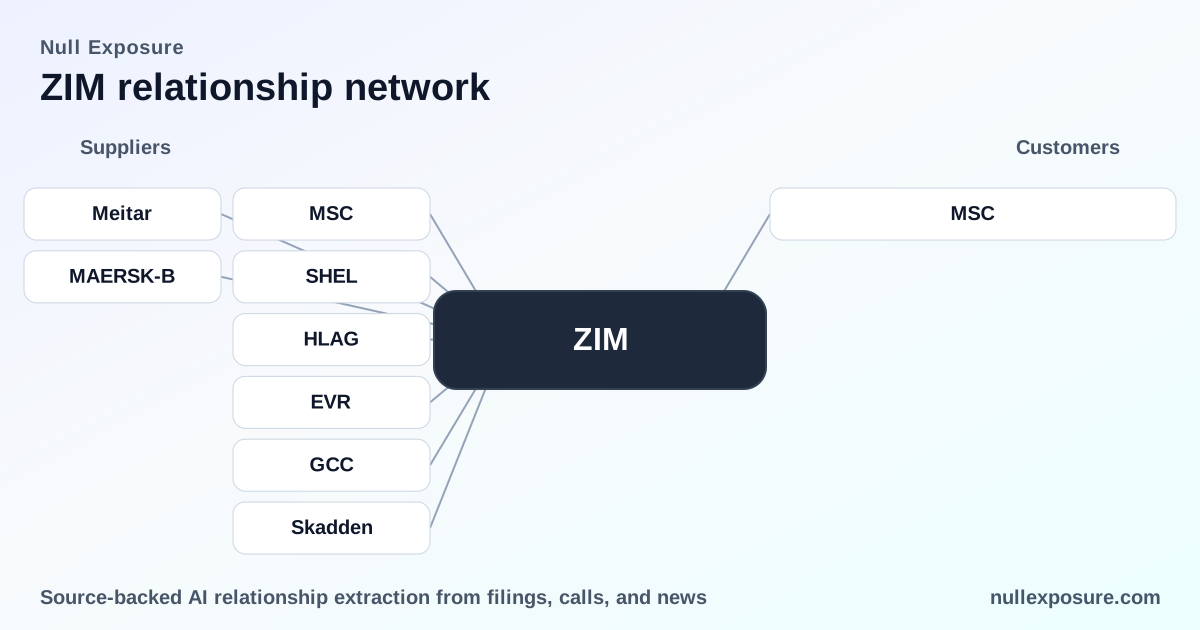
ZIM Integrated Shipping Services: customer relationships that shape the deal and the risk profile
ZIM Integrated Shipping Services monetizes by selling container shipping capacity and related logistics services while also participating in slot-charter and vessel-sharing arrangements; revenue is earned from freight rates, fixed slot agreements and vessel operations, and the company’s recent strategic transactions reprice those revenue streams for investors. ZIM’s customer relationships are now operating at the intersection of commercial slot providers, global carriers and private-equity buyers, and those relationships materially affect capacity control, route economics and regulatory exposure. For a concise view of the company and its positioning, see the firm’s investor materials and market overview at https://nullexposure.com/.
Why relationships matter more than headline multiples right now
ZIM’s 2025 financials show a profitable carrier working through cyclical revenue compression: revenue TTM roughly $6.9bn with EBITDA near $948.7m and a market cap around $3.14bn. Those numbers are useful context, but the near-term valuation and operational continuity are being driven by specific counterparties and transactions—a takeover by Hapag‑Lloyd, forced asset transfers to FIMI entities, and slot-sharing with MSC—each of which shifts who controls capacity and which revenues remain with ZIM. These counterparties are not commodity customers; they are strategic actors whose deals determine vessel deployment, route ownership and regulatory outcomes.
If you want a direct briefing or to track these counterparties in more depth, visit https://nullexposure.com/ for structured coverage.
How each named relationship changes the commercial map
Below I cover every relationship surfaced in recent reporting and explain the commercial implication in plain English.
MSC — operational partner and slot counterparty
ZIM operates vessels on several services marketed as ZCP and ZXB while MSC reserves roughly 30% of the slot capacity on those strings; conversely, in other services MSC provides the tonnage. That reciprocal slot-and-tonnage arrangement means ZIM and MSC are both commercial customers and strategic capacity partners, with revenue flows tied to slot reservations and vessel utilization rather than simple spot cargo contracts. Source: The Loadstar, March 10, 2026.
FIMI Opportunity Funds — buyer of divested vessels and routes
To comply with Israel’s golden-share rules tied to the takeover, a specified sale of 16 vessels and certain routes is being arranged with the FIMI Opportunity Funds, transferring operational assets and route economics away from the core ZIM platform. This divestment reallocates route-level cash flows and reduces fleet control, converting company-operated capacity into assets managed by a private-equity-backed buyer. Source: PrimaryIgnition, March 16, 2026.
Hapag‑Lloyd — acquirer reshaping strategic control
Hapag‑Lloyd signed an agreement to acquire Israel’s ZIM for approximately $4.2 billion, a transaction that reassigns ultimate control of ZIM’s customer contracts, vessel deployment and route network to an established global carrier. A Hapag‑Lloyd acquisition is an ownership change that consolidates commercial networks and will reprice legacy slot agreements and customer relationships under new corporate priorities. Source: DW, May 4, 2026.
FIMI — recipient of remaining Israeli obligations (the “golden share” carve‑out)
In addition to the FIMI Opportunity Funds transaction for vessels and routes, reporting describes FIMI assuming remaining assets and obligations tied to Israel’s so‑called “golden share,” effectively separating some domestic exposures from the Hapag‑Lloyd acquisition. This split structure places part of ZIM’s legal and operational obligations under a local private-equity sponsor, creating a two‑track outcome for stakeholders: global consolidation under Hapag‑Lloyd and localized stewardship under FIMI. Source: DW, May 4, 2026.
What these relationships imply about ZIM’s operating model and business constraints
The feed contains no explicit contractual constraint excerpts captured as structured constraints, which is itself a company-level signal: the dominant dynamics are transactional (acquisition, divestment, slot-sharing) rather than recorded long‑term contractual encumbrances in the data set provided. From the relationship evidence, derive the following operating-model characteristics:
- Contracting posture: Transactional and bilateral. ZIM’s agreements are a mix of slot-charters and vessel-sharing with large carriers (MSC) and asset sales to financial sponsors (FIMI), indicating negotiation leverage oscillates with vessel control and regulatory approvals rather than standardized long-term retail contracts.
- Concentration: High. A small set of counterparties—global carriers (MSC, Hapag‑Lloyd) and private equity (FIMI)—now determine a disproportionate share of capacity and route economics, increasing counterparty concentration risk.
- Criticality: Strategic. Relationships control route ownership and vessel deployments; any change in a major counterpart’s posture materially alters ZIM’s revenue base and operating footprint.
- Maturity and transition risk: Elevated. The Hapag‑Lloyd acquisition and the mandated divestments create a period of transition where contractual continuity and revenue recognition are contingent on closing conditions and regulatory clearances.
These characteristics together mean investors must treat ZIM less like a standalone carrier with stable route economics and more like a company in the middle of a strategic reshuffle whose cash flows are being reallocated to third-party owners and global consolidators.
Key investment takeaways and near-term watch items
- Control of capacity is the principal value driver. Whether ZIM retains vessels and route control or those assets transfer to FIMI or Hapag‑Lloyd changes future EBITDA scalability.
- Counterparty concentration increases execution risk. Large counterparties have negotiating leverage over slot economics and future vessel employment.
- Regulatory outcomes will determine residual value. Israel’s golden‑share conditions are the proximate cause of the divestments; outcomes shape which assets remain with the acquirer versus the local buyer.
For continued tracking of how these relationships evolve and how they affect revenue and fleet deployment, check our ongoing briefings at https://nullexposure.com/.
Bottom line: reposition exposure around counterparty control
ZIM’s fundamental business—moving containers—remains intact, but investors must underwrite the transaction map: which assets stay with the core business, which routes move to private-equity ownership, and how slot deals with carriers like MSC are re-specified under new ownership. The company’s valuation will re-rate based on the net retained route economics after divestments and the degree to which Hapag‑Lloyd integrates those flows into its global network. Monitor regulatory milestones, asset-transfer documents and any re-contracting of slot agreements for the clearest signals of future cash flow stability.