Zions Bancorporation, N.A. (ZIONP): customer relationships, operating posture, and what one recent deal reveals
Zions Bancorporation, N.A. is a regional commercial bank that monetizes through traditional lending and deposit-taking plus fee-generating services (commercial and small-business banking, capital markets and investment banking, commercial real estate lending, retail banking, and wealth management). The franchise earns net interest income from its loan book and noninterest income from transactional and capital markets activities across seven separately managed affiliates concentrated in the Western and Southwestern U.S. — a structure that produces stable core deposits while exposing the bank to regional economic cycles. For direct access to the underlying coverage and counterparty signals, visit https://nullexposure.com/.
How Zions operates and where the revenue comes from
Zions operates as a full-service regional bank headquartered in Salt Lake City, offering deposit, lending, and advisory services through seven affiliates (Zions Bank, California Bank & Trust, Amegy, National Bank of Arizona, Nevada State Bank, Vectra Bank Colorado, and The Commerce Bank of Washington/ Oregon). Revenue is driven by a mix of interest income on loans and fee income from capital markets and commercial services; trailing twelve-month revenue is reported at approximately $3.392 billion with robust operating margins consistent with a bank that combines retail deposit scale and commercial lending capabilities. According to Zions’ year‑end 2024 filings, the firm operated 404 branches and served more than one million customers across 11 states, underscoring a branch-based distribution model augmented by digital channels (Zions 2024 annual report/filings).
Customer mix and operating posture — what the signals say
The firm-level constraint signals show a broad customer mix across counterparty types: individuals and consumers, small business and mid‑market commercial customers, municipal and non‑profit borrowers. This translates into a diversified product set — retail mortgages and consumer lines, small business and commercial loans, municipal finance, and capital markets transactions — and an operating posture that is both service provider and lender.
Key operating characteristics derived from the company-level evidence:
- Contracting posture: Zions functions as lender and fee-based service provider; it recognizes revenue from contractual delivery of banking services and acts as arranging lender in syndicated financings (company filings).
- Concentration: Geographic concentration is material — operations and all revenues are derived within the United States and focused on 11 Western/Southwestern states; branch footprint and affiliate structure create regional exposure (Zions 2024 filings).
- Criticality: For many commercial and small-business clients in its footprint, Zions is a primary banking relationship and a major source of stable deposits, giving the bank structural importance in client ecosystems (2024 filings).
- Maturity: The bank is an established regional operator with a multi-affiliate structure and a legacy branch network, suggesting mature underwriting capabilities and institutionalized credit processes.
These signals imply strength in deposit stability and relationship-driven commercial lending, with attendant risk concentrated in regional economic cycles and sectoral exposures (commercial real estate and energy project finance participation are explicit business lines).
Customer relationship coverage — every relationship in the results
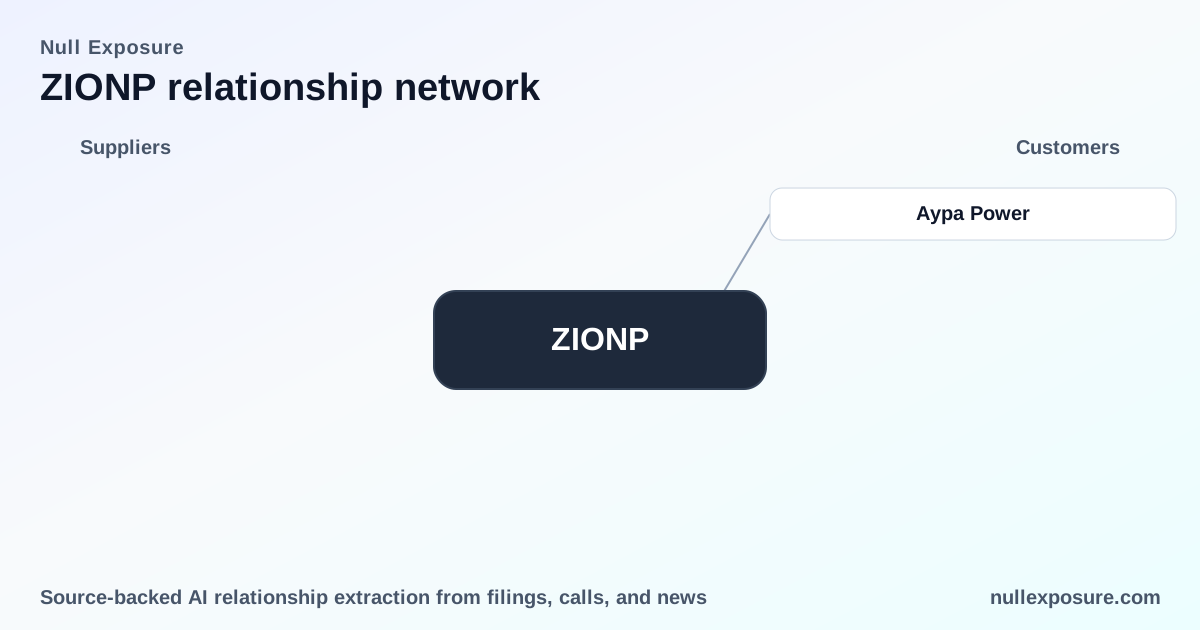
Aypa Power — Zions served as a mandated lead arranger and lender on a project finance deal for a large solar-plus-storage project. Mercom Capital reported on March 10, 2026, that Zions Bancorporation, N.A. acted as a Mandated Lead Arranger and Lender alongside U.S. Bank for a $535 million debt financing supporting the 320 MW Vidal solar-plus-storage project developed by Aypa Power, a Blackstone portfolio company, with Santander serving as Coordinating Lead Arranger and Green Loan Coordinator (Mercom Capital, March 10, 2026). This transaction demonstrates Zions’ active participation in large syndicated energy financings and its role as an arranger and lender in green infrastructure deals.
Why the Aypa relationship matters for investors and operators
The Aypa financing highlights several franchise capabilities and risk vectors:
- Execution capability in capital markets: Acting as a mandated lead arranger on a $535 million facility signals capacity to underwrite and place material project finance exposures beyond core commercial lending.
- Portfolio diversification into energy infrastructure: Participation in renewable energy and storage projects diversifies interest-earning assets but increases exposure to project-specific construction, completion, and commodity/merchant risks.
- Syndication risk management: Syndicated roles reduce single-lender concentration for large credits but create credit and reputational interdependence with co-arrangers (reported co-arrangers included Santander and U.S. Bank) (Mercom Capital, 2026).
Takeaway: Zions leverages its capital markets arm to originate and distribute larger credits, which supports noninterest income and expands lending capacity — a positive for revenue mix — while introducing project-finance risk that needs monitoring alongside core commercial and CRE exposures.
Credit and operational implications for the bank’s customer strategy
From the company-level signals and the Aypa example, investors should focus on the following implications:
- Deposit-funded balance sheet with relationship lending: The bank’s branch footprint and one-million-plus customer base underpin deposit stability, enabling origination of mid‑sized commercial loans and participation in syndicated facilities. Deposit franchise strength is a core competitive advantage.
- Regional concentration is a structural risk: Reliance on Western and Southwestern U.S. markets concentrates exposure to regional economic cycles and particular industry mixes (energy, real estate, agriculture). Regional concentration requires careful stress testing and portfolio diversification.
- Business mix evolution toward fee activities: Capital markets and syndicated lending increase fee income and diversify earnings, improving margins but adding market and execution risks that differ from consumer and small-business lending.
- Counterparty diversity cushions shocks: A mix of individuals, small businesses, mid-market firms, municipalities, and not-for-profits reduces dependence on any single sector or client type (company filings).
For investors and operators evaluating Zions’ counterparty footprint, prioritize monitoring collateral performance in commercial real estate and energy project loans, track deposit trends across affiliates, and assess capital markets exposure metrics disclosed in periodic filings.
If you want a curated readout of customer relationships and counterparty signals for diligence or portfolio monitoring, visit https://nullexposure.com/ for direct access to coverage and relationship intelligence.
Bottom line
Zions Bancorporation, N.A. is a deposit-funded regional bank that combines retail and commercial banking with capital markets capabilities. The bank’s participation in the Aypa Power $535 million project financing underscores its role as an arranger and lender in renewable infrastructure — a business that enhances fee income but adds project-specific credit risk. Investors should weigh Zions’ strong deposit franchise and diversified customer base against regional concentration and growing exposure to syndicated and project-finance credits when assessing credit and operational risk.