ZipRecruiter (ZIP): Customer Relationships and What They Mean for Revenue Durability
ZipRecruiter operates an employer-facing marketplace that monetizes by charging employers for job postings and recruitment services through a mix of time-based subscriptions, usage (performance) fees, and short-term flat-rate plans. For investors and operators, the critical signal is that ZipRecruiter combines recurring subscription anchors with transactional, performance-driven revenue, producing a business that is geographically concentrated in the U.S. and exposed to cyclical hiring dynamics. Learn more background and analytics at the NullExposure homepage: https://nullexposure.com/.
How ZipRecruiter charges employers — the commercial mechanics that matter
ZipRecruiter sells access to job distribution and candidate search in two distinct but complementary ways. Subscription revenue derives from time-based job posting plans, resume database access, and upsells that increase visibility or prominence for openings. Performance-based revenue is captured when candidates click on or apply to jobs distributed on behalf of customers and is typically charged per click or per application, often with contractual caps. The company also offers flat-rate plans on terms ranging from a day to a year, which target more transactional needs.
These contract types create a mixed contracting posture: subscription elements improve retention and predictability, while usage-based and short-term plans generate elasticity in revenue and higher sensitivity to hiring activity. These characteristics are documented in ZipRecruiter’s disclosures describing time-based job posting plans, per-click/per-application pricing, and flat-rate offerings in its filings for recent fiscal periods.
Geography and customer mix — where revenue really comes from
ZipRecruiter’s business is overwhelmingly U.S.-centric: foreign operations collectively produced less than 2% of revenue for the years ended December 31, 2024, 2023 and 2022, and substantially all revenue is generated by U.S. operations. The customer base spans small businesses through large and very large enterprises, with company statements explicitly positioning the platform to deliver candidates to companies of all sizes and industries. This breadth reduces single-segment dependency but also means ZipRecruiter competes across a wide set of buyer profiles with differing price sensitivity and procurement cycles.
The business role ZipRecruiter plays for customers
ZipRecruiter functions primarily as a seller of recruitment services to employers—charging fees for posting jobs and distributing listings—while also acting as a facilitator for employers to search the resume database. The company defines its customer population in operational metrics such as “Quarterly Paid Employer,” which counts employers on paying plans or performance campaigns that are active for at least one day in a quarter. This confirms an active, revenue-generating relationship model rather than a passive lead-generation role.
Relationship inventory: the partners and integrations worth tracking
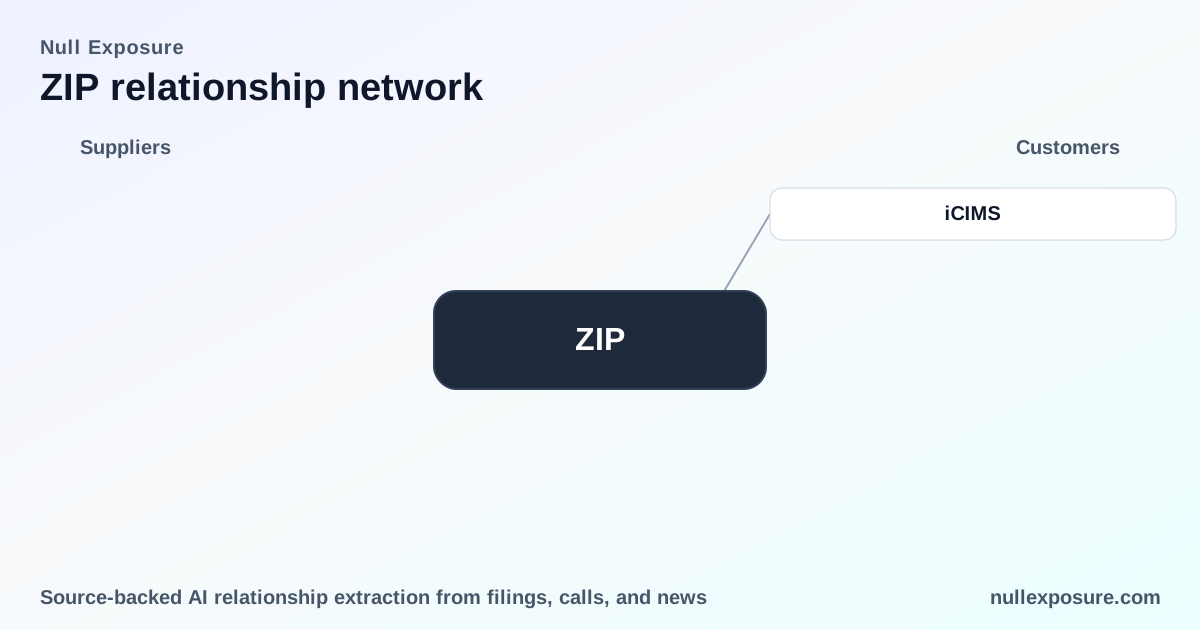
iCIMS integration — an open channel to applicant tracking systems
ZipRecruiter announced an integration with iCIMS that is free to existing iCIMS customers, positioning ZipRecruiter as an integrated distribution layer into a major applicant tracking system. The integration reduces friction for employers using iCIMS to post and manage roles and broadens ZipRecruiter’s reach into enterprise recruiting workflows. Source: HR Brew (March 14, 2024), reporting on the iCIMS–ZipRecruiter integration — https://www.hr-brew.com/stories/2024/03/14/technically-hr-icims-and-ziprecruiter-release-integration.
(That single listed relationship is active in public reporting; there are no other named customer relationships in the provided results.)
Operating constraints and what they imply for revenue quality
ZipRecruiter’s disclosures surface several company-level signals that influence revenue durability and commercial execution:
- Contracting posture: A mix of subscription, short-term flat-rate, and usage-based contracts produces partial revenue predictability. Subscription revenue supports baseline recurring cash flow; performance and short-term plans deliver upside in growth cycles but increase revenue volatility.
- Counterparty breadth: The firm explicitly targets small businesses through very large enterprises, which reduces concentration risk at the buyer level but requires differentiated sales and product strategies to optimize ARPU across segments.
- Geographic concentration: Substantially all revenue is U.S.-based and foreign revenue is immaterial in the recent years noted, so macro U.S. hiring trends are the dominant demand driver.
- Relationship role and stage: ZipRecruiter reports a defined, active paying employer base and both sells recruitment services and provides employer access to candidate data, confirming direct monetization rather than purely referral economics.
- Product segmentation: The company presents its offering as software-as-a-service for job posting alongside professional services-style distribution, which implies mixed gross-margin dynamics—software-scaled margins on the posting platform and variable costs tied to distribution and paid acquisition.
Collectively, these constraints describe a platform that is mature in product concept but still exposed to cyclical hiring and enterprise procurement patterns. The operating model rewards scale and integration (ease of posting from ATS platforms like iCIMS) while leaving headline revenue vulnerable to hiring slowdowns because of the usage component.
Financial context that supports commercial observations
ZipRecruiter reported TTM revenue of approximately $449 million with gross profit around $401 million, and trailing operating margin in the low single digits (Operating Margin TTM 3.85%). The company reported negative net income per share on a diluted basis over the trailing period. These figures are consistent with a platform investing in customer acquisition and product integration while maintaining gross-margin strength on digital distribution. Investor ownership is notable: institutional holders account for a large share of the float, which influences governance and strategic expectations.
Risks, levers, and what operators should watch
- Hiring cycle sensitivity: Because a material portion of revenue is usage-based and short-term, top-line growth tracks hiring demand closely; monitor macro hiring indicators and large-customer cohort behavior.
- Integration economics: Integrations like iCIMS expand reach but are often offered free to partners’ customers, pushing ZipRecruiter to monetize via volume or premium upsells rather than integration fees.
- Geographic concentration: U.S.-centric revenue exposes ZipRecruiter to domestic policy, labor-market shifts, and regulation around recruiting platforms.
- Contract maturity and churn: The subscription anchor improves retention, but the presence of many short-term and per-click arrangements requires careful attention to customer churn and ARPU trends.
Key takeaways and recommended actions for investors and operators
- ZipRecruiter is a hybrid monetization platform: subscriptions provide baseline stability while usage and short-term plans deliver cyclical upside. This mix creates both resilience and sensitivity to hiring cycles.
- Integrations amplify distribution but compress direct monetization: partnerships such as the iCIMS integration increase reach into enterprise workflows at limited direct fee upside initially.
- U.S. exposure concentrates macro risk: underweight international revenue requires investors to treat U.S. labor-market dynamics as the primary valuation input.
- Monitor ARPU, cohort retention, and large-customer hiring trends as the clearest short-term predictors of revenue trajectory.
For a deeper operational view and to track additional partner relationships as they surface, visit NullExposure: https://nullexposure.com/.