Zeta Network Group (ZNB): Treasury-led partnerships that re-shape monetization
Zeta Network Group builds blockchain infrastructure and decentralized applications and monetizes through service fees, tokenized product issuance, and active treasury management. The company leverages its crypto holdings and infrastructure to generate yield and productize on-chain assets, positioning treasury deployment as both a liquidity play and a commercial channel for issuing tokenized financial products.
For a concise map of customer relationships and connections, visit https://nullexposure.com/.
Why the SOLV relationship is material to investors
Zeta’s public reporting and market commentary indicate the company is treating its treasury as an economic lever, deploying Bitcoin into third-party platforms to extract yield and create tokenized offerings. A March 10, 2026 tech news item reported that under the arrangement Zeta will deposit Bitcoin treasury holdings onto SOLV Foundation’s platform via a regulated custodian to earn yield, enhance transparency, and pursue tokenized financial products. (ts2.tech, March 10, 2026).
Implication: this is a revenue-adjacent strategy—rather than relying solely on core product fees, Zeta is monetizing balance-sheet assets to supplement operating cash flow and to seed product innovation around tokenization.
The customer relationships catalog (complete)
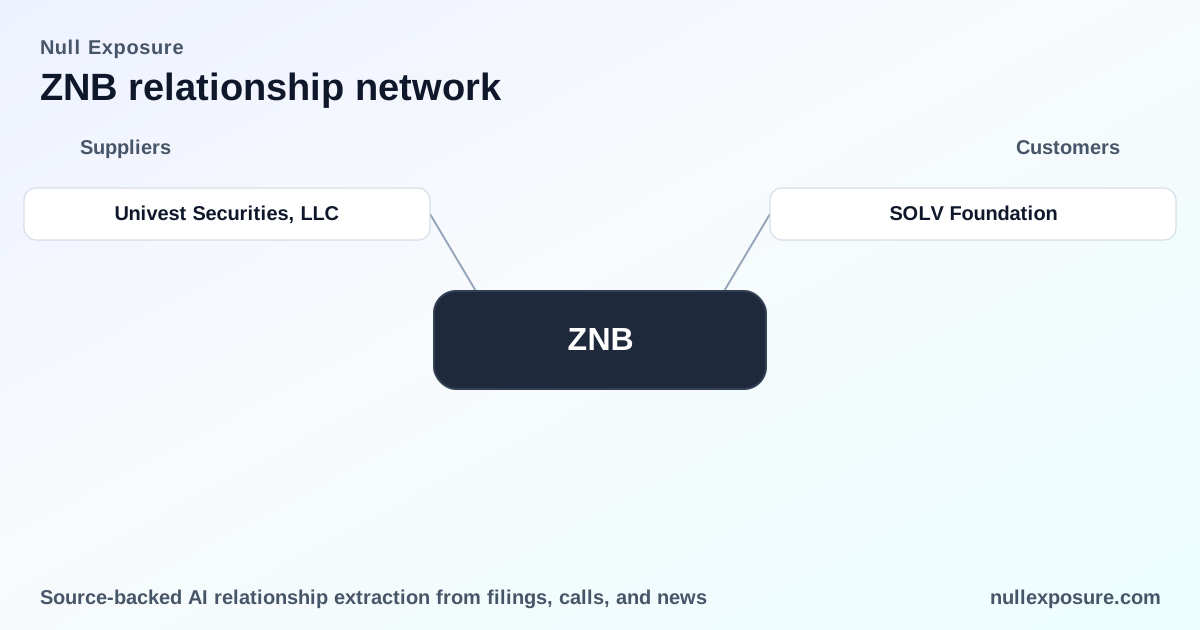
SOLV Foundation — Zeta will deposit Bitcoin holdings onto SOLV’s platform through a regulated custodian to earn yield and to support tokenized financial product initiatives; the arrangement is framed as both treasury optimization and product development. Source: a March 10, 2026 report on ts2.tech covering Zeta’s pivot to crypto-enabled treasury strategies.
(This section lists every customer relationship captured in available coverage.)
Financial posture that underpins commercial choices
Zeta’s financials and market data show the company is operating with revenue generation but negative profitability, which explains the strategic emphasis on treasury yield:
- Revenue (TTM): $8,726,000; EBITDA: -$2,520,085; Diluted EPS (TTM): -$3,950.94, based on the latest available reporting through the quarter ended September 30, 2025. These figures indicate an active top line but continued operating losses. (Company filings / public data).
- Market capitalization: $3,002,400 and shares outstanding: 1,766,100 imply a highly volatile public float and limited market depth. Institutional ownership is modest at ~11.8%, while insiders hold ~0.5% of shares.
Because operating margins are negative, deploying treasury reserves into yield-bearing crypto platforms is a deliberate lever to stabilize cash flows and to create chargeable tokenized products without diluting equity or immediately expanding sales operations.
Operating model and business-model constraints investors should weigh
There are no specific constraint excerpts recorded for individual relationships in the coverage reviewed, so the following points are company-level signals drawn from public metrics and the nature of the reported customer engagement:
- Contracting posture: Zeta is executing commercial arrangements that rely on custodial and third-party platform relationships rather than on in-house custody; this reduces custody overhead but increases counterparty exposure and operational dependence on partners’ compliance and custody frameworks.
- Concentration and criticality: Only one customer-level relationship surfaced in the coverage (SOLV Foundation). That single, high-profile treasury deployment is strategically important to Zeta’s near-term cash generation plan, which elevates concentration risk if similar channels do not scale.
- Maturity profile: The company shows revenue traction but negative EBITDA and sharply negative EPS, signaling a growth-stage technology firm that finances operations partly through treasury management and product experimentation.
- Market sensitivity: Zeta’s high beta (2.735) and extreme 52-week range suggest equity price is highly sensitive to crypto-market moves and narrative shifts; treasury deployments that depend on Bitcoin price dynamics increase earnings volatility.
What the SOLV deal means for operational risk and upside
- Risk: Using external custodial solutions and third-party yield platforms introduces counterparty and regulatory exposure; the company is now operationally linked to the custodial and compliance posture of its partners.
- Upside: If the SOLV deployment produces steady yield and enables tokenized product issuance that Zeta can commercialize, the move converts non-productive crypto holdings into recurring revenue streams without immediate operating expense increases.
Key takeaway: The SOLV arrangement is a leverage play on the balance sheet—it reduces idle-asset drag and creates a pathway to new revenue lines, but it increases third-party reliance and market-linked earnings variability.
Investment implications and short checklist for diligence
Investors evaluating Zeta’s customer relationships and commercial durability should prioritize the following:
- Confirm the custody and regulatory framework governing the SOLV deployment: is the custodian regulated in a jurisdiction with robust supervision?
- Quantify expected yield contribution to free cash flow and understand any lock-up or liquidity terms tied to the deployed Bitcoin.
- Monitor whether the SOLV relationship is one-off or a template for repeatable customer contracts; repeatability reduces concentration risk.
- Track balance-sheet composition and volatility metrics—given the company’s negative operating profitability, treasury returns are a material driver of near-term cash generation.
Bold summary for investors: Zeta converts treasury into product and yield exposure to cover cash needs and seed tokenized offerings; this is a pragmatic monetization tactic but one that shifts risk from product execution to counterparty and market exposure.
For a full relationship map and continuous monitoring, see https://nullexposure.com/.
Final assessment
Zeta Network Group is executing a clear pivot where treasury management is an active revenue lever rather than a passive balance-sheet footnote. The single documented customer relationship—SOLV Foundation—is strategically aligned with that intent and is sufficiently material to investors that it should be treated as an operating risk and an opportunity. Given negative EBITDA and extreme equity volatility, the success of these treasury-driven commercial experiments is central to any investment case.