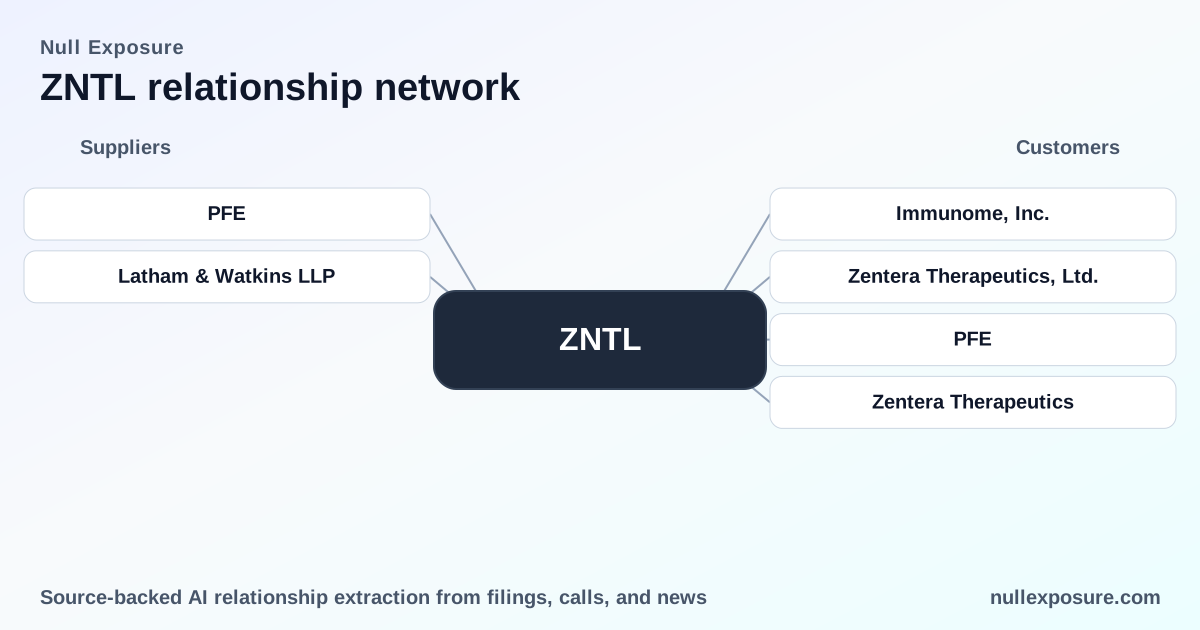
Zentalis Pharmaceuticals (ZNTL) — Customer relationships that monetize discovery-stage assets
Zentalis is a clinical-stage oncology company that monetizes proprietary small-molecule programs primarily through licensing, joint ventures and selective equity partnerships rather than through product sales today. The company generates revenue by granting regional or program-specific commercialization rights (notably for China), selling or licensing non-core assets, and accepting strategic equity investments from larger pharmas — a model that converts R&D value into near-term cash and equity liquidity while clinical programs advance. For more background on how partner arrangements affect valuation, visit https://nullexposure.com/.
Why partners are an operational lever, not a distraction
Zentalis operates with a clear contracting posture: licensing-first commercialization, retaining upside on core programs while using out-licensing to de-risk cash flow and establish territory-specific commercialization paths. The company’s FY2024 activity shows a pattern of taking material upfront payments and equity consideration for selective assets, which changes cash runway dynamics and reduces reliance on capital markets for immediate funding.
- Concentration: Revenue and strategic optionality come from a small number of counterparties — a positive for deal economics but a risk for revenue volatility.
- Criticality: Licensed assets include platform technology and candidate drug rights, which are central to Zentalis’s value creation and could determine future royalties or milestone streams.
- Maturity: Zentalis remains clinical-stage; licensing deals provide near-term monetization while late-stage development and regulatory risk remain.
These company-level signals — global licensing rights, EMEA/NA patient-market targeting, and upfront consideration in the $10M–$100M band — shape how investors should model revenue volatility and partner dependency.
Relationship inventory: who Zentalis works with and why it matters
Below are the specific customer and partner relationships documented in filings and news reporting, each summarized in plain English with source context.
Immunome, Inc.
Zentalis executed an exclusive, worldwide license with Immunome transferring ADC assets (including ZPC‑21/IM‑1021 and ADC platform technology), and the company treats those agreements as customer contracts under ASC 606. The Immunome agreement included $40.6 million in upfront consideration (cash plus equity) and was recognized in Zentalis reporting. (Source: Zentalis FY2024 10‑K and related licensing disclosures.)
A subsequent market-summary noted that Zentalis monetized non‑core ADC assets through Immunome transactions in 2024 while maintaining collaborations with major partners. (Source: TradingView coverage summarizing 2024 monetization, FY2026 commentary.)
Pfizer (PFE)
In April 2022 Pfizer made a direct equity investment in Zentalis: Zentalis sold 953,834 common shares at $26.21 per share for gross proceeds of approximately $25.0 million. Pfizer’s stake functions as both capital and strategic alignment with a large pharma. (Source: Latham & Watkins advisory note and a 2022 GlobeNewswire press release announcing the $25 million equity investment.)
Zentera Therapeutics / Zentera Therapeutics, Ltd.
Zentalis established a China‑focused joint venture, Zentera Therapeutics, and licensed multiple clinical/near‑clinical candidates (ZN‑c3, ZN‑c5 and ZN‑d5) to that JV for development and commercialization in China. Zentera is the sole licensee in China for those three Zentalis‑discovered therapies, giving Zentalis regional commercialization leverage without direct Chinese operations. (Source: CityBiz reporting and GlobeNewswire/NAI500 announcements from 2020–2022 documenting the JV formation and licensing terms.)
What the documented constraints tell investors about operating risk
The evidence set provides several company-level operating signals that inform valuation modeling and risk assessment:
- Contract type — licensing: Zentalis uses licensing as a primary commercial instrument, exemplified by the Immunome License Agreement for ADC assets; this indicates recurring deal execution competence and a willingness to trade future product economics for near-term funding.
- Geography — global and regional playbook: Zentalis consistently retains or grants worldwide development/commercial rights for some programs while delegating China rights to partners like Zentera; investor models should track regional revenue waterfalls and milestone allocations.
- Spend band — meaningful upfronts: The reported upfront consideration in the $10M–$100M range (notably $40.6M for Immunome) demonstrates Zentalis’s ability to secure mid‑double-digit million-dollar payments that materially affect near‑term liquidity and revenue recognition.
- Market targeting — NA/EMEA patient estimations: Corporate market assessments include U.S., EU4 and U.K. patient baselines, signaling a commercial planning horizon that contemplates large Western markets in parallel to Asia strategies.
Financial impact and risk checklist
Zentalis’s FY2024 and subsequent disclosures show a shift from zero licensing revenue to tens of millions recognized, which is a discrete inflection for cash flow profiles. That said, the company remains clinical-stage with negative operating margins, so licensed monetizations are an essential but non-recurring lever until products achieve commercial launch.
Key investor takeaways:
- Positive: Licensing deals and strategic equity (e.g., Pfizer) provide immediate cash and credibility, improving optionality without product commercialization risk on Zentalis’s balance sheet.
- Negative: Concentration risk to a handful of partners creates revenue lumpiness; regulatory and development outcomes still control long-term economics.
- Balance sheet signal: Upfront and equity consideration reduces near-term dilution pressure and extends runway when deals fall into the $10M–$100M bracket.
What investors should monitor next
Keep a close watch on three categories that will determine how partner revenue converts to lasting value:
-
Clinical and regulatory milestones for licensed programs that trigger milestones/royalties.
-
Any amendments or follow‑on deals with Pfizer, Immunome or Zentera that change economics or territory scope.
-
Recognition patterns: whether the company continues to book large licensing revenue items or returns to capital markets for funding.
-
Monitor press releases and 10‑Ks for updates to upfront/milestone receipts and equity transfers.
-
Track Chinese commercialization progress via Zentera for tangible market entry that could validate regional licensing economics.
For ongoing research and to track partner‑level disclosures in real time, visit https://nullexposure.com/.
Final read: partnership strategy is the valuation hinge
Zentalis’s partner arrangements are not peripheral — they are the central monetization mechanism that translates discovery into cash and strategic positioning. Investors should value these relationships for both their immediate balance‑sheet effect and as indicators of the company’s ability to de‑risk programs through licensing in major territories. Concentration, deal size, and regional splits are the drivers that will either stabilize Zentalis’s funding profile or produce episodic revenue volatility; model accordingly.