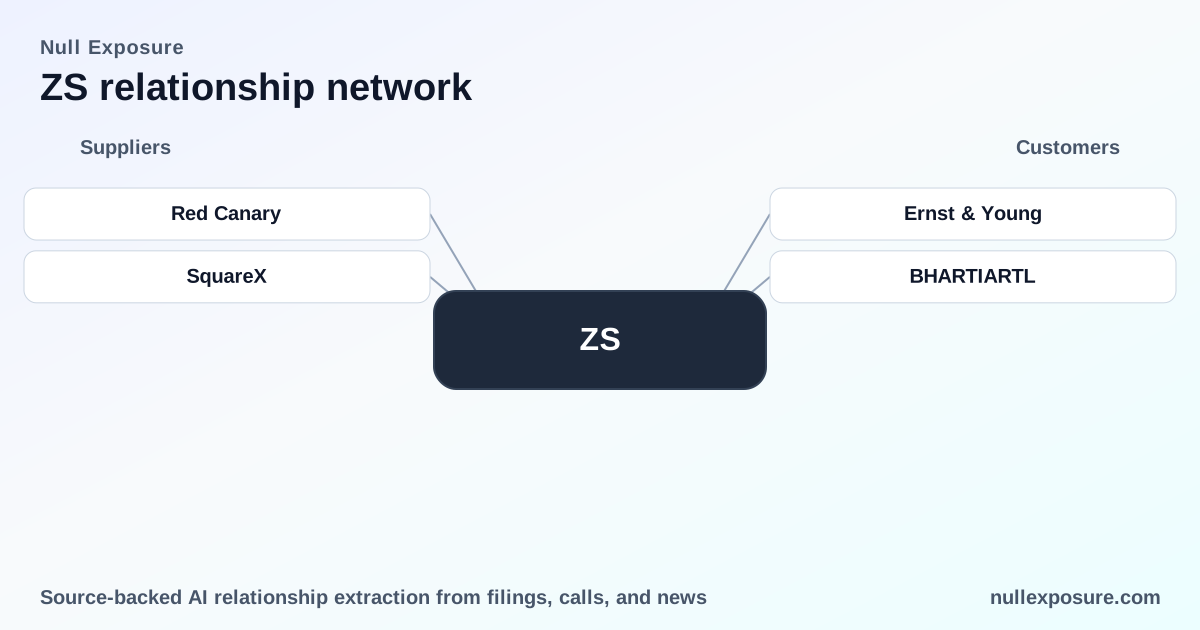
Zscaler’s Customer Web: Zero‑Trust SaaS, Channel Reach, and Strategic Security Partners
Zscaler operates a cloud‑native security platform delivered as subscription software, monetizing primarily through multi‑year SaaS contracts and support. The commercial model is subscription‑first, routed through a heavy channel mix, and focused on large enterprises and government accounts that adopt Zscaler as a primary security control. Investors should value recurring revenue durability, channel concentration, and strategic partnerships that expand the platform into adjacent ecosystems.
For a quick view of counterparty exposures and to track changes in customer relationships, visit https://nullexposure.com/.
How Zscaler actually sells and how that shapes counterparty risk
Zscaler’s financials and corporate disclosures make the economics and contracting posture explicit. Subscription and support revenue is recognized over time and accounted for roughly 97–98% of revenue, reflecting a pure SaaS subscription model with ratable recognition and typical contract tenors of one to three years. Zscaler sells both direct and, importantly, through channel partners — 88% of contract revenue in the latest period flowed through channel partners, while direct sales represent roughly 12%.
Key operating characteristics that drive counterparty dynamics:
- Contracting posture: Subscription contracts, usually 1–3 years, create predictable renewal cycles and expansion potential tied to seat, throughput, and additional modules.
- Customer concentration: No single end customer contributed 10% or more of revenue in recent years; customer concentration is immaterial at the single‑name level.
- Counterparty profile: The customer base skews to very large enterprises and government agencies, with penetration into Forbes Global 2000 and Fortune 500 companies.
- Geographic mix and diversification: North America is the largest region (~51% of revenue), EMEA about 30%, and APAC about 16%, giving global reach but North America dominance.
- Criticality and maturity: Many customers route virtually all internet traffic through Zscaler’s cloud, making the product mission‑critical for secure access and network control and indicating a mature relationship stage for top accounts.
These signals present both resilience (sticky recurring revenue, wide enterprise adoption) and structural risks (high channel concentration, reliance on large‑account renewals and expansions).
Recent relationship signals investors should track
Below I summarize every customer relationship referenced in the provided materials with a concise plain‑English takeaway and source.
IXT — embedding ZTNA at the SIM level for IoT connectivity
Zscaler’s Zero Trust Network Access (ZTNA) has been integrated into IXT’s full MVNO platform so that SIM‑level IoT device traffic is routed through Zscaler for inspection and policy enforcement, extending Zero Trust to cellular‑connected devices. See the IXT announcement via GlobeNewswire (April 29, 2026) and the April 2026 analysis published on SimplyWall that explains how this routes SIM traffic through the Zscaler Zero Trust Exchange for inspection and attack‑surface reduction.
Why it matters: This expands Zscaler’s reach into IoT connectivity vendors and illustrates product embedment beyond enterprise endpoints into carrier and SIM ecosystems.
Sources: GlobeNewswire press release (Apr 29, 2026) and SimplyWall coverage (April 2026).
Google — platform and cloud workload integrations
Zscaler provides security for Google workloads, data loss prevention for Workspace users, and integrations with Google SecOps and Vertex AI, underpinning Zscaler’s role within Google Cloud’s security ecosystem. InvestingNews reported on Zscaler winning Google Cloud Partner of the Year for Security (application category) in 2026, citing these integrations.
Why it matters: A recognized partner relationship with Google reinforces Zscaler’s positioning inside major cloud platforms and supports cross‑sell into cloud workload protection and data security use cases.
Source: InvestingNews coverage of Google Cloud Partner award (May 2026).
Ernst & Young — cryptographic discovery and PQC advisory
Ernst & Young uses Zscaler as a primary data source for cryptographic discovery so EY clients gain insights to drive post‑quantum cryptography (PQC) migration planning and future‑proofed decision‑making. Zscaler described this EY use case on its product blog in March 2026, framing Zscaler as a data source for enterprise cryptography inventories.
Why it matters: This relationship positions Zscaler as a telemetry provider for compliance and cryptographic transition projects, broadening the platform’s strategic value beyond immediate network security controls.
Source: Zscaler product blog post detailing EY collaboration (March 2026).
Bharti Airtel — AI & Cyber Threat Research Center in India
Zscaler and Bharti Airtel launched an AI & Cyber Threat Research Center in India with a national remit for cyber resilience, combining Airtel’s network scale with Zscaler’s security research and AI capabilities. SimplyWall reported on the partnership in March 2026, noting the creation of a dedicated research center.
Why it matters: The alliance strengthens Zscaler’s go‑to‑market in India, couples carrier‑level scale with enterprise security R&D, and supports localized research into AI‑driven threats.
Source: SimplyWall coverage (March 2026).
What these relationships imply for valuation and risk
Collectively, these relationships show Zscaler executing on a strategy of platform embedding across cloud providers, carriers, professional services firms, and IoT MVNOs. For investors the implications are clear:
- Revenue durability is strong because of the subscription model and mission‑critical deployments where customers route bulk internet traffic through the Zscaler cloud.
- Channel concentration is a double‑edged sword: 88% channel partner revenue accelerates scale and distribution but compresses direct control over renewals and pricing negotiations.
- Customer diversification reduces single‑name risk: No customer exceeds 10% of revenue, which lowers headline concentration risk even as the base is weighted to very large enterprises and governments.
- Strategic partnerships expand TAM: Integrations with Google Cloud, carrier‑level IoT routing (IXT), advisory/telemetry roles with EY, and regional research centers (Bharti Airtel) all serve to deepen product stickiness and open adjacent monetization paths.
Financial context to weigh alongside these relationship signals: Zscaler’s trailing revenue stands around $3.0B with healthy gross margins but operating losses in the recent TTM period and a forward P/E near 30x on consensus estimates, implying investors are pricing growth and platform expansion into these partnerships.
For more granular counterparty exposure mapping and updates, explore the platform at https://nullexposure.com/.
Bottom line
Zscaler’s customer relationships reflect a deliberate strategy to convert enterprise and carrier traffic control into broader security telemetry and platform services. The business combines high subscription revenue visibility, low single‑name concentration, and strategic partnerships that expand product reach — while channel dependence and ongoing profitability investments are the primary execution risks. Investors should monitor contract renewal patterns, channel dynamics, and partnership commercialization as primary drivers of upside or downside to the current valuation.