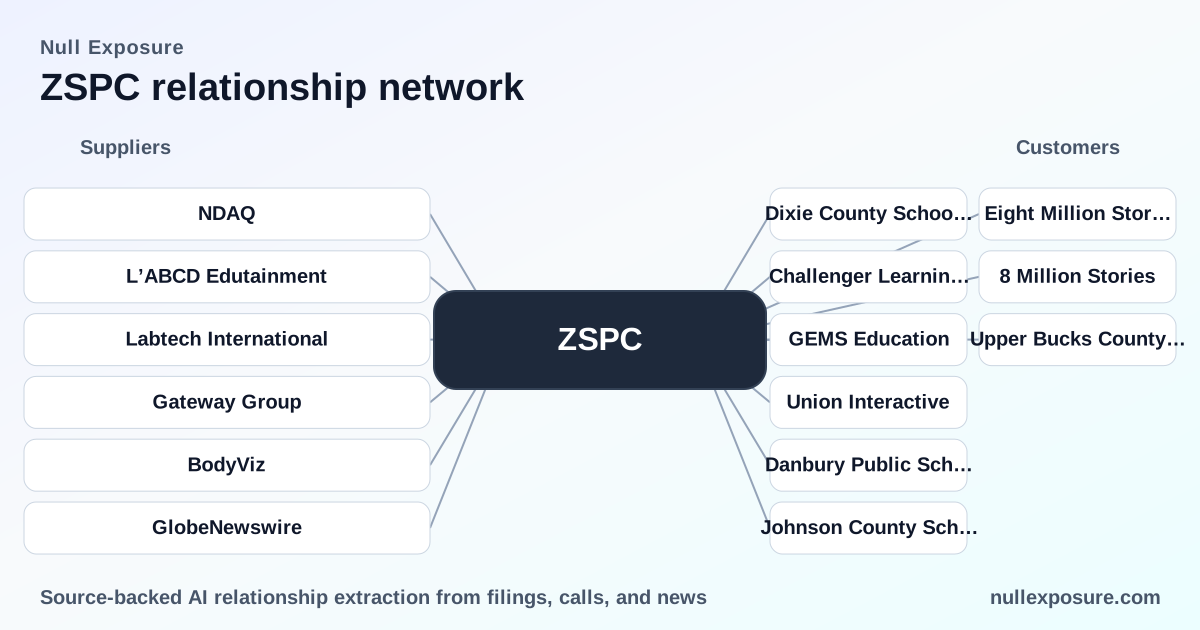
ZSPC customer relationships: where the revenue actually comes from
ZSPC (zSpace, Inc.) sells immersive AR/VR hardware and a recurring software platform into K–12 and vocational education markets, monetizing through hardware sales, multi-year software subscriptions, and implementation/professional services. Recent disclosures and press coverage show new deployments across U.S. school districts, international private-school groups and nonprofit program partners — reinforcing a business model that pairs one-time device revenue with recurring software and service contracts.
For a concise investor briefing on named customers and the company’s operating characteristics, read on. If you want the full coverage and source links, visit https://nullexposure.com/ for the complete tracker.
How ZSPC sells and how that shapes risk/reward
ZSPC’s commercial model is a three-legged stool: hardware drives initial adoption, software subscriptions drive recurring revenue, and professional services drive implementation and training revenue. Company disclosures indicate customers “generally enter into software application subscription agreements with a one-to-three-year term,” establishing a contractual posture biased toward recurring revenue with defined renewal points. The filings also show hardware, software and services split into separately reported lines, with hardware being the largest single line and software and services contributing recurring and implementation revenue respectively.
The customer base is heavily public-education centric: the company reports implementation in more than 3,500 U.S. public school districts and discloses that the majority of revenue is from U.S. public school districts. For 2024, the U.S. accounted for 88% of revenue and outside the U.S. only 12%, underlining geographic concentration in North America. Financial disclosures also note material customer concentration: one customer represented 13% of 2024 revenue and the top five accounted for ~$9.8 million, a spend band consistent with mid-market district procurement.
Key company-level constraints and operational signals:
- Contracting posture: Software subscription contracts are typically 1–3 years, creating renewal risk but visible bookings.
- Counterparty type: Predominantly government/education buyers (U.S. public school districts), which implies procurement cycles, grant funding dependence and longer sales pipelines.
- Geography: Heavy U.S. concentration (88% of 2024 revenue).
- Revenue mix: Hardware-led with meaningful software subscription and services revenues (company lists discrete hardware, software and services lines).
- Concentration: Material single-customer exposure (13% of revenue in 2024) and a top-five bucket representing mid-single-digit millions.
- Stage and maturity: Active and multi-year relationships with large districts are common, supporting retention but amplifying concentration risk.
For deeper methodology on how relationships are tracked, see the company page at https://nullexposure.com/.
Named customers and partners called out in recent disclosures
The following entries summarize every named customer or partner reported in the supplied results, each with a concise source reference.
Dixie County Schools (Florida)
Dixie County Schools invested in robotics and health applications for high school students funded by a workforce development incentive grant, deploying zSpace solutions to support career-education programming. This deployment was mentioned in the company’s 2025 Q3 earnings call. (2025 Q3 earnings call)
Challenger Learning Center (Alabama)
The Challenger Learning Center deployed zSpace to enhance elementary STEM education, with the company positioning the solution to foster STEAM/STEM interest and learning in K–12. This was disclosed on the 2025 Q3 earnings call. (2025 Q3 earnings call)
GEMS Education (Dubai)
ZSPC began deployments at GEMS Education’s flagship School of Research and Innovation in Dubai, indicating expansion into international private-school networks and supporting the company’s off-U.S. revenue base. This was referenced in the 2025 Q3 earnings call and reiterated in reporting by MarketBrief/EdWeek (Jan 2026). (2025 Q3 earnings call; MarketBrief/EdWeek, Jan 2026)
Union Interactive (Bulgaria)
Union Interactive expanded use of zSpace as part of Bulgaria’s National STEM project for K–12, a program funded by the European Union, signaling channel partner-led international rollouts. This deployment was noted on the 2025 Q3 earnings call. (2025 Q3 earnings call)
Danbury Public Schools (Connecticut)
ZSPC signed Danbury Public Schools as a new customer, a transaction reported in MarketBrief/EdWeek coverage of the company’s funding and strategic activity in January 2026. (MarketBrief/EdWeek, Jan 2026)
Johnson County School Board (Tennessee)
The Johnson County School Board approved a $20,147.12 purchase of a zSpace virtual-reality career-exploration system for a middle school, funded through a district grant (Innovative Schools Model). Local reporting documented the approved purchase in FY2026. (CitizenPortal.ai, FY2026)
Eight Million Stories, Inc. / 8 Million Stories (nonprofit partner)
ZSPC announced a partnership with Eight Million Stories (also referenced as “8 Million Stories”), integrating zSpace into nonprofit programming aimed at at-promise youth and addressing school-to-prison pipeline objectives. Multiple press releases and news wires covered the partnership in early 2026. (BayStreet/TechInsider press release; Bitget; ManilaTimes/GlobeNewswire, FY2026)
Upper Bucks County Technical School (Pennsylvania)
At Upper Bucks County Technical School, instructors transformed labs using zSpace to create immersive CTE/automotive learning environments, a case example highlighted in ZSPC marketing and press around ACTE CareerTech Vision 2025. (The Globe and Mail press release, FY2025)
What these relationships mean for investors
The mix of named customers illustrates ZSPC’s go-to-market motion: grant-funded public school purchases, district budget approvals in the low tens of thousands for pilot systems, and larger multi-site rollouts via private-school groups and channel partners internationally. That mix validates the three revenue pillars: device purchases (often one-time, grant-financed), software subscriptions (1–3 year terms), and paid services for implementation and PD.
Investor implications:
- Recurring revenue upside with renewal risk: One- to three-year subscription terms create predictable recurring revenue if renewals hold, but every renewal is a material event for revenue visibility.
- Concentration is a real risk factor: The company disclosed a single 13% customer and top-five concentration (~$9.8M in 2024), which magnifies the impact of any large-district procurement changes.
- Public-sector procurement shapes cadence: Dependence on U.S. public-school budgets and grants produces lumpiness and slower sales cycles; however, it also creates stickiness once deployments and PD are in place.
- International growth via partners: Deployments with GEMS Education and Union Interactive demonstrate a channel strategy for non-U.S. expansion, but those revenues remain a small share today (12% in 2024).
Bottom line: ZSPC’s named customers confirm a hardware-led acquisition strategy reinforced by subscription economics and services revenue, combined with material customer concentration and U.S.-centric exposure. For investors assessing growth vs. execution risk, the critical items to monitor are subscription renewal rates, concentration shifts among large customers, and the pace of international partner rollouts.
For ongoing tracking of ZSPC’s customer activity and to review source documents in one place, see https://nullexposure.com/.