ZeroStack (ZSTK) — Customer Relationships and Commercial Footprint
ZeroStack operates as a hybrid commercial operator that historically generated revenue as a manufacturer and distributor of cannabis, pharmaceutical and related consumer packaged goods, and is executing a strategic pivot that adds financial exposure to decentralized AI infrastructure through accumulation of a native token. The company monetizes through wholesale distribution, direct-to-consumer and retail channels for physical products, plus balance-sheet holdings and trading of nascent digital assets tied to its rebranding strategy. For investors, the investment thesis is therefore dual: an incumbent distribution/manufacturing revenue stream with short-term commercial contracts, and a nascent, balance-sheet-driven exposure to decentralized AI tokens.
For an up-to-date investor overview, see https://nullexposure.com/.
What ZeroStack sells, and how it gets paid
ZeroStack’s historical operating model centers on three monetization channels: manufacturing of CPG and medicinal products, wholesale distribution to large channels (pharmacies, clinics, retailers), and retail/direct-to-consumer sales. Company filings and disclosures show revenue concentrated in manufacturing and distribution activities and payment terms that are short-term in nature (payment windows generally 0–30 days, sometimes up to a few months). Financials show revenue of roughly $35.7M TTM and persistent operating losses (negative EBITDA and operating margin), indicating a business still in transition while it diversifies its balance sheet exposure. These features make the company operationally transactional, cash-cycle sensitive, and sensitive to inventory and channel execution.
Recent customer/partner move you need to know
ZeroStack bought 0G to gain exposure to decentralized AI
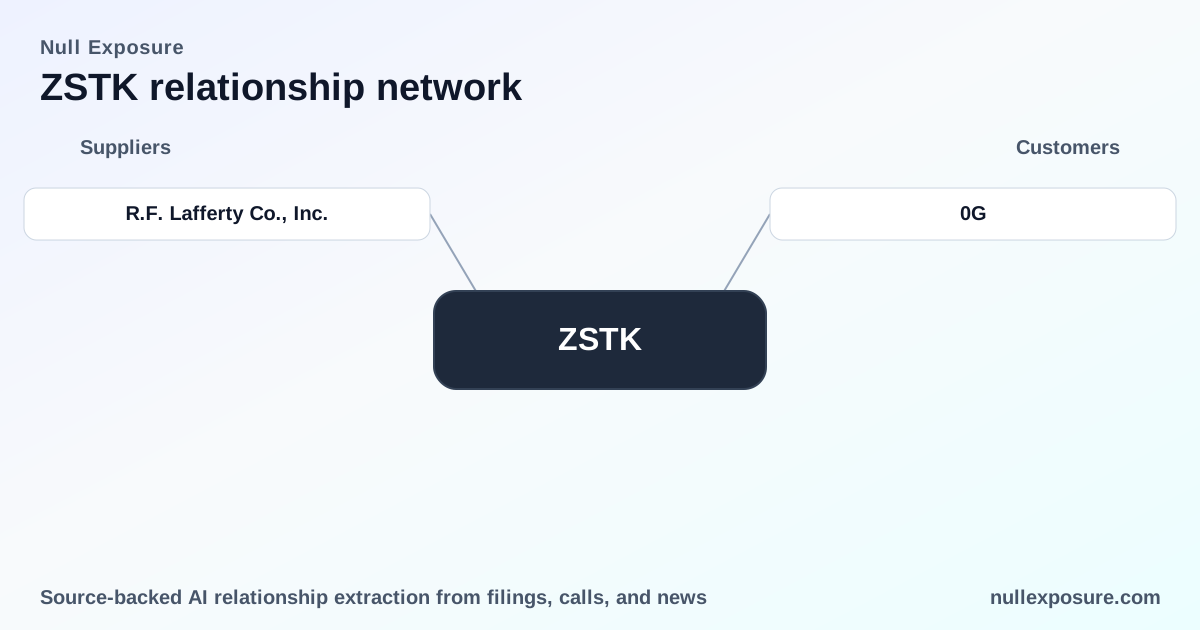
ZeroStack announced a purchase of 772,200 units of 0G at an average price of $2.59 as part of a repositioning that ties the public company to the 0G decentralized AI project. This trade converts a portion of corporate capital into a native token, reflecting a strategic tilt from pure physical goods distribution to alternative asset exposure. A press release on Newsfile dated March 10, 2026, described the transaction and the company’s rebrand activity in connection with 0G (FY2025 disclosure).
Source: Newsfile press release, March 10, 2026.
Every customer/partner relationship surfaced
- 0G — ZeroStack executed a direct purchase of 772,200 0G tokens at an average price of $2.59 as disclosed in a March 2026 company announcement tied to the company’s rebranding into ZeroStack and its exposure to decentralized AI infrastructure. Source: Newsfile press release (March 10, 2026).
Company-level relationship signals and how they affect underwriting
The available relationship constraints and filing excerpts deliver a coherent picture of how ZeroStack contracts, who it serves, and where revenues come from. Present these as company-level signals rather than tie them to the single 0G relationship:
- Contracting posture: short-term. Payment terms are routinely 0–30 days from transfer of control, sometimes stretching to a few months. This drives working capital sensitivity and requires disciplined receivables and inventory management.
- Counterparty mix: mixed individual and large enterprise exposure. The company serves individual consumers through retail and DTC channels and targets large channel distributors (pharmacies, clinics, cosmetic companies) for scale distribution.
- Geographic footprint: North America with significant EMEA distribution and global reach. Filings reference operations in the United States (Fort Lauderdale) and European distribution hubs in Germany, supporting a multi-region sales base.
- Materiality: revenue concentration is low at the customer level. Filings state that no single customer accounted for more than 10% of consolidated revenue in 2023–2024, indicating low customer concentration risk.
- Primary commercial roles: distributor and manufacturer, with reseller and seller activity as complementary channels. The company describes itself as a manufacturer and distributor of consumer-packaged and pharmaceutical products, and also operates reseller/retail channels.
- Segments: manufacturing and distribution dominate the revenue profile. The business is product-centric with distribution economics that hinge on channel access and logistics.
Collectively, these signals produce a set of operating constraints: short revenue collection cycles, multi-channel logistics complexity, and modest client concentration — a profile that supports transactional revenue stability but constrains pricing power and margin expansion absent scale or product premiumization.
Financial and strategic constraints that matter for customers and partners
ZeroStack’s financial statements show negative EBITDA and a large reported net loss per share, underlining that the company is still scaling or restructuring its margins as it executes strategic changes. The asset allocation into 0G tokens adds balance-sheet volatility and introduces exposure to token price movements that are unrelated to core product sales. Investors and counterparties should treat that exposure as a strategic pivot rather than an operating revenue generator until the company demonstrates token-related monetization beyond holding or trading.
Investment implications and risk/reward considerations
- Operational risk is driven by working capital and distribution execution. Short payment terms and multi-region logistics create exposure to inventory turn and receivable cycles.
- Concentration risk is limited. The lack of a >10% customer concentration historically reduces single-counterparty credit exposure.
- Strategic-transformation risk is elevated. Management is balancing legacy manufacturing/distribution operations with a new balance-sheet allocation to decentralized AI tokens; that trade-off increases short-term volatility in reported results.
- Market valuation is bargain-priced but volatile. Small market capitalization, negative earnings, and a high beta imply upside for a successful pivot and downside if the balance-sheet token allocation underperforms or if distribution margins compress.
For underwriting counterparties, treat ZeroStack as a transactional distributor with conservative payment enforcement and a need for short cash-conversion cycles. For equity investors, the security combines an operating business with an explicit speculative bet on a decentralized AI token.
Next steps for analysts and operators
- Review recent 10-K/10-Q disclosures for working capital schedules and token accounting policies to quantify balance-sheet volatility. Company filings from 2023–2024 already document payment terms and geographic distribution centers.
- Monitor trading and disclosure around the 0G holdings for changes in realized gains/losses or monetization plans.
- Validate distribution contracts with large channel partners cited in filings to confirm shelf-space and margin terms.
Explore further context and ongoing relationship monitoring at https://nullexposure.com/.
Bottom line
ZeroStack is a distribution-first company that is deliberately diversifying into decentralized AI exposure via balance-sheet token accumulation. Its operating model is short-cycle, geographically diversified, and historically low in customer concentration, but the firm is currently loss-making and carries additional market risk tied to its new token holdings. Investors should underwrite both the execution risks of the distribution business and the market risk of token exposure when evaluating ZSTK.