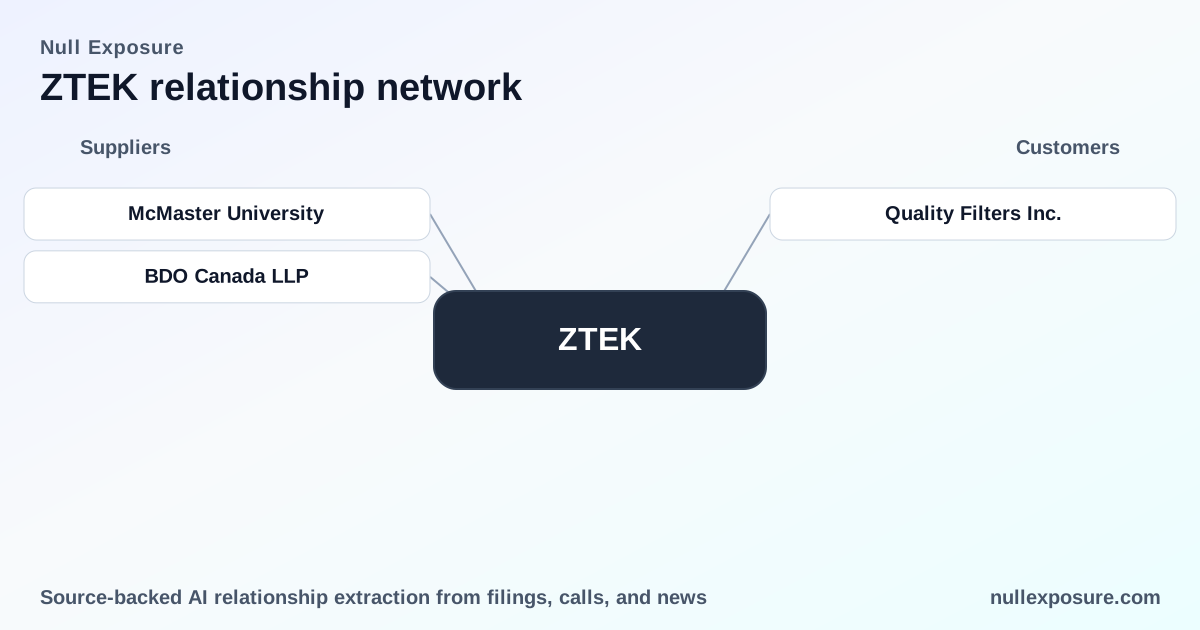
ZTEK customer relationships: pilot engagements, government validation, and early commercial traction
ZEN Graphene Solutions Ltd (ZTEK) operates as a materials-technology company commercializing high-purity graphene products and related intellectual property across environmental remediation, energy storage, and advanced manufacturing, and through its subsidiary Triera Biosciences in biotech applications. The company monetizes by licensing proprietary materials, selling engineered graphene media to OEMs, and pursuing government R&D contracts that de-risk product development and enable follow-on commercial sales. For investors, the current revenue base is small and episodic; value creation will depend on converting pilot programs and government awards into recurring OEM or licensing revenue.
For direct investor resources visit https://nullexposure.com/.
A compact investor snapshot: how ZTEK's operating profile shapes customer risk
ZTEK is an early-commercialization company with $0.94M trailing twelve-month revenue, negative EBITDA, and a market capitalization (~$53.5M), reflecting a classic technology commercialization valuation where optionality and future licensing matter more than current cash flow. Institutional ownership is low (roughly 1.8%), insiders hold a modest stake (~5.5%), and operating margin is deeply negative, pointing to concentration of execution risk at the commercialization stage rather than demand shortfall. Contracting behavior observed in public reporting tilts toward pilot evaluations and government-sponsored development, not large-scale manufacturing agreements. That posture makes partner conversion rates and proof points the primary levers for near-term valuation re-rating.
Customer relationships: what the public record shows
The following section covers every customer relationship noted in available public references and summarizes the practical commercial implication of each engagement.
Quality Filters Inc. — pilot evaluation program (March 2026)
ZTEK announced the initiation of a pilot evaluation program with Quality Filters Inc., a U.S. HVAC and industrial air filtration manufacturer, to test ZTEK’s proprietary air-filtration media for integration into commercial product lines. This is a pilot-stage OEM evaluation that, if successful, can lead to product adoption across Quality’s commercial channels. (Accesswire release, March 10, 2026.)
TKC / Turkcell — 5G + Wi‑Fi 7 fixed wireless access collaboration (May 2026)
Public reporting references a collaboration involving Turkcell and ZTE/Netas to add a 5G + Wi‑Fi 7 fixed wireless access solution into Turkcell’s 5G Superbox ecosystem, signaling ZTE (through the ZTE/Netas alliance) as a technology supplier in telecom product rollouts; this represents channel-level exposure to telecom OEM deployment cycles rather than direct ZTEK product sales. (SimplyWallStreet community update referencing May 4, 2026 coverage.)
TV / Grupo Televisa — MVNO service relaunch using ZTE technology (FY2025 reporting)
Earnings call commentary for Grupo Televisa noted the relaunch of a new MVNO service developed by ZTE, delivering an upgraded user experience for end customers and indicating ZTE’s role as a solutions provider in telecom services architectures. This reference highlights technology-for-service arrangements where ZTE provides platform capability that supports a telco’s customer-facing offerings. (InsiderMonkey transcript reference, FY2025.)
Innovative Solutions Canada (ISC) — Triera Biosciences government contract (FY2026)
ZTEK’s subsidiary Triera Biosciences completed a Government of Canada contract through the Innovative Solutions Canada (ISC) program, advancing Triera’s platform toward new candidate development; this is a government-sponsored validation and R&D milestone that strengthens Triera’s development pathway and provides non-dilutive funding for product maturation. (TradingView / TMX newsfile, May 4, 2026.)
How these relationships map to the business model and operating constraints
The public relationship set conveys a pilot- and validation-centric contracting posture: engagements are largely evaluation programs, platform development for third parties, and government R&D awards rather than long-term supply contracts. Because the constraints inventory in the public record contains no explicit contractual covenants or exclusivity clauses, treat the following as company-level signals rather than relationship-specific facts:
- Commercial maturity is early. The mix of pilots and government R&D indicates the company is in the scale-up and validation phase rather than mass production. This elevates execution risk and makes conversion metrics (pilot → purchase orders; ISC milestones → paid milestones or licensing) the critical performance indicators.
- Revenue concentration and scale risk are present. With sub-$1M annual revenue and negative operating margins, ZTEK depends on a small number of advancement events (pilot wins, government contract completions) to generate meaningful recurring revenue.
- Customer criticality is limited today. Pilot status implies partners can test alternative technologies; therefore, ZTEK’s current solutions are complementary rather than presently mission-critical to partner operations.
- Valuation reflects optionality, not stable cash flow. High price-to-sales and EV-to-revenue ratios reflect investor pricing of future commercialization rather than current business economics.
- Low institutional ownership signals informational inefficiency and activist opportunity. Low institutional coverage often translates to a higher volatility profile around news flow and milestones.
For a deeper look at how these relationship dynamics inform investment decisions, visit https://nullexposure.com/.
Investor implications — what to watch next
- Milestone conversion cadence: Track announcements that convert pilots into commercial purchase orders or licensing deals, and ISC contract completion certificates that trigger follow-on revenue.
- Customer diversification: A single OEM win in filtration or a repeatable telco deployment would materially de-risk the revenue profile.
- Cash runway and funding pathway: With negative EBITDA, watch capital raises, grant receipts, or licensing payments that fund scaling of production or commercialization.
- Governance and insider alignment: Insider ownership levels and board composition will influence strategic execution and potential M&A or licensing negotiations.
- Proof points from telco deployments: The ZTE/Netas and MVNO references provide route-to-market evidence in telecom ecosystems; commercial uptake there would validate platform scalability beyond materials markets.
Bottom line
ZTEK’s public customer footprint consists of pilot-stage OEM evaluations, technology-for-service arrangements in telecom, and government R&D awards, collectively painting a company advancing from lab to market through discrete validation events. Investment thesis depends on execution — specifically, the conversion of pilots and government milestones into recurring revenue and licensing flows. Monitor conversion announcements, funding milestones, and any movement from pilot status to long-term supply or licensing contracts as the principal catalysts for re-pricing.