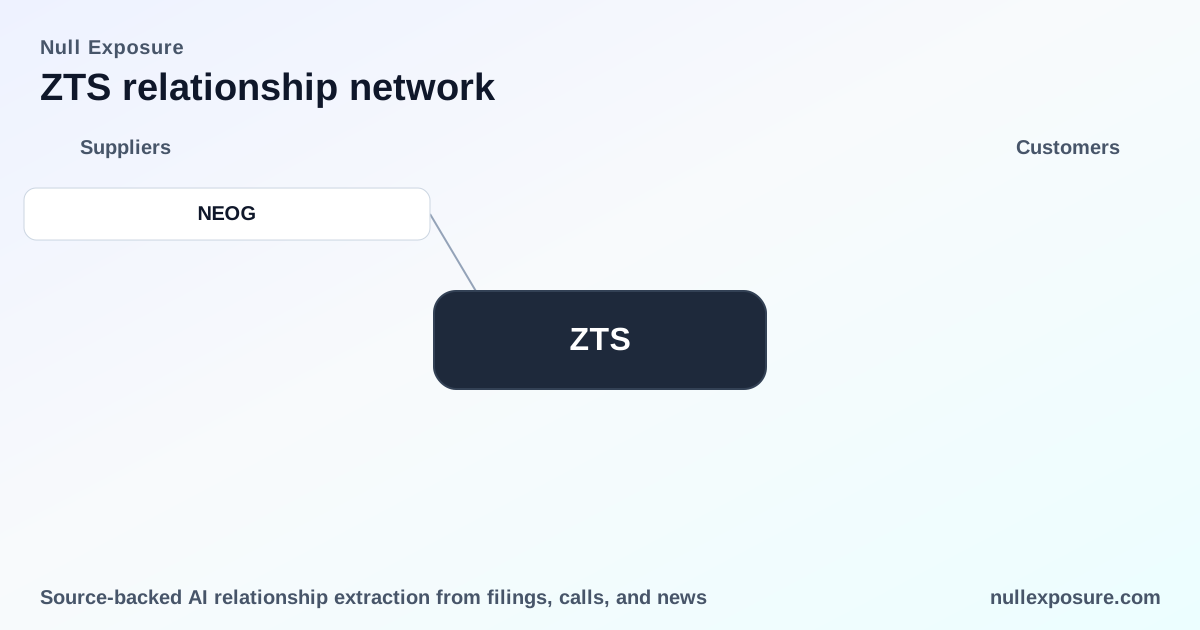
Zoetis (ZTS): How customer relationships drive durable animal-health cash flow
Zoetis is the global leader in animal pharmaceuticals and vaccines, monetizing through direct product sales to veterinarians and livestock producers, distribution channels that resell into clinics and farms, and a small contract-manufacturing business. The company’s revenue mix is geographically diversified but still weighted to the U.S. (54% of 2025 revenue), and its operating model relies on repeatable commercial relationships with veterinary networks and large-scale livestock customers. For investors tracking customer risk, the key vectors are channel concentration (distributors and veterinarians), geographic exposure, and the strategic reallocation of product lines such as medicated feed additives. Explore more company relationship intelligence at https://nullexposure.com/.
What to watch in Zoetis’s customer franchise
Zoetis’s commercial model is straightforward: product-led revenue with a sales force that promotes to veterinarians and livestock producers, supported by third‑party distributors and retail outlets. That structure creates three investor-relevant characteristics:
- Contracting posture and channel structure: Zoetis sells both directly and through third‑party distributors and resellers, which means revenue recognition and margin profiles vary by channel. The company recognizes revenue when title passes, typically at shipment.
- Customer concentration and geography: The U.S. is a dominant single-market contributor (54% of 2025 revenue), but Zoetis sells in more than 100 countries and directly markets in roughly 45, indicating broad international reach offset by U.S. concentration.
- Criticality and maturity: As an incumbent market leader, Zoetis benefits from entrenched veterinary relationships and scale in livestock segments; its Client Supply Services contract manufacturing represents a minor, but strategic, revenue line (~1% in 2025).
Together these signals describe a mature, recurring-revenue commercial engine with predictable counterparty dynamics: veterinarians and distributors are primary revenue conduits; large livestock customers are important direct buyers; and third-party manufacturing is ancillary.
All observed customer relationships in the record
Below are every relationship result returned for ZTS’s customer scope. Each entry is summarized in plain English with the source cited.
PAHC — 2025 Q4 earnings call (pahc-2025q4-earnings-call)
Phibro reported that its medicated feed additive (MFA) and related portfolio, after integrating the Zoetis MFA assets, grew 77% in the fourth quarter — a direct performance metric tied to the Zoetis-originated business. This was disclosed in Phibro Animal Health’s Q4 earnings call transcript in March 2026 (earnings call, March 2026).
PAHC — Sahm Capital analysis (April 4, 2026)
A Sahm Capital note highlighted that Phibro’s integration of the Zoetis medicated feed additive business and an expanding vaccines franchise are shifting Phibro toward higher‑value products and broader international reach, reflecting the commercial significance of the Zoetis-originated MFA assets. (Sahm Capital commentary, April 4, 2026: "Is strong Q2 results…PAHC".)
PAHC — Sahm Capital valuation note (February 10, 2026)
A separate Sahm Capital valuation piece argued that Phibro’s recent growth is heavily dependent on the integration of the acquired Zoetis MFA business and related cost synergies, and it characterized those synergies as non-repeatable drivers of near-term earnings. (Sahm Capital valuation analysis, February 10, 2026.)
PAHC — Sahm Capital report on insider moves (March 18, 2026)
Sahm Capital connected Phibro’s operational programs (including "Phibro Forward") and insider activity to performance that is supported in part by the acquisition of Zoetis’ MFA business, indicating the Zoetis transaction is a material operational lever for Phibro. (Sahm Capital report, March 18, 2026.)
Phibro Animal Health — Sahm Capital reposting (April 4, 2026)
A repeat Sahm Capital item on April 4, 2026 reiterated that Phibro’s business mix is shifting due to the Zoetis MFA integration and vaccine expansion, underscoring the consistency of market commentary around the same underlying transaction. (Sahm Capital commentary repost, April 2026.)
What these relationships imply for Zoetis investors
The collection of records shows a transfer of a specific product franchise (medicated feed additives) from Zoetis to Phibro, and that transfer is now a visible growth vector for Phibro. For Zoetis shareholders this produces several concrete effects:
- Product-line reallocation: Divesting or transferring the MFA business reduces Zoetis exposure to that product category but also removes associated revenue and cost base; investors must track whether displaced revenue is redeployed into higher-margin vaccines and companion-animal lines.
- Channel and counterparty dynamics: Zoetis operates across direct sales, distributors/resellers, and retail/e‑commerce, so lifecycle and margin effects from product transfers play out differently across channels—distributors can reprice or shift inventory strategies quickly while veterinarians preserve clinical loyalty.
- Geographic and concentration risk: Zoetis’s U.S. weighting (54% of 2025 revenue) combined with direct marketing in ~45 countries and sales into 100+ countries creates global diversification but retains single‑market sensitivity; changes to a business line can have asymmetric regional impacts.
- Scale and maturity advantages: As a market leader with high operating margins and recurring veterinary relationships, Zoetis can absorb portfolio moves at scale, but investors should watch execution on redeployment and margin retention.
Key takeaways for portfolio and operating decisions
- Zoetis is predominantly a seller to veterinarians and livestock producers, and also relies on third‑party distributors and resellers—those channels are the commercial heartbeat of the business.
- The MFA carve‑out to Phibro is material enough to be referenced repeatedly in sell‑side and corporate commentary, signaling that Zoetis’s product-line reshaping is consequential for competitor economics and industry structure.
- Geographic breadth tempers single‑market concentration, but U.S. exposure remains the single largest regional risk to revenue variability.
- Contract manufacturing (Client Supply Services) is strategically present but economically modest (~1% of revenue as of 2025).
If you need a focused customer-risk mapping for ZTS — showing counterparty roles, channel concentration, and recent transaction effects — visit https://nullexposure.com/ for tailored exposure reports and relationship analytics.
Bold, transaction-driven changes like the MFA transfer are a lens through which to assess future margin trajectory and competitive positioning; investors should prioritize channel-level revenue trends and management commentary on redeployment of capital and product focus.