ZVRA: How customer agreements and the March 2026 SDX sale reshape revenue risk
Zevra Therapeutics operates as a commercial-stage rare-disease biopharma that monetizes through product sales (notably OLPRUVA and MIPLYFFA), licensing arrangements, royalties and one-off asset dispositions. The company sells finished product into the U.S. channel (mostly through a single specialty pharmacy purchaser), earns license and milestone proceeds from collaborations, and recently crystallized value by selling its serdexmethylphenidate (SDX) portfolio — including AZSTARYS® and KP1077 — to Commave Therapeutics for $50 million. For investors and operators, the combination of concentrated commercial relationships and punctuated licensing exits defines both the cash runway and the revenue profile going forward.
For monitoring customer-concentration and counterparty shifts, see our coverage at https://nullexposure.com/.
The Commave relationship — from license in filings to a cash sale in 2026
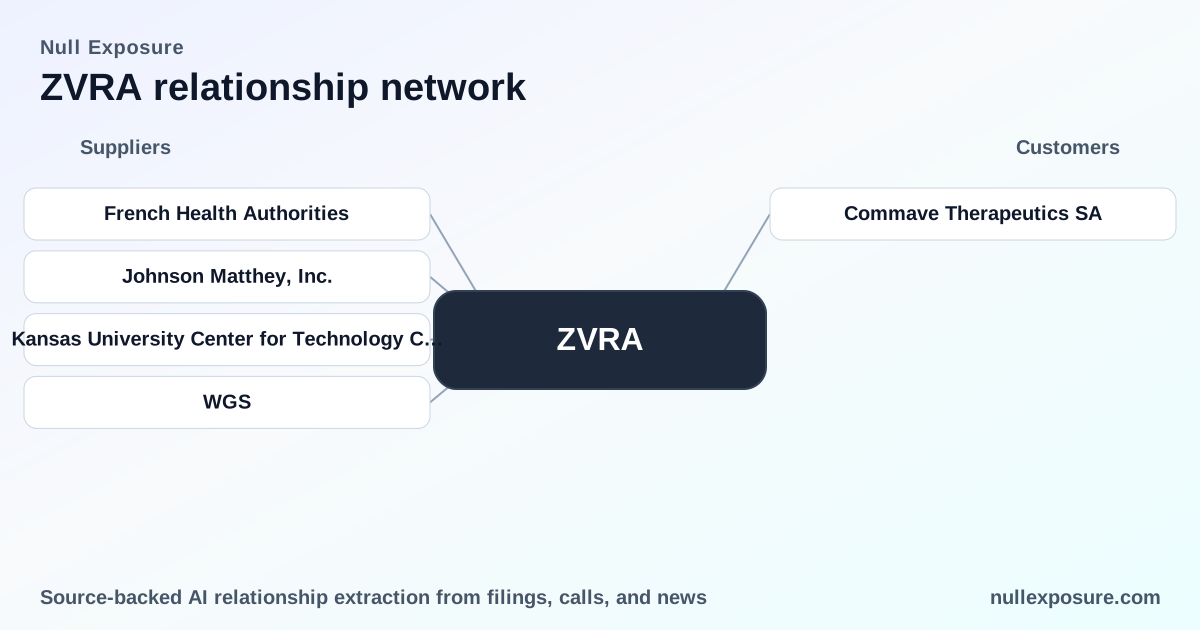
Zevra’s public record shows a multi-stage relationship with Commave Therapeutics SA that moved from a licensing arrangement to an outright portfolio sale. According to Zevra’s FY2024 Form 10‑K, the company documented a Collaboration and License Agreement (the AZSTARYS License Agreement) with Commave (then Boston Pharmaceutical S.A.), establishing a contractual relationship around the SDX assets. A cluster of press releases and media reports in March 2026 then confirmed a strategic shift: Zevra sold the SDX portfolio, including AZSTARYS and KP1077, to Commave for $50 million, converting licensing rights and contingent economics into upfront cash (company press releases and media coverage, March 2026).
Visit https://nullexposure.com/ for continued mapping of customer and counterparty events.
Exhaustive list of relationship entries in the record
- Zevra’s FY2024 Form 10‑K records that the company entered into a Collaboration and License Agreement (the AZSTARYS License Agreement) with Commave Therapeutics SA (formerly Boston Pharmaceutical S.A.), establishing a formal commercial/legal relationship. Source: Zevra FY2024 10‑K filing (filed as zvra-2024-12-31).
- A Manila Times TMT/GlobeNewswire report (March 16, 2026) states that Commave will purchase Zevra’s SDX portfolio, including AZSTARYS and KP1077, for $50 million, highlighting the headline terms of the transaction. Source: ManilaTimes (Mar 16, 2026) referencing GlobeNewswire release.
- A GlobeNewswire release (published March 20, 2026) announcing an inducement grant to a new CFO also repeated that Zevra sold the SDX portfolio to Commave for $50 million, reflecting the company’s disclosure cadence around the sale. Source: GlobeNewswire (Mar 20, 2026).
- A second GlobeNewswire post (March 16, 2026) carried the company announcement that Zevra sold the SDX portfolio to Commave for $50 million, the primary corporate press release for the transaction. Source: GlobeNewswire (Mar 16, 2026).
- A Bitget news summary (March 2026) relayed the same transaction headline: Commave will acquire the SDX portfolio from Zevra for $50 million, showing syndication of the press release across financial news aggregators. Source: Bitget news (Mar 2026).
- An alternate GlobeNewswire posting (March 16, 2026, duplicate distribution) again communicated the $50 million sale of the SDX portfolio to Commave, consistent across Zevra disclosures. Source: GlobeNewswire (Mar 16, 2026).
- A GlobeNewswire note tied to Zevra’s Q1 2026 financial results cadence (April 22, 2026) summarized the corporate messaging that Zevra sold the SDX portfolio to Commave for $50 million, indicating the company reiterated the transaction during investor communications. Source: GlobeNewswire (Apr 22, 2026).
- Yahoo Finance syndication published the press release content, stating Commave will acquire Zevra’s SDX assets (AZSTARYS, KP1077) for $50 million, confirming broad market dissemination. Source: Yahoo Finance (Mar 2026).
- SimplyWall.St entries (aggregator pages) recorded the acquisition news and characterized the transaction as Commave acquiring Zevra’s serdexmethylphenidate portfolio for $50 million, reflecting retail- and research-facing summaries of the same deal. Source: SimplyWall.St (Mar–Apr 2026).
Each entry in the public record points to the same legal and commercial effect: Zevra transitioned SDX portfolio rights to Commave and received $50 million in consideration, while earlier SEC filings documented the licensing framework that governed those assets.
What the Commave deal changes for Zevra’s revenue and risk profile
- Immediate liquidity boost: The $50 million sale converts a revenue stream (royalties/milestones/licensing economics) into upfront cash, improving short-term liquidity and potentially funding commercialization of other core products.
- Revenue mix shift: With the SDX assets transferred, future top-line will rely more heavily on OLPRUVA and MIPLYFFA commercial performance, specialty pharmacy channel sales, and any remaining licensing arrangements.
- Operational simplification: Divesting SDX reduces product management complexity and regulatory obligations for those assets, permitting tighter allocation of commercial resources toward remaining core products.
- Loss of potential upside: The sale caps future upside from SDX if those assets scale under Commave; investors trade asymmetric future royalty upside for certain near-term cash.
Company-level constraints that shape customer dynamics
Zevra’s filings and disclosures reveal structural constraints that define how customer relationships convert into revenue and risk:
- Geographic concentration (U.S.-centric commercialization): The company reports that all revenues from OLPRUVA and MIPLYFFA are U.S.-derived, and that commercialization investments are focused on domestic marketing, sales and distribution — a signal that international diversification is limited. This is a company-level operating signal, not tied to any single counterparty.
- Government procurement posture: Zevra participates in a program that requires products be available under an FSS contract with U.S. federal agencies and priced at or below the Federal Ceiling Price for covered purchasers (VA, DoD, PHS, U.S. Coast Guard). That commitment establishes a regulated pricing constraint when selling to government purchasers.
- Customer concentration (single specialty pharmacy buyer): Filings explicitly state the company’s current single commercial customer is a specialty pharmacy provider, which creates concentrated counterparty risk for product revenue.
- Role flex between buyer and seller: Corporate disclosures show Zevra operates as a seller of approved products and a licensor of IP, while also recording buyer interactions in procurement contexts; this dual posture affects negotiation leverage and pricing flexibility.
- Core-product revenue dependency: Company statements group product sales of OLPRUVA and MIPLYFFA — plus reimbursements and license proceeds — as the primary revenue drivers, indicating core-product dependency rather than a broad diversified commercial base.
Risk/return calibration for investors and operators
- Key upside: The $50M sale reduces near-term financing pressure and funds core product commercialization; that liquidity is a catalyst for execution on OLPRUVA and MIPLYFFA.
- Key risks: Customer concentration (single specialty pharmacy) and U.S.-only revenue create single-point vulnerabilities to reimbursement or payer shifts; government pricing obligations impose downward pricing pressure in the public-pay channel.
- Operational focus: Management’s priorities should include building diversified distribution channels, expanding payer coverage, and replacing the economic potential ceded by the SDX sale through higher-margin sales or new licensing deals.
What to watch next
- Monitor Zevra’s disclosure on the use of proceeds from the Commave transaction and whether proceeds fund commercial expansion or R&D.
- Track specialty pharmacy billing and revenue cadence in upcoming quarterly filings to assess whether concentration risk is increasing or being mitigated.
- Watch for announcements of new licensing or commercialization partners that offset the SDX transfer’s long-term revenue forfeiture.
For a consolidated view of customer relationships and counterparty events across healthcare issuers, visit https://nullexposure.com/.
Bold takeaway: Zevra converted uncertain future SDX economics into $50 million in cash while concentrating future revenue exposure on a handful of U.S. commercial channels — a trade that materially reshapes both runway and revenue risk.