Zhengye Biotechnology (ZYBT): Customer concentration and capital signals that drive valuation
Zhengye Biotechnology (ZYBT) is a small-cap specialty drug manufacturer that monetizes through commercial sales of biopharmaceutical products and licensed offerings to large agricultural and healthcare customers, supported by periodic capital raises. The company generates revenue from product sales (Revenue TTM $153.7M) and sustains R&D and scale-up through equity financings; its market capitalization (≈ $47.2M) and recent underwriting activity are material inputs for an investor view of upside versus execution risk.
For further company-level background and document access, see https://nullexposure.com/ for consolidated evidence and reporting.
How Zhengye operates and where the economics come from
Zhengye positions itself as a developer and manufacturer of specialty and generic biologics with a commercial footprint in animal health and human therapeutics. Revenue is realized primarily through product sales—the company reported Revenue TTM of $153.7 million and Gross Profit TTM of $57.46 million, indicating commercial scale in at least a subset of its product lines. Profitability metrics remain negative: Diluted EPS TTM is -$0.23 and Operating Margin TTM is -46.3%, reflecting continued investment and cost pressure. Market capitalization and capital structure show a company still in the transition from development toward sustained profitability: market cap ~$47.15 million with a modest institutional ownership of 2.10%.
Key balance and market facts that shape valuation and risk:
- Commercial revenue base exists but growth is weakening (Quarterly Revenue Growth YOY -34.4%).
- Profitability is not yet established (Profit Margin -12.6%; EBITDA negative).
- Liquidity and investor participation are limited (Shares Outstanding 47.39M; Shares Float 4.42M; low institutional stake). These metrics define a business that generates meaningful top-line but trades with small-cap illiquidity and execution risk.
Customer and capital relationships that matter
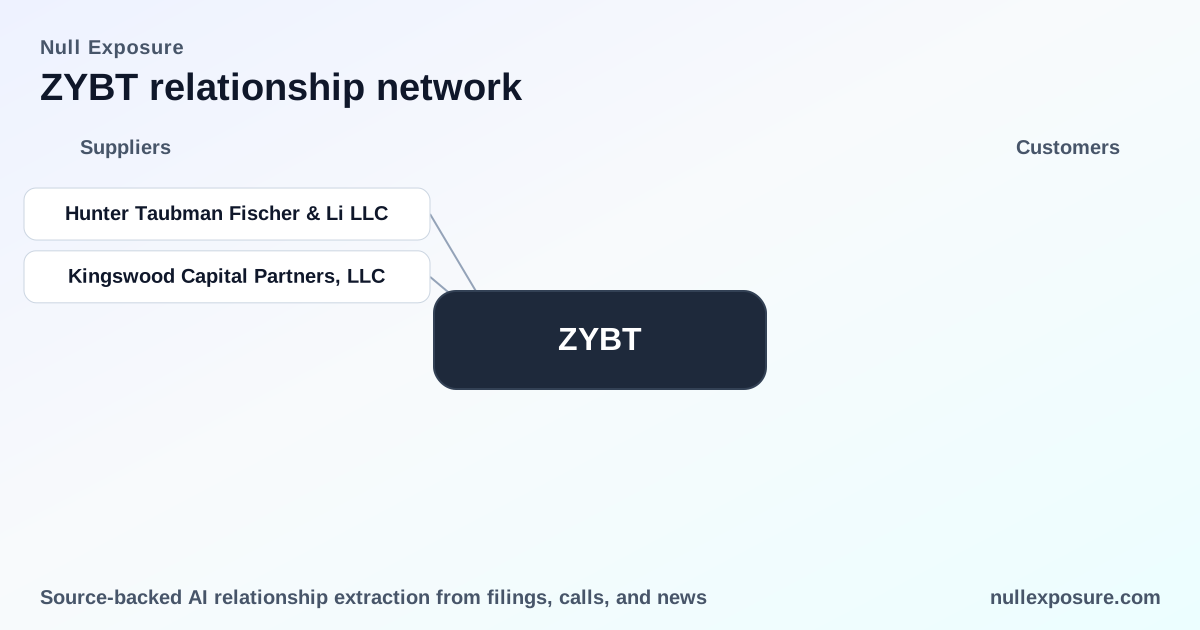
Kingswood Capital Partners, LLC — underwriting follow-on activity
Kingswood Capital Partners acted as representative of the underwriters for Zhengye’s offering and exercised the full over-allotment option to buy 225,000 ordinary shares at $4.00 per share on January 14, 2025, which reduced immediate supply pressure and indicates underwriter support for the transaction pricing. Source: PR Newswire release republished by The Manila Times (July 3, 2025): https://www.manilatimes.net/2025/07/03/tmt-newswire/pr-newswire/zhengye-biotechnology-holding-limited-announces-fiscal-year-2024-financial-results/2143300
Muyuan Foods — largest commercial customer (agricultural end-market)
Zhengye’s largest customer is identified as Muyuan Foods (002714.SZ), the world’s second-largest hog farmer, and reporting shows that Muyuan experienced an 11.2% revenue decline in 2023 and swung to a loss of RMB 4.17 billion—an outcome that constrains end-demand dynamics for suppliers. The connection to Muyuan highlights customer concentration and exposure to agricultural commodity cycles. Source: analysis and reporting in The Bamboo Works (coverage of Zhengye’s IPO and customer profile): https://thebambooworks.com/zhengye-biotechs-pet-sized-ipo-leaves-plenty-of-room-for-more-fundraising/
Structural signals and operating model constraints
Zhengye’s company-level signals define its contracting posture, concentration, criticality, and maturity profile:
-
Contracting posture — transactional with large customers and capital markets reliance. The underwriting over-allotment exercised by Kingswood is evidence of capital markets dependency to fund growth and operations, rather than internal free cashflow sufficiency. That underwriting support completed an equity transaction priced at $4.00 per share in early 2025.
-
Concentration — customer-level risk is material. The explicit identification of Muyuan Foods as the largest customer is a direct concentration signal: a meaningful portion of commercial revenue is linked to a single large buyer in the agricultural sector, exposing Zhengye to cyclical demand and margin pressure when its customer suffers a downturn.
-
Criticality — supplier position is significant but not exclusive. Zhengye supplies product lines relevant to large agricultural operators; that relationship establishes commercial importance but not documented exclusivity. This creates predictable purchasing cycles but limited pricing leverage against a giant customer.
-
Maturity — commercial but fragile. Financials show meaningful revenue scale (>$150M) but negative earnings and falling quarterly revenue, consistent with a company in commercial expansion but still dependent on capital markets and concentrated customers to sustain growth.
No formal third-party constraints or contractual restrictions were flagged in the examined records; the absence of disclosed constraints in the available relationship scope is itself a company-level signal indicating that documented external covenants or named contractual restrictions were not present in the reviewed relationship data.
Investment implications: what investors and operators should watch
Zhengye’s value proposition is straightforward: commercial revenue combined with an addressable pipeline offers upside if the company converts scale into sustainable margins. The primary risks and opportunities resolve around two themes:
- Concentration exposure: Muyuan’s financial stress translates into demand risk for Zhengye—diversifying the customer base or deepening product attachment will materially reduce headline volatility.
- Capital dependence: underwriting activity (Kingswood’s over-allotment) demonstrates market support but also dependence on equity issuance to fund growth; future dilutive financings will be valuation-sensitive.
Practical watcher list for investors and managers:
- Track quarterly revenue mix and the percentage of sales attributable to Muyuan to quantify concentration risk.
- Monitor cash runway and any new or recurring underwriting or financing events; underwriter exercises are near-term liquidity signals.
- Assess gross margin stability and whether R&D and SG&A trends compress operating losses toward breakeven.
For a consolidated view of filings, relationship evidence, and ongoing monitoring tools, visit https://nullexposure.com/ to access curated documents and source links.
Bottom line: concentrated commercial strength with capital-market dependence
Zhengye runs a commercially validated but concentrated business that is still finding a stable profit model. Customer concentration (Muyuan) and recent underwriting activity (Kingswood) are the two proximate drivers of near-term revenue volatility and financing needs. Investors should value Zhengye on a scenario basis: upside tied to customer diversification and margin recovery, downside dictated by continued top-line contraction and the need for dilutive capital. Operators should prioritize broader commercial channels and cash preservation while leveraging underwriting relationships only as bridge capital.