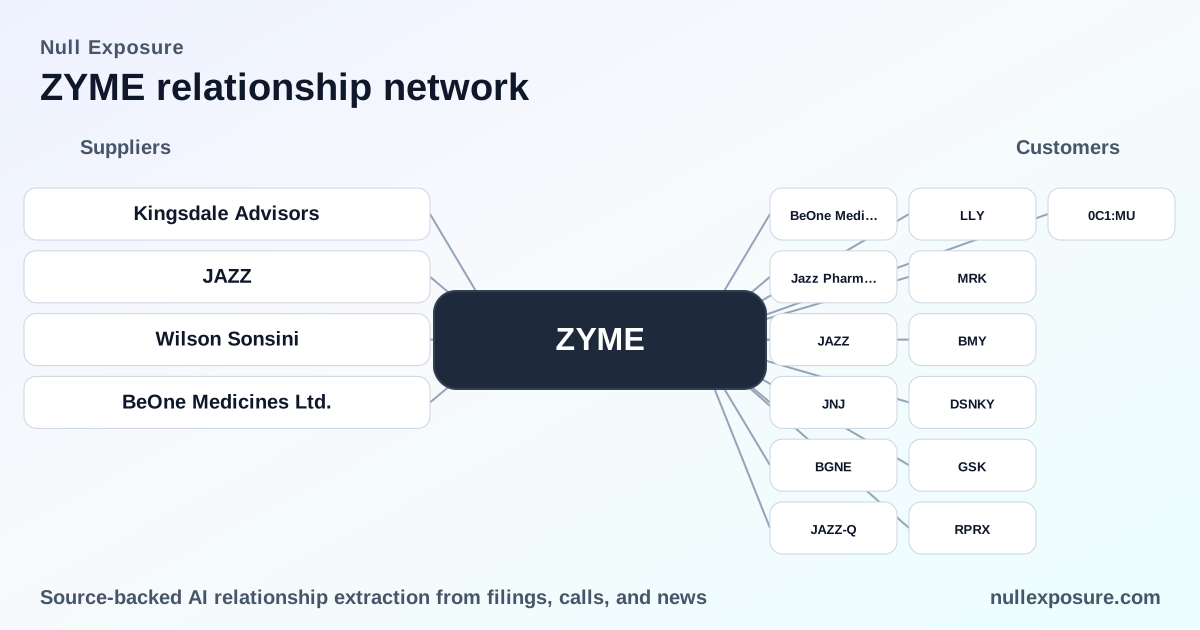
Zymeworks (ZYME): Partnership Map and Revenue Signals for Investors
Zymeworks operates as a platform biotech: it discovers and engineers bispecific and multispecific therapeutic antibodies, then monetizes through licensing deals, development and drug‑supply contracts, milestone receipts, and tiered royalties, supplemented by strategic non‑recourse royalty financing. The company’s near‑term cash flow profile is dominated by a small set of large pharma partners that drive milestone and drug‑supply revenue, while the long‑term upside is carried in contingent commercial royalties on products out‑licensed from its Azymetric platform. For a concise feed of relationship intelligence and historical filing excerpts on Zymeworks, visit https://nullexposure.com/.
How the business actually generates cash — and what that implies for investors
Zymeworks’s operating model is licensing‑centric: it transfers development and commercialization rights to partners in exchange for upfront fees, development support and drug supply revenue, discrete development and regulatory milestones, and tiered royalties on net sales. That structure produces lumpy, partner‑driven revenue, with drug‑supply and development support recognized when services are delivered (not when long‑tail royalties ultimately convert). The financing posture is non‑dilutive and asset‑backed: Zymeworks monetized future royalties via a royalty‑backed note with Royalty Pharma for $250 million, preserving equity while pledging revenue streams as collateral. These characteristics imply concentration risk (few partners account for most booked revenue), high counterparty criticality (partners control development and commercialization decisions), and revenue maturity tied to regulatory and clinical milestones rather than recurring product sales today.
Partnership roll call: every customer relationship in the record
Below is a plain‑English, investor‑oriented summary for each relationship surfaced in public filings and news excerpts in the dataset. Each line cites the document or press coverage supporting the statement.
BeOne Medicines / BeOne / BeOne Medicines Ltd.
BeOne is a commercial partner for Ziihera (zanidatamab) in Asia, and Zymeworks has received royalties tied to Ziihera sales by Jazz and BeOne, including a reported $1.0 million royalty in Q3 2025. Source: Zymeworks Q3 2025 earnings call and FY2026 corporate update (Q3 2025 earnings call; Globenewswire FY2026 release).
Jazz Pharmaceuticals Ireland Limited / Jazz Pharmaceuticals Ireland Ltd. / Jazz Pharmaceuticals / Jazz Pharmaceuticals plc / Jazz / JAZZ / JAZZ-Q
Jazz holds exclusive development and commercialization rights for zanidatamab across major territories outside Asia, has paid development support and drug‑supply revenue (e.g., $19.228M recognized in FY2024) and is contractually responsible for global development outside Asia—Zymeworks is entitled to tiered royalties of roughly 10% to the high teens up to $2B and 20% above $2B under the Jazz agreement. Source: Zymeworks FY2024 10‑K; PR news release and FY2025–FY2026 company disclosures.
Johnson & Johnson / J&J / JNJ / Johnson & Johnson Innovative Medicine (J&J)
J&J is a collaboration partner that licensed pasritamig (a KLK2‑targeting bispecific engineered on Zymeworks’ Azymetric platform); Zymeworks recognized a $25 million development milestone in Q3 2025 tied to clinical progress, and remains eligible for additional development and commercial milestones plus royalties up to the amounts disclosed in its FY2026 update. Source: Zymeworks Q3 2025 earnings call and FY2026 Globenewswire press release.
BeiGene / BGNE
BeiGene holds rights in certain Asia/Pacific territories under prior agreements and, under current disclosures, Zymeworks is eligible for tiered royalties on BeiGene’s sales of zanidatamab (reported tiers span mid‑single to mid‑double digits up to defined thresholds). Source: PR materials and company Q4 2025 disclosures cited in FY2024–FY2026 summaries.
Royalty Pharma / RPRX
Zymeworks executed a royalty‑backed financing agreement with Royalty Pharma that provides $250 million of non‑recourse capital secured by future royalty streams, leaving other future royalty streams (e.g., potential J&J royalties) unencumbered per the company’s disclosure. Source: Q4 2025 earnings call transcript and press releases.
Bristol‑Myers Squibb / BMS / BMY
BMS is listed among collaboration partners where options and milestones were exercised in 2025; exercise of options and clinical/regulatory milestones with partners including BMS materially drove year‑over‑year revenue growth. Source: Globenewswire FY2026 company release.
GSK
GSK is a collaboration partner referenced in Zymeworks’ FY2026 results where clinical/regulatory milestones and option exercises across partners (including GSK) contributed to revenue growth for the year. Source: Globenewswire FY2026 release.
Daiichi Sankyo / DSKYF / DSNKY
Daiichi Sankyo is identified among partners whose option exercises and milestone events materially contributed to Zymeworks’ FY2026 revenue increase. Source: Globenewswire FY2026 release.
Merck / MRK
Historical industry coverage notes Zymeworks signed discovery‑stage agreements with large pharmas including Merck as part of early platform commercialization, which included upfront payments and milestone potential. Source: The Globe and Mail (coverage of historical licensing deals, FY2022 context).
Eli Lilly / LLY
Eli Lilly was among the large pharma companies that previously executed discovery or research deals with Zymeworks, contributing to earlier non‑dilutive cash inflows under multi‑partner programs. Source: The Globe and Mail (FY2022 reporting).
Atreca / ATRC
Atreca paid an upfront fee (reported $5.0 million) under a research license; Atreca is listed among partners that provided earlier research license fee revenue. Source: Zymeworks corporate update and earnings transcripts referencing FY2022–FY2023 receipts.
Weyerhaeuser / WY
A legacy research collaboration with Weyerhaeuser (circa 2005) is cited in company history for enzyme research; this is a historical non‑operational partner reference rather than a current major revenue source. Source: local business coverage (How I Did It profile, FY2013 context).
0C1:MU
A press aggregation entry labeled 0C1:MU references recorded research license fees and other partner payments in historical periods; this entry reflects a reporting artifact in the financial press coverage of past fee income. Source: markets.financialcontent.com (FY2023 summary).
Remainder of named partners in FY2026 disclosures (collective summary)
Zymeworks’ FY2026 materials and earnings transcripts list multiple partners (including J&J, BeOne, GSK, Daiichi Sankyo, BMS) where clinical and regulatory milestones, option exercises, and payments collectively drove the majority of year‑over‑year growth, demonstrating the company’s reliance on discrete partner events for revenue realization. Source: Zymeworks FY2026 corporate release (Globenewswire, The Globe and Mail) and Q4 2025 earnings discussion.
What investors should take from the relationship map
- Revenue concentration is high. Jazz and a handful of other pharma partners account for the majority of recognized development, drug‑supply and milestone revenue in recent years (10‑K and quarterly earnings disclosures show multi‑million receipts from those partners).
- Cash is lumpy and milestone‑driven. Expect step changes tied to regulatory filings, approvals and clinical readouts rather than evenly distributed recurring revenue.
- Downside is partner‑execution risk. Commercial upside is contingent on partner commercialization decisions and regulatory outcomes; financing (Royalty Pharma) reduces financing risk but ties specific royalty streams to a note.
- Maturity profile is improving. Licenses signed in 2022 and subsequent Phase‑III progress by partners in 2025–2026 have moved several candidates into late‑stage development, shifting some value from R&D option value to nearer‑term milestone realization.
For deeper, source‑level relationship intelligence and to track how partner milestones translate into cash flow, consult our relationship database at https://nullexposure.com/.
Investors evaluating Zymeworks should weight the asymmetric upside of royalty streams and milestone receipts against the concentrated counterparty exposure and milestone execution risk that define the company’s current revenue profile.