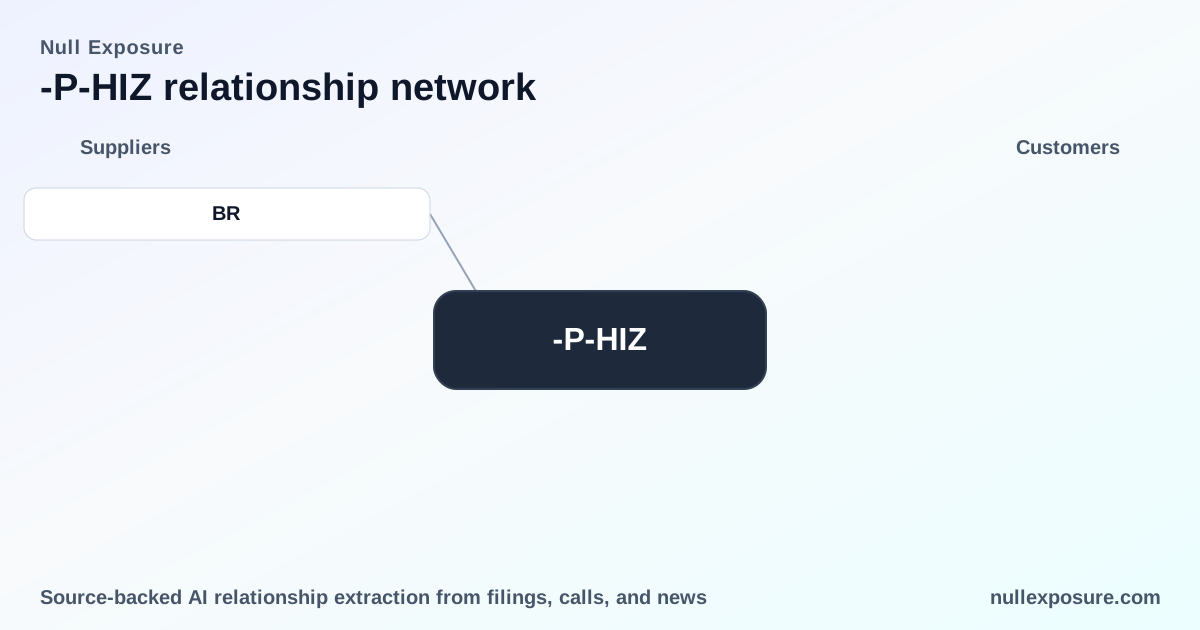
-P-HIZ Supplier Landscape: How outsourcing concentration shapes Presurance’s operating risk
Presurance Holdings (-P-HIZ) operates as an insured-risk platform that underwrites policies and sells insurance products while outsourcing core distribution and operational functions to a small set of third-party providers; the company monetizes through premium margins and related investment income while relying on partner networks for placement, policy administration, and shareholder communications. For investors, the relevant trade is exposure to operational concentration risk and counterparty execution — not pure underwriting performance alone. Learn more about how supplier relationships alter capital and operational risk at https://nullexposure.com/.
Why suppliers matter to valuation and downside risk
Presurance has built a business model that outsources scale-critical functions. Concentrated third-party relationships create operational leverage: when partners execute, the company scales inexpensively; when they fail, remediation costs and distribution interruption are immediate and material. The supplier profile in public disclosures shows both governance activity (a rights offering administered through a custodian/issuer services firm) and deep operational outsourcing (underwriting, claims, IT handled by two agencies). Those characteristics translate into four investor-relevant signals:
- High counterparty concentration. Two agencies handle underwriting, claims and IT, which places placement and operational continuity squarely in the hands of a few vendors.
- Service criticality. The outsourced services are not peripheral; they are mission-critical to premium flow and claims resolution.
- Transaction administration dependence. Capital-markets actions — a rights offering — are administered through established issuer services, which reduces execution risk on corporate finance events but increases reliance on third-party administrators.
- Observable governance activity. The company engaged in a rights offering (FY2026), a corporate action that invites scrutiny of shareholder communication and administration workflows.
These are not abstract points: they directly affect liquidity management, the speed of remediation after adverse events, and the credibility of capital-raising exercises.
Relationship-by-relationship: what to watch
BR
Broadridge is listed as the contact point for investor questions related to a rights offering Presurance initiated in early 2026. According to a GlobeNewswire press release announcing the rights offering (February 6, 2026), Broadridge Corporate Issuer Solutions, LLC was named as the contact for shareholder inquiries, which indicates Broadridge’s role as the issuer services administrator for the transaction.
Broadridge Corporate Issuer Solutions, LLC
Broadridge Corporate Issuer Solutions, LLC served as the administrative agent for the rights offering; the GlobeNewswire release (Feb 6, 2026) lists Broadridge’s phone and shareholder email contact for the event, implying formal issuance and communication responsibilities for Presurance’s equity action. Using Broadridge for a rights offering is evidence the company relies on established capital-markets processors for corporate actions.
CIS (inferred symbol CISO)
A TradingView summary of Presurance’s 2025 10‑K (reported May 2, 2026) notes that distribution and several operational functions are concentrated with two third-party agencies, one referenced as CIS, which now handles underwriting, claims and IT; this assigns CIS a material role in day-to-day risk selection and policy servicing. CIS is therefore a first-order operational counterparty for underwriting throughput and claims adjudication.
SSU (inferred symbol SSUP)
The same TradingView review of the 2025 10‑K (May 2, 2026) identifies SSU as the other agency sharing responsibility for distribution, underwriting, claims and IT, driving placement and operational reliance. SSU and CIS together encapsulate the company’s outsourced operating backbone, so vendor-health is equivalent to operational health for Presurance.
Operational characteristics investors should bake into models
- Contracting posture: Presurance’s posture is vendor-dependent; contracts with SSU and CIS are central to front- and back-office execution. That structure reduces fixed-cost leverage on the company but raises vendor-performance exposure.
- Concentration: The company’s distribution and core operations sit with two agencies — a concentration that magnifies idiosyncratic vendor risk into company-level operational risk.
- Criticality: Functions outsourced are core (underwriting, claims, IT). Any sustained disruption at those vendors imposes immediate revenue and expense consequences.
- Maturity: Outsourcing to established service providers for corporate actions (Broadridge) indicates maturity in capital-markets operations, even as operational outsourcing for underwriting/claims can be younger or less standardized and therefore less predictable.
These operating attributes translate into valuation adjustments: apply higher liquidity and execution discounts where vendor continuity or contract renewal risk is uncertain, and treat vendor counterparty stress as a scenario that can quickly impact loss adjustment expenses and new business flow.
Practical investment checklist and red flags
- Monitor contract renewals, SLA details, and termination provisions with SSU and CIS; absence of multi-year commitments or performance guarantees is a red flag.
- Track operational incident reporting and claims adjudication timelines from the vendors; systemic delays will show up quickly in loss reserve development.
- Treat Broadridge’s involvement in the FY2026 rights offering as a neutral-to-positive signal on capital-markets execution, but confirm whether Broadridge’s role extends beyond administrative tasks to escrow or trustee responsibilities. GlobeNewswire disclosed Broadridge contact details for the rights offering (Feb 6, 2026).
- Stress-test scenarios where one of the two agencies is incapacitated — model re-onboarding costs, placement friction, and short-term sales interruption.
If you want a consolidated view of all supplier exposures and how they interact with capital events, see additional analysis at https://nullexposure.com/.
Bottom line for investors and operators
Presurance’s commercial profile is not just underwriting risk; it is also vendor risk. The company’s reliance on SSU and CIS for underwriting, claims and IT makes vendor performance a first-order determinant of operational continuity, while Broadridge’s role in the rights offering confirms reliance on established issuer-services infrastructure for corporate actions. For investors, that combination requires active monitoring of vendor contracts, performance history, and contingency plans; for operators, it prescribes rigorous vendor management and redundancy planning as value-preservation mechanisms.
If you need a tailored supplier-risk brief or a consolidated counterparty map for -P-HIZ, visit https://nullexposure.com/ for subscription options and deeper supplier analytics.