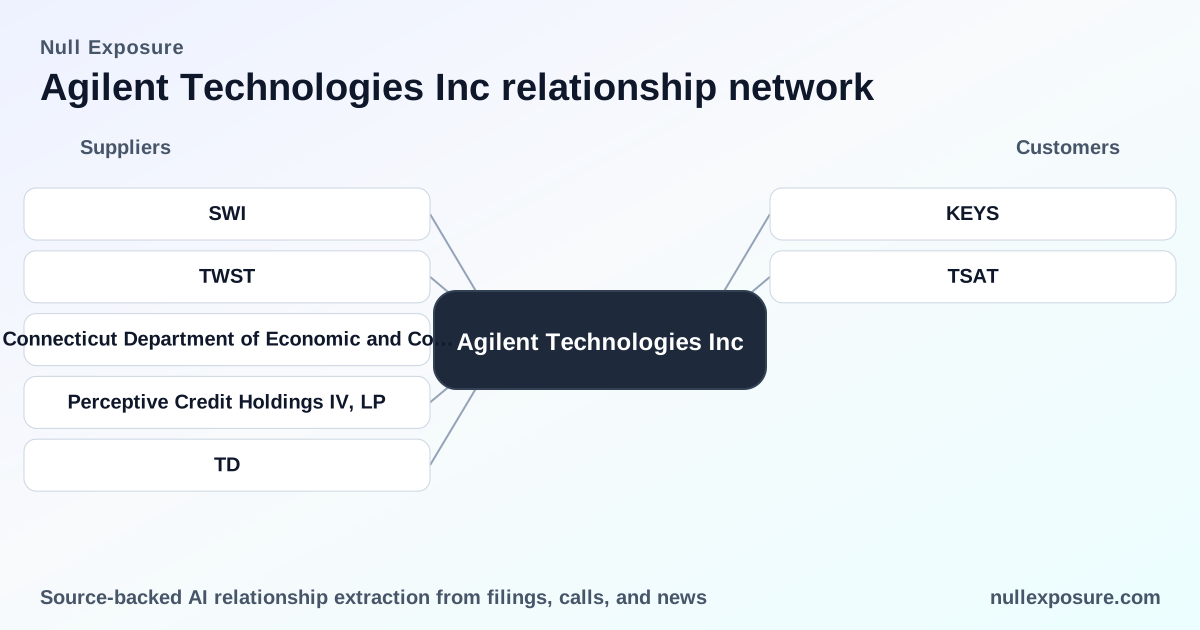
Agilent Technologies (A) — supplier relationships, operating posture, and what investors should act on
Agilent Technologies operates as a global developer and manufacturer of analytical instruments, reagents and laboratory services that monetize through three pillars: capital equipment sales, high-margin recurring consumables and reagents, and service and maintenance contracts. The company converts instrument placements into durable revenue streams by pairing hardware with consumables and cross‑lab service contracts, and it finances growth with a combination of operating cash flow and targeted capital markets activity. For investors assessing Agilent as a supplier counterpart or counterparty, the firm presents a mature, global supply footprint with substantial outsourcing of manufacturing and IT functions — a profile that drives steady margins but concentrates operational risk in third-party providers. Learn more at https://nullexposure.com/.
Quick investment thesis: durable revenue, outsourced operational edges
Agilent’s financial profile supports a supplier‑oriented read: high gross margins (about 52% of trailing revenue), consistent operating margin (≈23%), and recurring revenue from consumables and services create a defensible cash flow base that underwrites supplier payments and long-term contracts. The business is capital intensive in instrument R&D and production, but it offsets that with global sourcing and contract manufacturers to maintain unit economics. Institutional investors dominate the shareholder base, and the company distributes a modest dividend — all signals of a stable, creditworthy counterparty for suppliers and lenders.
How Agilent structures external relationships — what the constraints show
The company-level documentation and excerpts reveal a clear operating posture:
- Contracting posture: Agilent uses long-term financing instruments and long-standing license arrangements. The company’s filings reference a 3.050% senior note due 2026 and a trademark license with Keysight Technologies (2014), signaling formal long-term obligations and IP-sharing arrangements.
- Global scale and sourcing: Agilent purchases materials from thousands of suppliers worldwide, and management actively consolidates manufacturing to selected facilities to drive margin efficiency. This creates a global supply network with geographically dispersed dependencies.
- Outsourcing and criticality: Agilent outsources significant IT functions and portions of manufacturing, warehousing and logistics. Information technology and contract manufacturing are explicitly called out as critical to operations, elevating third-party operational and cyber risk.
- Roles the company plays: Company-level excerpts identify Agilent as buyer, manufacturer (through contractors), distributor, and heavy service consumer/provider in its channels. This multiplicity increases counterparty complexity for anyone evaluating contractual exposure.
- Maturity and financial posture: With market capitalization near $31.7 billion, steady EBITDA and a dividend program, Agilent operates as a mature enterprise that funds supplier relationships with both operating cash flow and occasional market support (e.g., ATM sales agreements).
Key takeaway: Agilent is a large, creditworthy buyer and platform provider, but its operational model relies on outsourced manufacturing and third‑party IT, which concentrates operational and cyber dependency risk around suppliers.
Relationship roundup — every mention from the source material
- Twist Biosciences (TWST) — Agilent is recorded purchasing diagnostic testing kits and lab materials from Twist Biosciences as related-party expenses in FY2026 disclosures, indicating procurement of specialized consumables tied to diagnostic workflows (Source: GeneDx 10‑K excerpts via StockTitan, FY2026).
- SolarWinds (SWI) — Agilent identified an impacted SolarWinds server and undertook containment and remediation steps, signaling exposure to a third‑party IT vendor security incident in FY2026 (Source: Agilent 10‑Q via StockTitan, FY2026).
- VDI — Agilent referenced extender modules sourced from solution partner VDI in a trade news mention, showing product‑level partnerships for modular instrument components (Source: Trade press via Yahoo, May 2013, cited in aggregated results).
- BaseSolve Informatics — Agilent entered a co‑marketing arrangement combining its genomics instruments and reagents with BaseSolve’s software to deliver an integrated NGS workflow in the United States, demonstrating a go‑to‑market partnership that bundles hardware, consumables and analytics (Source: press release via The Wire, May 2026).
- TD Securities (USA) LLC / TD Cowen — The company executed a sales agreement with TD Securities in April 2024 allowing Agilent to offer and sell Class A common stock up to $75.0 million through TD Cowen as sales agent, reflecting utilization of equity distribution capacity rather than a supplier relationship (Source: filing excerpts via StockTitan, FY2026).
- Perceptive Credit Holdings IV, LP — Agilent recorded a credit agreement providing a senior secured delayed draw term loan facility up to $75.0 million, indicating committed financing capacity from Perceptive to support capital needs (Source: filing excerpts via StockTitan, FY2026).
- Connecticut Department of Economic and Community Development (DECD) — Agilent received an assigned loan funding commitment from the DECD tied to a Genetic Sequencing Laboratory Project in Branford, Connecticut, with disbursement contingent on meeting project development milestones (Source: filing excerpts via StockTitan, FY2026).
What these relationships imply for suppliers and counterparties
- Operational concentration: The repeated emphasis on outsourced manufacturing and IT services means suppliers and partners will interact with a layered supply chain; contracts should anticipate subcontracting and third‑party performance clauses.
- Cyber and operational risk: The SolarWinds remediation note is concrete evidence that Agilent’s platform is exposed to third‑party IT incidents; suppliers should require clear incident response coordination and SLAs.
- Product and go‑to‑market partnerships: Co‑marketing deals such as the BaseSolve arrangement show Agilent is actively bundling instrumentation with software partners — an opportunity for software and service suppliers to gain scale by integrating into Agilent workflows.
- Liquidity and financing profile: Documented access to equity distribution agreements and committed credit facilities (TD Cowen, Perceptive) supports Agilent’s payout and capex profile, making it a reliable payer on contractual obligations relative to smaller peers.
Risks that should drive contract design and pricing
- Third‑party dependency risk: Given Agilent’s outsourcing posture, include robust warranties, performance milestones, and remedies for supplier agreements that depend on contract manufacturers or IT providers.
- Global supply volatility: With sourcing across thousands of suppliers, anticipate logistics-driven cost variability and build indexed pricing or pass‑through mechanisms into long‑term supply contracts.
- Regulatory and IP complexity: Existing licensing arrangements (for example, the trademark license with Keysight) indicate legacy IP and brand constraints; ensure clarity on branding, IP ownership, and indemnities when integrating products or co‑marketing.
Investment-relevant conclusions and recommended actions
Agilent is a stable, well‑capitalized counterparty with a business model that converts capital equipment into recurring consumables and service revenue. For investors and operators evaluating supplier relationships, prioritize contracts that address third‑party IT and contract manufacturing risks, and structure pricing to reflect global logistics exposure. Integrative partnerships (software + instrumentation) represent the most attractive upside for suppliers seeking scale with Agilent.
For a deeper supplier‑level diligence package and monitoring of Agilent’s supplier signals, visit https://nullexposure.com/ — our platform aggregates these relationship indicators and constraint signals for investment and procurement teams.
Bottom line: Agilent’s scale and recurring-revenue model make it a desirable supplier partner, but successful engagement requires explicit contract terms that mitigate outsourced manufacturing and IT dependencies.