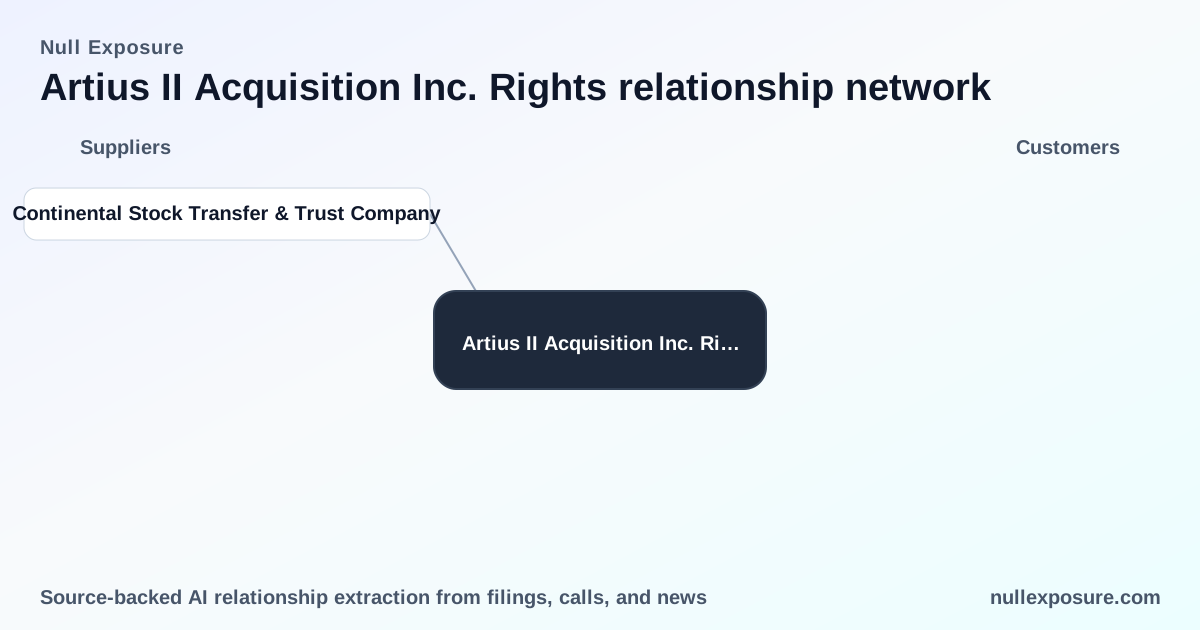
Artius II Acquisition Inc. Rights (AACBR): Supplier Map and Operational Implications for Investors
Artius II Acquisition Inc. (rights ticker AACBR) operates as a SPAC that monetizes by raising capital through an IPO and private placement, placing those proceeds in a trust account, and executing a business combination that converts trust capital into equity in a target company; the rights are a tradable instrument tied to the SPAC’s capital structure and post-combination mechanics. For investors and operators evaluating counterparty exposure, the critical supplier set is compact and highly consequential — the transfer agent, the trust bank, and the listing exchange together determine custody, regulatory compliance, and liquidity of the securities.
For deeper supplier intelligence, visit the Null Exposure homepage: https://nullexposure.com/
Why supplier relationships matter for a SPAC rights investor
Artius II’s commercial model is not an operational business; it is a capital vehicle whose functionality depends on a small number of service providers executing precise legal and custody roles. Supplier relationships in this setup are high-criticality, low-volume, and legally governed — service failures or restrictive contract terms produce outsized impacts on investor access to capital and the mechanics of a business combination or redemption.
Key business-model characteristics to monitor:
- Contracting posture: Structured and formal — trust agreements, transfer-agent instructions, and exchange listing rules define the operating envelope rather than commercial negotiations. These contracts are typically standardized but legally binding.
- Concentration: The supplier set is highly concentrated. A handful of institutions perform custody, transfer, and listing functions, so counterparty risk is concentrated by design.
- Criticality: Each supplier is mission-critical for a SPAC: trustee banks manage the cash that underpins redemptions; transfer agents handle unit separation and recordkeeping; the exchange provides market access and compliance oversight.
- Maturity: These suppliers are mature providers with established protocols for SPACs; operational risk is real but the service model is standardized across the sector.
Supplier relationships: what the public record shows
Continental Stock Transfer & Trust Company
Continental is identified as the transfer agent responsible for unit separation and recordkeeping functions. According to a company announcement published on Yahoo Finance, holders of units must have their brokers contact Continental Stock Transfer & Trust Company to separate units into Class A ordinary shares and rights (March 9, 2026). This places Continental at the center of any operational effort to convert unit holdings into tradable rights or shares. (Source: Yahoo Finance, Mar 9, 2026)
JPMorgan Chase
JPMorgan Chase serves as the trust bank where the IPO proceeds were deposited. Investing.com reported that the proceeds from the IPO and private sale, totalling $220 million, were placed in a trust account with JPMorgan Chase Bank (May 2, 2026). That custody arrangement makes JPMorgan the counterparty holding the capital that underwrites redemptions and the SPAC’s ability to consummate a business combination. (Source: Investing.com, May 2, 2026)
The Nasdaq Stock Market
The Nasdaq provides the listing venue and market infrastructure; the company’s Class A ordinary shares and rights trade on The Nasdaq Stock Market under tickers AACB and AACBR, respectively. Investing.com’s SEC filing coverage notes the listing arrangement, which dictates disclosure, trading rules, and delisting risk (May 2, 2026). Market access and regulatory compliance flow through Nasdaq’s ruleset for listed SPAC securities. (Source: Investing.com, May 2, 2026)
What the absence of disclosed constraints signals
There are no supplier-specific constraints reported in the available relationship data for AACBR. At a company level, the lack of disclosed contractual constraints suggests standardized, market-conventional agreements rather than bespoke operational encumbrances. Investors should interpret this as a neutral signal: the fundamental SPAC service relationships are present and typical, but absence of disclosed constraints does not eliminate counterparty, compliance, or liquidity risk inherent to the structure.
Investment implications and a practical risk checklist
The supplier map drives a focused risk and monitoring agenda for investors and operators evaluating AACBR exposure:
- Trust concentration risk: With $220 million in IPO proceeds placed at a single bank, counterparty credit and operational custody controls at JPMorgan are core to value preservation. Investors should confirm the trust terms and redemption mechanics disclosed in SEC filings.
- Transfer-agent frictions: Continental controls unit-to-share separation processes; transfer-agent processing delays can affect exercise windows, transfers, and settlement. Confirm broker coordination and cut-off timelines for unit separation.
- Listing and market liquidity: Nasdaq listing standards determine ongoing compliance and trading continuity; rights instruments historically trade thinly, so instrument liquidity is a function of market interest and exchange rules.
- Operational law and contract enforceability: SPAC trust agreements and transfer-agent instructions are legal documents that govern redemptions and distributions; these are the operative contracts for monetization outcomes.
Practical monitoring actions:
- Review the trust agreement and related SEC filings to confirm redemption mechanics and interest/earnings handling.
- Track transfer-agent notices and broker instructions for key dates affecting unit separation and rights exercisability.
- Monitor Nasdaq filings and trading volumes to gauge market liquidity for AACBR.
Bottom line for investors and operators
Artius II’s value chain is compact and dominated by three types of suppliers: the transfer agent (Continental), the trust bank (JPMorgan), and the listing exchange (Nasdaq). Each performs an outsized, legally defined role that directly affects liquidity and redemption outcomes for AACBR holders. Public reporting confirms the roles and custodial placements: Continental handles unit separation (Yahoo Finance, Mar 9, 2026), JPMorgan holds the trust funds (Investing.com, May 2, 2026), and Nasdaq supplies market access (Investing.com, May 2, 2026). Investors should prioritize document-level review of trust and transfer-agent agreements and maintain active surveillance of trading liquidity and filing activity.
For ongoing supplier intelligence and research tools tailored to capital-markets counterparties, visit Null Exposure: https://nullexposure.com/