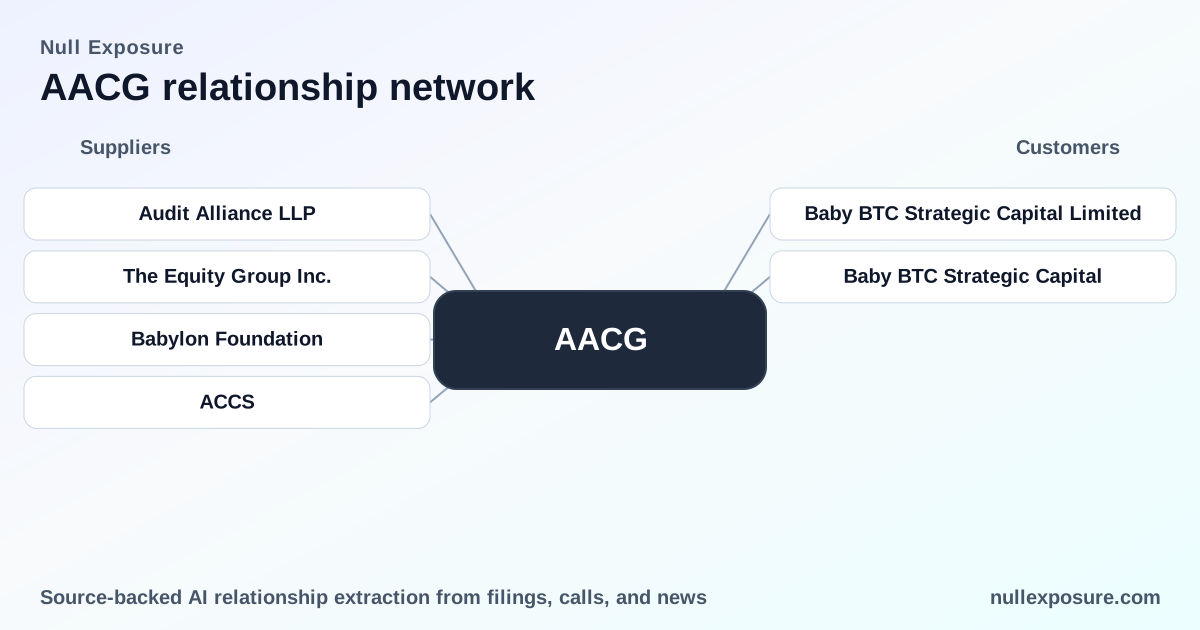
AACG supplier map: what investors need to know about partners and commercial touchpoints
ATA Creativity Global (AACG) runs an education and cultural-content business that monetizes through tuition, franchised and exclusive preparatory centres, short-term workshops and master classes, and capital markets activity supported by external investor-relations and communications firms. The company outsources key functions—auditing, investor relations, press distribution—and builds market-facing credibility through partnerships with established universities and conservatoires; it is also pursuing a speculative digital-asset initiative through a memorandum of understanding. For a deeper supplier network view, explore the full map at https://nullexposure.com/.
Executive read: concentration, critical vendors and strategy signals
Investors should focus on three structural signals from AACG’s supplier set. First, the business model is delivery- and reputation-driven: partnerships with top-tier universities and conservatoires function as both program providers and marketing anchors, which supports pricing and student recruitment. Second, compliance and capital-market functions are outsourced—a stable auditor and a retained investor-relations firm reduce internal operating burden but create single-vendor dependency for critical regulatory and market communications. Third, the company is extending into high-risk digital finance experiments, which lengthens the risk profile beyond education services. These are not isolated facts but coherent operating choices that affect contract posture, supplier criticality, and strategic concentration.
Key takeaways:
- High reputational leverage from academic partners supports student demand and product differentiation.
- Critical single providers for audit and IR increase operational concentration and regulatory risk if relationships change.
- New crypto-related MoU is strategic diversification with elevated governance and execution risk.
Supplier-by-supplier rundown (concise, verifiable)
Below are every relationship surfaced in the public results, each summarized in plain English with source context.
Audit Alliance LLP
AACG re‑appointed Audit Alliance LLP as its independent auditor for the fiscal year ending December 31, 2025, and authorized the board and audit committee to determine the auditor’s remuneration. Source: company press reporting on the annual general meeting (StockTitan, March 9, 2026).
The Equity Group Inc.
The Equity Group Inc. is repeatedly named as AACG’s investor‑relations contact across filings and press releases, indicating an ongoing retained relationship for capital‑markets communications and investor engagement. Source: multiple filings and press releases (StockTitan and MarketBeat, 2025–2026).
ACCS / ACCESS Newswire
AACG has used ACCS / ACCESS Newswire for press distribution, as press releases note “View the original press release on ACCESS Newswire,” which signifies reliance on a commercial newswire channel for external communications. Source: press release distribution notice (StockTitan, March 2026).
Leeds Conservatoire
AACG established its first music preparatory center in Chengdu under an exclusive partnership with Leeds Conservatoire to provide a one‑year intensive study program prior to students finishing bachelor degrees in the U.K. This is an example of an exclusive program partnership used to feed international degree pathways. Source: quarterly report summary (MarketBeat earnings coverage, May 2, 2026).
Aalto University
AACG’s youth and short‑program activity includes a winter camp that offers student visits to Aalto University in Finland for sustainable development workshops and cultural learning, demonstrating international curriculum partnerships beyond degree pathways. Source: program description in investor reporting (MarketBeat, May 2, 2026).
Carnegie Mellon University
AACG hosted online master classes featuring lecturers from Carnegie Mellon University, indicating collaboration for short‑form academic content and external faculty participation. Source: quarter reporting on master classes (MarketBeat, May 2, 2026).
Harvard University
Harvard University faculty participated as lecturers in AACG’s online master classes, used to broaden program credibility and content quality for short courses. Source: company earnings and program disclosures (MarketBeat, May 2, 2026).
University of the Arts London
The University of the Arts London supplied lecturers for AACG’s online master classes tied to creative projects, reinforcing the company’s strategy of partnering with established art and design institutions. Source: program and earnings coverage (MarketBeat, May 2, 2026).
Royal College of Art
Faculty from the Royal College of Art contributed to AACG’s online master classes, aligning AACG’s content proposition with recognized design education brands. Source: program disclosures in company reporting (MarketBeat, May 2, 2026).
Babylon Foundation
AACG entered a memorandum of understanding with the Babylon Foundation to expand Bitcoin staking activities and integrate staked assets into decentralized finance applications; this represents an exploratory pivot into crypto‑asset infrastructure and potential non‑educational revenue channels. Source: MoU announcement (StockTitan, March 9, 2026).
What the supplier map implies for contracting posture and risk
- Contracting posture: Most academic relationships are structured as partnerships or exclusive preparatory‑centre agreements, which are commercial collaborations rather than commodity supplier contracts—this supports brand value capture but requires active partner management.
- Concentration and criticality: Audit Alliance LLP and The Equity Group Inc. are functionally critical—auditing and investor relations are single points of failure for compliance and capital access. Press distribution and media partners are operationally important but replaceable.
- Maturity of relationships: Partnerships with long‑standing academic institutions and repeated citations of the same IR firm suggest established, ongoing arrangements rather than one‑off deals.
- Strategic extension risk: The Babylon Foundation MoU signals a new and high-risk strategic axis; crypto staking initiatives introduce regulatory, custody, and market volatility exposure that are distinct from the company’s core education services.
For a complete supplier mapping and risk brief, visit https://nullexposure.com/.
Investment implications and recommended monitoring
Investors should prioritize monitoring: (1) continuity of the auditor and IR firm ahead of reporting cycles; (2) progress and contractual terms of exclusive preparatory centres (for enrollment and margin impact); and (3) governance and legal disclosures around the Babylon Foundation MoU, given the non‑core and volatile nature of crypto initiatives. Loss of audit or IR coverage would be material to liquidity and compliance; a failed or overhyped crypto initiative would be material to reputational and balance‑sheet risk.
Bottom line
AACG’s supplier network is a deliberate blend of academic brand partnerships to underpin educational delivery and outsourced capital‑markets and compliance vendors that externalize regulatory burden. This structure supports growth in international student pathways while concentrating critical operational dependence on a small set of external suppliers. Investors should track partner renewals, enrollment outcomes at exclusive centres, and any formal agreements or financial exposures tied to the Babylon Foundation initiative to assess near‑term execution and risk.