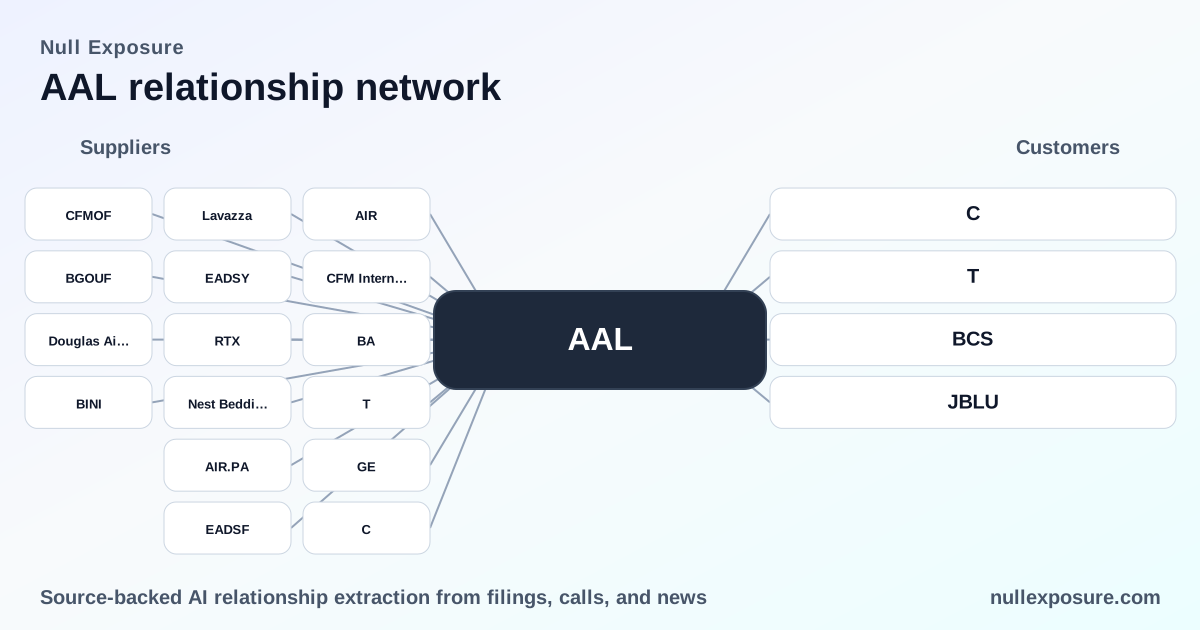
American Airlines (AAL) — Supplier Map and Strategic Exposure
American Airlines monetizes a high-fixed‑cost, asset‑heavy network by selling passenger and ancillary services while outsourcing large portions of operations and specialized inputs. The company controls revenue generation (pricing, schedule, seat inventory) and pays predetermined fees or purchases hardware and services from a concentrated set of suppliers — aircraft manufacturers, engine and maintenance providers, regional operators, financing banks and in‑flight partners — which together shape cash flow volatility and capital intensity for investors.
If you want a consolidated supplier risk view and actionable relationship summaries, visit the NullExposure homepage for model-ready signals and further vendor analytics: https://nullexposure.com/
How to read this supplier picture
American’s supplier network is a hybrid of long‑term capital relationships and service contracts. Aircraft and engines are purchased under multi‑year purchase agreements, regional flying is delivered under capacity purchase agreements (CPAs) that shift operational risk to third parties but keep revenue with AAL, and financial markets provide structured funding via bookrunners and EETC transactions. These dynamics produce four investment‑relevant constraints:
- Contracting posture: American uses long‑term purchase agreements and framework CPAs that lock in delivery schedules, vendor commitments and pre‑funding obligations; these contracts increase predictability of supply but also create exposure to counterparties over multi‑year horizons.
- Concentration: Aircraft, engines and regional capacity are sourced from a limited set of manufacturers and regional carriers, concentrating operational and replacement risk.
- Criticality: Several suppliers are operationally critical — engine OEMs, airframe OEMs, and core regional carriers — where failure or performance disruption would materially affect operations and liquidity.
- Maturity & spend: Many arrangements are active and long‑dated with high spend exposure (>$100m bands for fleet and CPA commitments), which influences leverage, liquidity cadence and capital allocation.
These company‑level signals come from American’s regulatory filings and press releases aggregated in FY2025–FY2026 disclosures.
Explore vendor scoring and scenario outputs at https://nullexposure.com/ if you want the underlying relationship matrix.
Supplier relationships — concise, investor‑grade summaries
Below I list every supplier relationship recorded in the source set and provide a plain‑English summary with a short source citation. Each entry is a one‑to‑two sentence investor summary.
Airbus / AIR / AIR.PA / EADSY / EADSF
American is actively sourcing Airbus narrowbody and long‑range variants (A321neo / A321XLR) to increase premium capacity and transatlantic reach; Airbus deliveries are embedded in long‑term purchase agreements shaping AAL’s fleet plan. Source: American press materials and market coverage (Airbus / A321XLR rollout), March 2026 — https://news.aa.com/news/news-details/2026/American-Airlines-flights-to-Porto-Portugal-NET-RTS-02/
Boeing / BA
Boeing is a principal airframe supplier with long‑standing purchase agreements and supplemental amendments that govern 787 and 737 deliveries and financing; Boeing delivery timing constrains capacity and therefore pricing dynamics. Source: AAG 10‑K exhibits and market reports on Boeing deliveries, FY2025–FY2026 — https://aal-2025-12-31
CFM International / CFM / CFMOF / CFM LEAP‑1A
CFM (GE/Safran JV) will power American’s A321neo deliveries and handle long‑term engine services for the LEAP‑1A fleet, creating a durable maintenance and parts relationship. Source: American press release on engine selection, March 2026 — https://news.aa.com/news/news-details/2026/American-chooses-CFM-International-engines-for-A321neos-OPS-OTH-02/default.aspx
GE / GE Aerospace
GE Aerospace is embedded in American’s engine base across narrowbody and regional fleets and provides technology continuity and MRO footprint influence. Source: ASD News and company comments, February–March 2026 — https://www.asdnews.com/news/aerospace/2026/02/19/american-airlines-selects-cfm-engines-services-airbus-a321neo-fleet-expansion
Pratt & Whitney (RTX)
American cites engine maintenance frictions with Pratt & Whitney as a supply constraint that has affected capacity — this is part of the broader OEM engine risk profile. Source: Market analysis on supply chain friction, March 2026 — https://markets.financialcontent.com/stocks/article/finterra-2026-1-23-deep-dive-american-airlines-group-inc-aal-navigating-the-centennial-pivot
Credit & Bond Bookrunners: Goldman Sachs, Morgan Stanley, MUFG, Bank of America Securities, JP Morgan, Citigroup, Barclays, BNP Paribas, Deutsche Bank Securities, NatWest, Natixis, BOK Financial Securities, CIBC Capital Markets, Loop Capital Markets, ICBC Standard Bank, SMBC Nikko
American’s 2026 EETC and bond transactions are underwritten by a syndicate of global and regional banks (Goldman, Morgan Stanley, MUFG and a long tail of co‑bookrunners), reflecting active capital markets access and structured aircraft financing. Source: FlightGlobal and BusinessTimes coverage of the US$1.14bn 2026 transaction, April–May 2026 — https://www.flightglobal.com/american-airlines/2026/04/american-to-raise-1-1bn-in-32-aircraft-deal/ and https://www.businesstimes.com.sg/companies-markets/transport-logistics/american-airlines-sells-us1-14-billion-bonds-32-planes
Citi / Citigroup
Citi is the exclusive U.S. issuer of AAdvantage co‑branded cards and has expanded partnership rights into Admirals Club lounge operations, creating a meaningful, recurring non‑fares revenue channel. Source: American press release, January–March 2026 — https://news.aa.com/news/news-details/2026/American-and-Citi-expand-their-partnership-across-the-Admirals-Club-network-MKG-LNGE-03/
AT&T / T
AT&T sponsors free high‑speed satellite Wi‑Fi for AAdvantage members and is a visible in‑flight connectivity partner in 2026 rollouts. Source: American Q1 2026 results and press releases, March 2026 — https://news.aa.com/news/news-details/2026/American-Airlines-reports-first-quarter-2026-financial-results-CORP-FI-04/default.aspx
SpaceX’s Starlink and Amazon (connectivity discussions)
American is in discussions with Starlink and Amazon to upgrade in‑flight connectivity, indicating ongoing vendor evaluation for future connectivity architecture. Source: Industry reporting on connectivity talks, April 2026 — https://stockstotrade.com/news/american-airlines-group-inc-aal-news-2026_04_01/
Infinium
American signed as the physical offtaker for Infinium’s eSAF from Project Atlas, securing sustainable aviation fuel supply for decarbonization targets and corporate fuel logistics. Source: StocksToTrade and Project Atlas coverage, April 2026 — https://stockstotrade.com/news/american-airlines-group-inc-aal-news-2026_04_17/
Vertical Aerospace / EVTL
American holds a pre‑delivery commitment and investment posture with Vertical Aerospace for up to 250 eVTOL aircraft and a $25m strategic investment, signalling optionality in urban air mobility. Source: Vertical and media coverage of PDCs and investment, March–May 2026 — https://intellectia.ai/news/stock/vertical-aerospaces-evtol-prospects-and-partnerships
Mesa Air Group / MESA and RJET / Republic Airways
American outsources material regional capacity to operators such as Mesa and Republic (RJET) under CPAs; these third‑party carriers provide critical feeder flying and capacity that AAL cannot replace quickly. Source: MarketBeat and company news on CPAs and regional operations, 2022–2026 — https://www.marketbeat.com/instant-alerts/mesa-air-group-nasdaqrjet-shares-up-45-heres-what-happened-2026-04-20/ and https://www.citybiz.co/article/225861/mesa-air-group-appoints-christian-daoud-as-vp/
SkyWest / SKYW and Envoy
SkyWest and Envoy operate prorate and wholly‑owned regional flying respectively, expanding AAL’s regional capacity under active agreements in 2026. Source: SkyWest earnings calls and American press materials, Q1 2026 — https://m.investing.com/news/transcripts/earnings-call-transcript-skywest-q1-2026-beats-earnings-expectations-93CH-4634333 and https://news.aa.com/news/news-details/2026/American-Airlines-updates-timing-for-Venezuela-service-NET-RTS-04/default.aspx
MRO, amenities and retail partners: Lavazza, Champagne Bollinger / Bollinger, Nest Bedding, Bang & Olufsen
American has elevated onboard and lounge amenities with branded partners (Lavazza, Bollinger, Nest Bedding, Bang & Olufsen headphones), supporting premium product differentiation and ancillary revenue. Source: American lounge partnership announcements and lifestyle press, March 2026 — https://news.aa.com/news/news-details/2026/American-and-Citi-expand-their-partnership-across-the-Admirals-Club-network-MKG-LNGE-03/
Airport agreements: Los Angeles World Airports (LAWA) — regional geography signal (NA)
American executed a material lease for LAX Terminal modernization, reflecting concentrated North American infrastructure commitments. Source: 10‑K excerpts and lease discussion (2018/2024 excerpts) — AAG filings, FY2024–FY2025
Ratings & Credit: S&P Global Ratings, Fitch Ratings
Credit agencies (S&P and Fitch) drive the cost of capital and grading of AAL’s bond issuances; S&P classifies AAL at B+ (non‑investment grade) in 2026 commentary, affecting debt pricing and covenant negotiation leverage. Source: BusinessTimes coverage on bond sale and ratings, May 2026 — https://www.businesstimes.com.sg/companies-markets/transport-logistics/american-airlines-sells-us1-14-billion-bonds-32-planes
Miscellaneous: Douglas Aircraft, Miuho, Loop Capital, ICBC Standard Bank, BOK Financial, US Bancorp, CIBC, BNP Paribas, Barclays, Deutsche, NatWest, Natixis, SMBC, SMBC (SMFG)
A wide syndicate of regional and global banks and legacy aerospace names (Douglas as historical reference) underpin financing, liquidity facilities and distribution of aircraft securitizations; these relationships collectively provide structured funding and liquidity intermediation. Source: Syndicate lists in FlightGlobal and related coverage, April–May 2026 — https://www.flightglobal.com/american-airlines/2026/04/american-to-raise-1-1bn-in-32-aircraft-deal/
Investment takeaways and risk framing
- Fleet and engine supplier concentration (Boeing, Airbus, CFM/GE/Safran, Pratt) creates operational leverage: delivery slips increase unit costs or sustain higher fares, but also protect premium pricing when capacity tightness persists.
- Regional capacity is material and contractually framed: CPAs shift ticket revenue to American while making AAL the buyer of capacity — this is a structural operating model that is material and hard to replace quickly per filings.
- Financing diversity provides access but ties AAL to market windows; syndicated bookrunners and EETCs reduce immediate cash strain but replicate exposure to market sentiment and ratings action.
If you want a model-ready supplier risk score and time‑series exposure view, the full relationship matrix and scenario tools are available at NullExposure: https://nullexposure.com/