AAM-WS: Trustee dynamics reshape short-term cash profile and strategic runway
AAM-WS’s near-term economics are governed less by operating revenue and more by trust-account mechanics and sponsor funding decisions. The company relies on a trustee relationship to manage its Trust Account and funds extension options by depositing a fixed monthly amount; that contractual cash flow, not operating cash generation, drives investor returns and dilution timing. For deal-sourcing and arbitrage-oriented investors, the central question is how extension cost and trustee terms affect the timeline to a transactional outcome and the likelihood of liquidation.
For quick access to deeper supplier intelligence and relationship history, visit https://nullexposure.com/.
The March 2026 amendment: what changed and why it matters
According to an 8‑K filing reported on StockTitan on March 9, 2026, AAM-WS executed an amendment to its Trust Agreement with its trustee that permits the Company to extend the Trust Agreement up to 12 separate times, each extension covering one month, by giving the trustee five days’ advance notice and depositing $173,000 per extension month into the Trust Account. This amendment transforms the trade-off facing holders: pay predictable monthly cash to buy runway for a continued search for a business combination versus accept liquidation outcomes.
Key takeaway: the amendment creates a repeatable, transparent cash outflow schedule tied to extension decisions—this converts uncertainty about runway into discrete funding events of $173k per month.
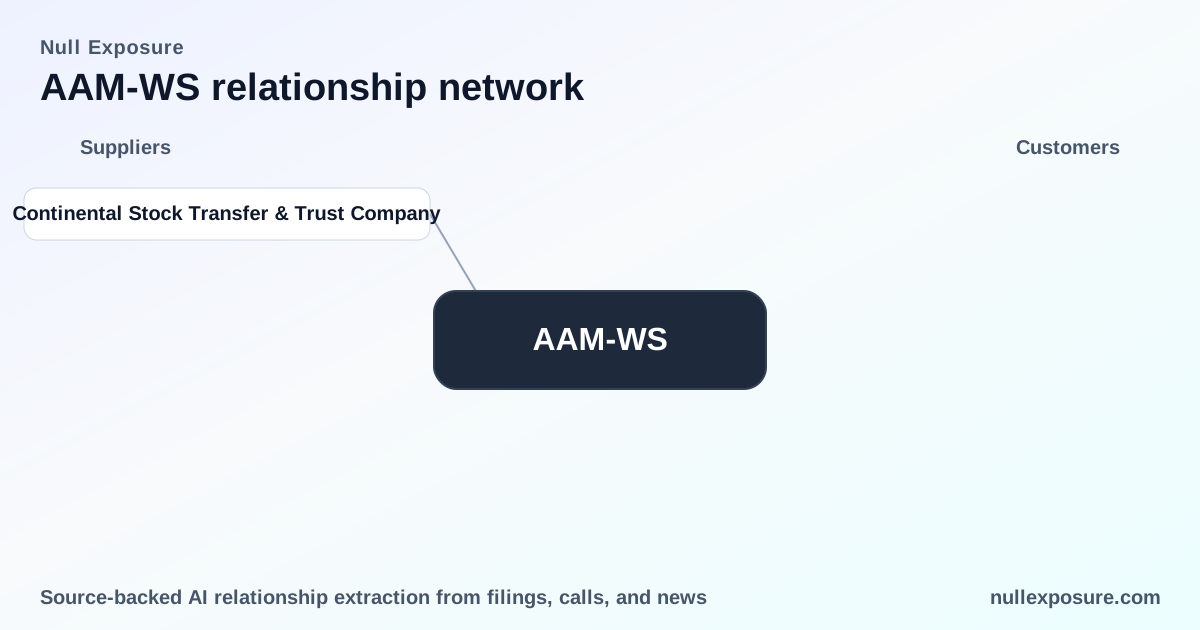
Continental Stock Transfer & Trust Company — the single supplier relationship in scope
Continental Stock Transfer & Trust Company acts as the trustee under the Trust Agreement that was amended in March 2026; the filing documents the trustee’s role in accepting monthly deposits and administering extensions. According to the listed 8‑K (reported March 9, 2026 on StockTitan), the Trust Agreement amendment allows up to 12 monthly extensions with five days’ notice and a $173,000 deposit per month. (Source: 8‑K filing summary on StockTitan, FY2026).
Relationship implication: a single trustee handles custody and administration for the Trust Account, and the amended mechanics are explicit in the FY2026 filing.
Why the trustee relationship dictates strategic optionality
Trustee services are not exotic: they provide custody, recordkeeping, and execution of trust terms. For AAM-WS, that means the trustee is the operational gatekeeper for deposits, extensions, and any downstream distribution or liquidation mechanics. Because the amendment specifies timing and amount, the trustee’s administrative role converts sponsor decisions into enforceable cash flows.
- Contract enforcement becomes operationally simple: five days’ notice and a deposit trigger the extension.
- The predictability of the deposit amount ($173k/month) lets investors quantify how much sponsor capital is required to avoid immediate liquidation.
- The trustee’s willingness to accept monthly extensions through an amended agreement signals an operational path for extending runway without renegotiating core trust economics.
Company-level operating-model signals investors should read as facts
Interpreting supplier-side signals requires seeing them as attributes of how the company runs:
- Contracting posture — flexible, option-based runway management. The amendment institutionalizes a short-duration extension option structure; the company has built contractual levers to buy time with repeated, small cash injections rather than a single large renegotiation.
- Concentration — single critical administrative counterparty. Reliance on one trustee concentrates operational dependency; a disruption at the trustee would be operationally significant.
- Criticality — high for trust-account execution, moderate for market-facing outcomes. The trustee does not source deals, but it controls the mechanics that determine whether the company maintains the possibility of completing a business combination or proceeds to liquidation.
- Maturity — standardized trustee mechanics consistent with SPAC trust practices. The amendment follows common market practice of permitting extensions via deposits; this is a mature, predictable contracting pattern rather than a bespoke or experimental structure.
These are company-level signals derived from observable contract mechanics and are material to assessing governance, timeline risk, and cash requirements.
What investors and operators should worry about — and where there is optionality
The practical implications are straightforward and actionable:
- Cash burn for runway is now explicit and small but cumulative. At $173,000 per month, a sponsor could buy a year of runway for $2.076 million if all 12 one-month extensions are used. That transforms negotiation into a cost/benefit decision rather than a binary reset.
- Governance friction is low but notice windows are short. Five days’ notice reduces the window for stakeholders to respond or litigate; investors should track announcement timing for any extension election.
- Operational concentration is a single point of failure. Continental Stock Transfer & Trust Company’s continuity and operational integrity are material — any service disruption would be consequential for Trust Account administration.
- No new counterparty relationships were disclosed in this filing. The amendment deals with mechanics between the company and existing trustee rather than adding new providers or changing custody arrangements.
For investors monitoring supplier risk, the amendment reduces ambiguity about monthly funding needs but increases the importance of monitoring sponsor willingness to deposit funds and the trustee’s ongoing capacity. For a closer review of supplier interlocks and historical filings, browse the research hub at https://nullexposure.com/.
Bottom line: runway is a contractual lever, not a mystery
AAM-WS’s March 2026 Trust Agreement amendment turns runway into an explicit, repeatable cost ($173k per month) administered by a single trustee under clear notice requirements. That structure favors holders who can model out extension scenarios precisely: the decision calculus is now a straightforward trade between incremental sponsor funding and the value of more time to complete a transaction. Operationally, the single trustee relationship concentrates risk but also simplifies predictability.
Investors should prioritize: tracking extension notices, quantifying cumulative extension cost against potential deal value, and monitoring the operational health of Continental Stock Transfer & Trust Company, because those three items determine whether the amended mechanics preserve optionality or simply delay an inevitable liquidation.