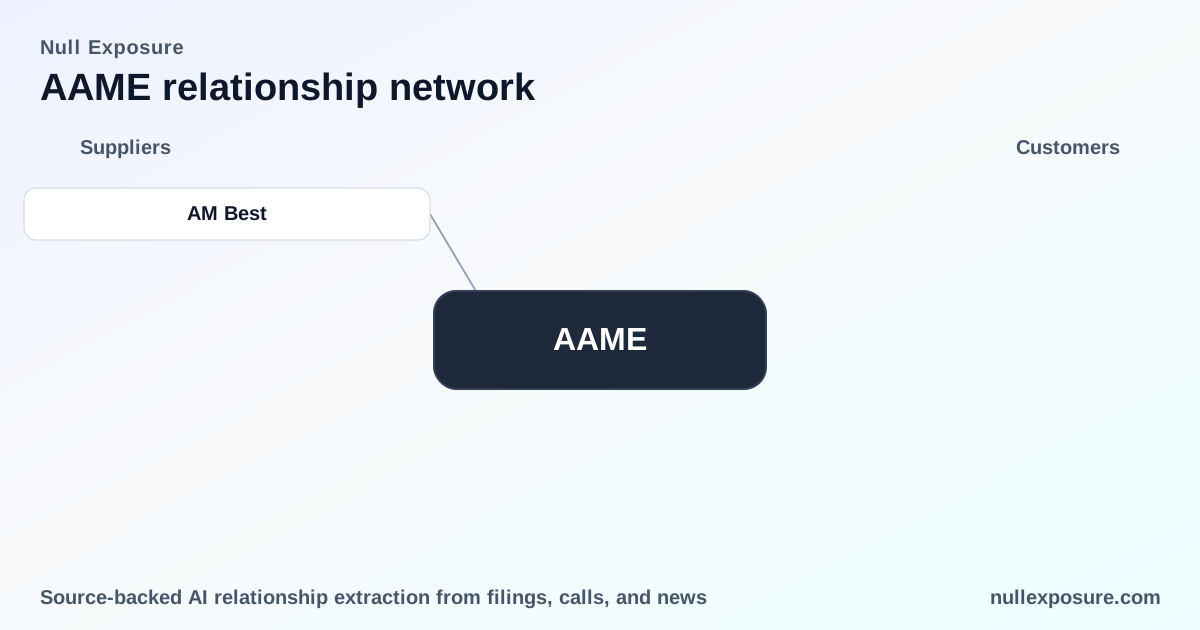
Atlantic American (AAME) supplier intelligence: AM Best affirmations and what suppliers reveal about capital and concentration risk
Atlantic American Corporation (NASDAQ: AAME) underwrites life and supplemental health insurance through subsidiaries (notably Bankers Fidelity and Atlantic American Employee Benefits), monetizing primarily through insurance premiums, cessions to reinsurers, and investment income on balance-sheet assets. The company relies on a mix of long‑dated financing, service vendor relationships (including hosted policy/claims systems), and reinsurance structures to manage underwriting risk and capital—making supplier and counterparty posture a direct driver of solvency and earnings volatility. For investors assessing partner exposure, the combination of long-term contractual anchors, high counterparty concentration, and mid‑single digit ceded premium spend defines the material supplier risk profile.
For a focused supplier diligence overview, see https://nullexposure.com/.
AM Best’s public stamp — what it says about credit stability
AM Best’s published ratings are critical market signals for insurers because they aggregate balance-sheet, underwriting, and counterparty risk judgments into a single credit view. Two recent citations show continuity in AM Best’s view of Atlantic American’s credit standing.
AM Best affirmation referenced in May 2026 (FY2026)
AM Best affirmed Atlantic American’s Long‑Term Issuer Credit Rating at “bbb‑” (Good) in a notice reported on May 2, 2026 by Yahoo Finance, confirming the company’s credit profile at that assessment window. According to the Yahoo Finance report (May 2, 2026), the rating affirmation reflects AM Best’s view of the company’s current capitalization and risk management relative to peers.
Earlier AM Best affirmation captured in a March 2026 report (FY2021 reference)
A March 9, 2026 news item on StockTitan also records AM Best’s affirmation of the Long‑Term ICR at “bbb‑”, citing earlier fiscal references (FY2021) that underscore rating consistency over multiple reporting periods. The StockTitan piece (March 9, 2026) reiterates the same credit position documented across AM Best commentary.
What supplier and contract evidence reveals about operating constraints
The supplier signal set is rich: Atlantic American contracts across multiple tenors, relies on external asset managers and reinsurers, and engages hosted software vendors—each characteristic embedding different liquidity and operational risks.
- Contracting posture: predominantly long‑term. The company’s revolving credit amendment (first amended March 22, 2024) extended facility maturity to March 22, 2027 and adjusted pricing to Adjusted Term SOFR + 200 bps, illustrating multi‑year financing commitments and covenant mechanics. Long‑dated subordinated debentures mature in 2032 and 2033 and leases were amended to extend occupancy through 2026 with future rent escalators. These provisions create predictable financing and occupancy cash flows but also set refinancing points investors must monitor.
- Short‑term reinsurance behavior complements long contracts. Portions of in‑force life insurance are reinsured under yearly renewable term and coinsurance arrangements, producing short‑dated counterparty exposures layered on top of longer strategic contracts.
- Vendor model includes subscription SaaS hosting. Policy, billing, claims, and customer management functions are delivered under a hosted service contract, meaning operational continuity depends on a single hosted platform relationship that has been renewed and extended.
- High counterparty concentration is the most acute signal. Approximately 99.8% of reinsurance recoverables were due from a single reinsurer as of December 31, 2024, a concentration that elevates counterparty default risk into a solvency‑relevant metric rather than an operational annoyance.
- Geographic and managerial diversification is present but limited. Atlantic American engages a global investment manager for portfolios—introducing professional asset oversight but not eliminating the concentrated reinsurer counterparty risk.
- Financial scale of supplier spend is material but not enormous. Ceded new Medicare Supplement premium totaled $5.1 million of $10.1 million new annualized premium—placing this category in the $1M–$10M spend band and signaling meaningful yet manageable vendor/payer flows.
These signals together construct a profile of a company that is structurally financed for multi‑year operation but operationally vulnerable to a single large reinsurer counterparty disruption.
How these constraints translate into investor action items
The supplier posture implies a concise set of monitoring and execution priorities for investors and operators:
- Monitor the reinsurer counterparty. Given that nearly all reinsurance recoverables were due from one reinsurer, any downgrade, rating volatility, or insolvency within that reinsurer will immediately stress AAME’s recoverables and require rapid capital or liquidity action. AM Best rating stability reduces but does not eliminate this tail risk.
- Track credit facility maturities and covenant tests. The revolving credit amendment to March 2027 and the presence of subordinated debentures into the 2030s create defined refinancing horizons that influence liquidity planning and dividend/capital return policies.
- Review vendor continuity and renewal terms. The hosted SaaS arrangement for core operations has been renewed and extended; operational outages or contract renegotiation at renewal could inflect expense and service delivery.
- Watch for lease rent step‑ups and scheduled adjustments. Lease amendments include rent adjustments in 2025, 2027, and 2030 that will alter fixed cost baselines and free cash flow.
- Quantify ceded premium impact. The $5.1 million ceded Medicare Supplement premium is material to that product line and illuminates how reinsurance pricing or capacity shifts would alter margins.
For a practical next step in supplier due diligence, stakeholders can review the company’s public filing schedules and rating notices; for an integrated supplier risk profile see https://nullexposure.com/.
Investments and risk governance: the bottom line
Atlantic American operates with a mixed maturity profile—long‑term financing and leases coupled with short‑term reinsurance mechanics—and a concentrated reinsurance recoverable that is the single largest supplier risk. AM Best’s repeated affirmation at “bbb‑” provides a stable credit backdrop that supports current operations, but it does not remove the economic fragility created by counterparty concentration and finite refinancing windows. Investors should prioritize scenario analysis on reinsurer failure, refinancing stress around 2027, and SaaS vendor continuity as decision triggers for underwriting, capital allocation, or trading positions.
Key watch items: reinsurer credit and concentration, credit facility covenant and maturity status, debt maturities into the early 2030s, and vendor hosting contract renewals. These signals determine whether Atlantic American’s supplier posture is a controlled operational dependency or a lever for systemic earnings and balance‑sheet stress.