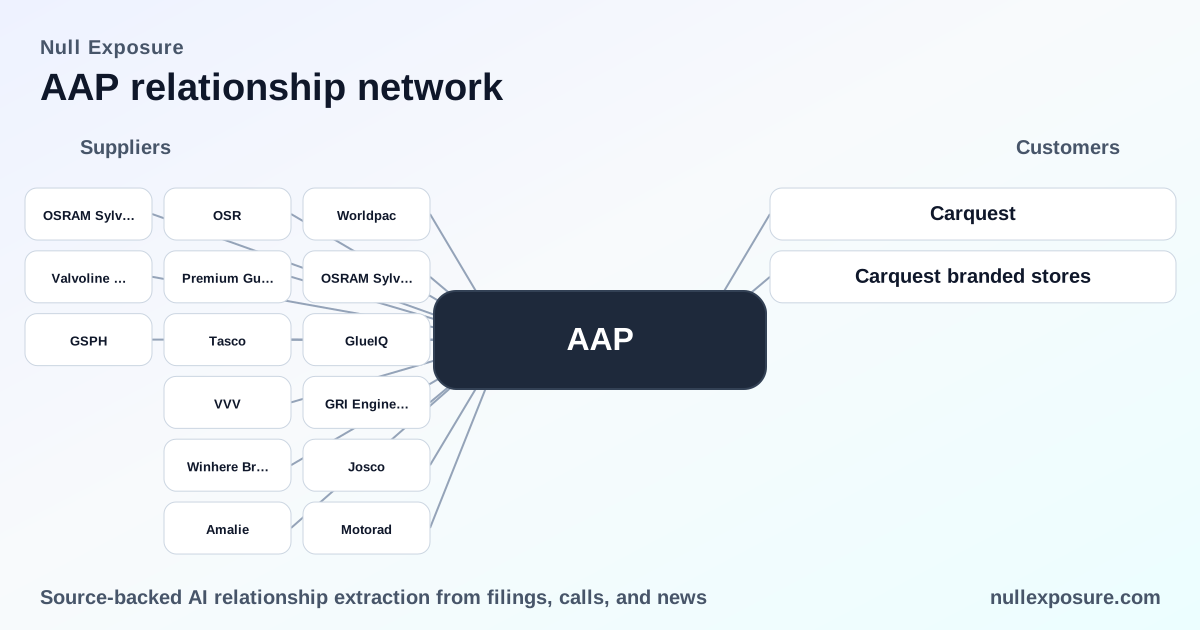
Advance Auto Parts (AAP) — supplier relationships that drive margin and execution
Advance Auto Parts operates a national retail and professional distribution business that monetizes by buying auto parts and consumables from a broad set of vendors, driving resale margin through inventory management, promotions and commercial sales to professional customers. Revenue flow is underpinned by negotiated vendor agreements, volume rebates and supply‑chain financing that convert supplier relationships into working‑capital leverage and purchasing optionality. For investors, the supplier roster and contracting posture are direct inputs to gross margin stability and inventory turn performance. Visit https://nullexposure.com/ for a consolidated view of supplier risk and relationship signals.
Vendor awards and execution signals — what management is telling the market
Advance’s vendor awards announced at the “Accelerate” event function as both recognition and a public signal of which suppliers are integrated into merchandising, supply chain and marketing flows. OSRAM Sylvania was named 2025 Global Vendor of the Year — a high‑visibility nod to collaborative merchandising and supply‑chain alignment — while a slate of category winners highlights where AAP prioritizes execution (inventory, e‑commerce, content and marketing). A Business Wire release and subsequent coverage summarized those awards in early 2026 and serve as the primary public evidence of current supplier prioritization (Business Wire via Finviz; Bastille Post and StockTitan coverage, Jan–Mar 2026).
If you want the supplier map consolidated for modelling or diligence, check the full supplier index at https://nullexposure.com/ and compare awardees against AAP’s FY2026 disclosures.
Line‑by‑line vendor relationships (plain English, source cited)
Below are the relationships extracted from public filings and press coverage; each item is a concise investor‑oriented summary with the cited source.
Worldpac
Advance Auto Parts agreed to sell Worldpac for $1.5 billion, with customary working‑capital adjustments, as disclosed in AAP’s FY2026 10‑K filing (filing aap-2026-01-03, FY2026). This is a material divestiture that reduces AAP’s parts distribution footprint tied to the Worldpac business and crystallizes proceeds for corporate use.
OSRAM Sylvania Inc. (OSRAM / OSR)
OSRAM Sylvania was named Advance’s 2025 Global Vendor Partner of the Year, recognized for cross‑functional collaboration across stores, supply chain and merchandising (Business Wire reported via Finviz and covered by Bastille Post, Jan–Mar 2026). That award signals deep product and promotional integration in lighting categories.
Amalie
Amalie earned the 2025 Inventory Vendor of the Year – Front Room award for strong execution and logistics that improved front‑store inventory metrics (Bastille Post and StockTitan, Mar 2026). The recognition indicates Amalie’s role in improving shelf availability and promotional responsiveness.
GlueIQ
GlueIQ was named 2025 Marketing Vendor of the Year for driving brand elevation and omnichannel creative work that supported Advance’s promotional program (Bastille Post, Mar 2026). This flags a strategic marketing partnership rather than a product supply relationship.
GRI Engineering
GRI Engineering won Supply Chain Vendor of the Year and Inventory Vendor of the Year – Back Room for operational contributions that improved service levels and inventory distribution (Bastille Post and StockTitan, Mar 2026). The award underscores AAP’s reliance on external engineering/logistics partners to smooth warehouse/back‑room flows.
FVR (ticker: FVR)
A quoted transcript reference noted Advance Auto as one of several tenants or exposures discussed by FrontView REIT, indicating Advance’s presence in landlord portfolios and the company’s extended lease/real‑estate footprint (Investing.com transcript, May 2026). This is a real‑estate/occupancy context rather than a product supplier relationship.
Josco
Josco was recognized as a Content Vendor of the Year (together with Motorad) for contributions to customer‑facing and store team content quality (Bastille Post and StockTitan, Mar 2026). This indicates outsourced content production for product pages and store guidance.
Motorad
Motorad shared the Content Vendor of the Year award with Josco for content that strengthens customer and store communications (Bastille Post and StockTitan, Mar 2026). This is a content/media relationship supporting merchandising and e‑commerce listings.
Premium Guard
Premium Guard won 2025 E‑Commerce Vendor of the Year for ensuring content and online experience readiness and communication cadence when launching assets (Bastille Post and StockTitan, Mar 2026). That award points to an operational role in digital merchandising execution.
Tasco
Tasco secured 2025 Vendor Rep of the Year for consistent follow‑through and collaborative account representation with Advance (Bastille Post and StockTitan, Mar 2026). The recognition calls out field sales/representation as a lever in vendor performance.
Valvoline Global (VVV)
Valvoline Global received 2025 DIY Vendor of the Year, credited with introducing new products and delivering category insights that drove growth and promotional opportunities (Bastille Post and StockTitan, Mar 2026). This reflects product innovation and category management in do‑it‑yourself segments.
Winhere Brakes
Winhere Brakes was named 2025 Visionary Vendor of the Year for product quality and willingness to partner on growth initiatives (Bastille Post and StockTitan, Mar 2026). That award highlights component quality and strategic alignment in braking categories.
GSP / GSPH
GSP (listed as GSPH) won Pro Vendor of the Year for supporting the professional channel and cross‑functional efforts that grew that side of the business (Bastille Post and StockTitan, Mar 2026). The award underscores AAP’s split go‑to‑market between pro and DIY customers and the importance of pro distribution partners.
StockTitan aggregated mentions
StockTitan’s coverage summarized all nine additional vendor awardees (Amalie, Valvoline Global, Winhere Brakes, GRI Engineering, Premium Guard, Motorad, Josco, GlueIQ, Tasco) in a March 2026 item that reiterates AAP’s vendor recognition program (StockTitan, Mar 2026). This article functions as a convenient compilation for investors tracking supplier prioritization.
ADC
An earnings‑call transcript from Agree Realty noted that the speaker had pared back Advance Auto Parts exposure, reflecting landlord/tenant portfolio adjustments and the macro view on retail tenants (InsiderMonkey/Agree Realty transcript, May 2026). This is a pointer to commercial real‑estate investor sentiment toward AAP’s store footprint.
Operational constraints and what they mean for investors
AAP’s public disclosures and the signal set above reveal a number of company‑level operating characteristics that should be priced into models and diligence.
- Contracting posture: AAP negotiates a mix of multi‑period agreements and annual arrangements; the company discloses that many incentives are under long‑term agreements in excess of one year while others are shorter‑term. This creates a layered renewal profile where a portion of supplier economics is locked and a portion is re‑priced more frequently (FY2026 10‑K excerpts).
- Scale and concentration: AAP purchased merchandise from over 634 vendors, and accounts payable tied to supply‑chain financing totalled several billion dollars, indicating large absolute supplier spend and meaningful counterparty concentration in aggregate (FY2026 disclosures).
- Buyer leverage with supplier incentives: The company receives volume rebates and promotional considerations that effectively convert supplier relationships into margin enhancement and working‑capital management, and Advance maintains supply‑chain financing agreements to provide receivables options to suppliers (FY2026 disclosures).
- Global sourcing exposure: Some merchandise is imported from Canada, China and Mexico; therefore tariff or trade‑policy changes are a clear supply‑cost vector (FY2026 disclosures).
- Relationship maturity and criticality: Awards and repeated recognition signal mature, operationally integrated partnerships in categories critical to customer experience (e.g., lighting, lubrication, brakes, supply chain engineering), while marketing and content partners point to outsourced capability where AAP prioritizes specialization.
Key takeaway: procurement scale plus a mix of long‑ and short‑term agreements gives Advance both negotiating power and renewal risk — model margin risk around rebate resets and supply‑chain cost pass‑throughs.
Investment implications and risks
The vendor awards and FY2026 disclosures together indicate a supplier ecosystem that supports both margin and service‑level delivery. For investors, the critical monitoring points are: rebate renewal cadence, concentration among top suppliers, exposure to import tariffs, and the continued execution of supply‑chain partners that handle back‑room inventory flows.
For a quick, consolidated supplier risk view and the underlying source links, visit https://nullexposure.com/.
Conclusion: Advance’s supplier program is structured to convert procurement into margin and inventory control through a mixture of long‑term agreements, vendor incentives and targeted third‑party operational partnerships. Those levers both protect EBITDA in steady markets and create renewal risk under margin pressure — a dynamic investors should bake into scenario analyses.