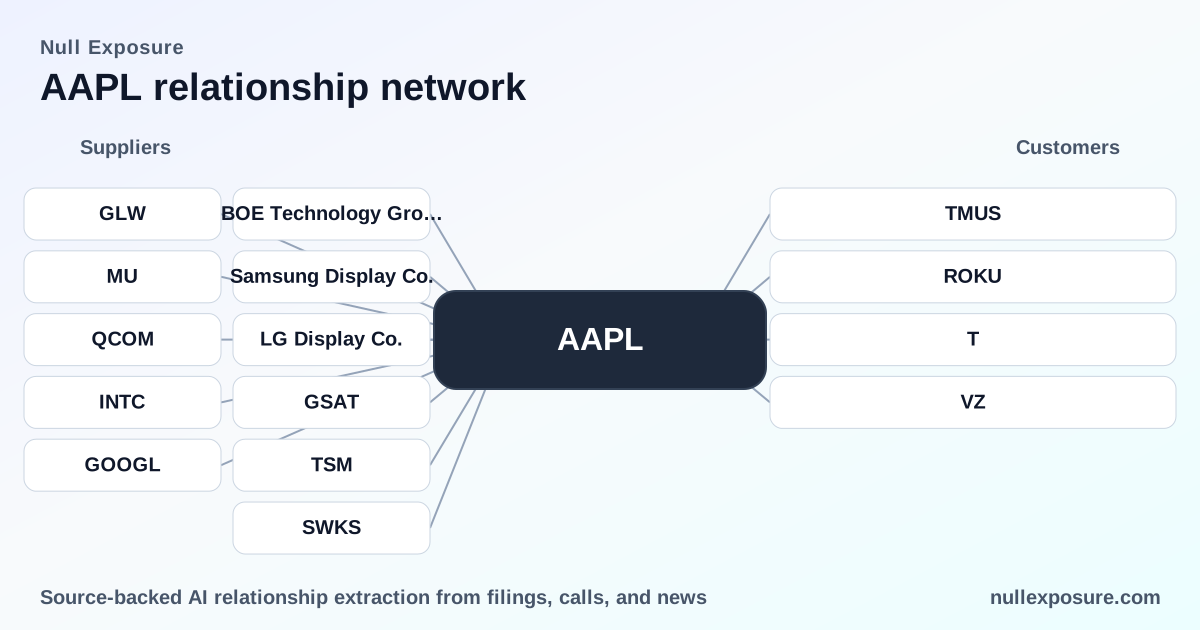
Apple (AAPL) — supplier map and what it means for investors
Thesis: Apple designs and monetizes tightly integrated hardware, software and services ecosystems; it outsources the vast majority of physical manufacturing and key components to a global supplier base while capturing margin through device and services sales, platform lock‑in, and recurring services. For investors, Apple’s supplier relationships translate into very large, short‑dated manufacturing commitments, high operational criticality for a handful of partners, and geographic concentration in APAC manufacturing plus a growing onshore investment program that reshapes where economic benefits accrue. Explore deeper supplier signals at https://nullexposure.com/.
Quick framing: how Apple structures supplier economics
Apple’s business model converts product design, software IP and consumer demand into recurring hardware volume; suppliers convert that volume into cash flow. Apple negotiates short to medium procurement cycles, keeps substantial leverage through scale, and uses multiyear strategic commitments selectively (for example, U.S. manufacturing initiatives) to secure capacity and political goodwill. The result: high spend with concentrated counterparty risk, but also strong negotiating power and a proclivity for near‑term purchase obligations (billions payable within 12 months).
The supplier relationships investors need to know
Below I list every relationship captured in the results and a concise commercial takeaway with source context.
-
MP — Long‑term, high‑value agreement to supply American‑made rare‑earth magnets from recycled materials, including an upfront prepayment and dedicated recycling/magnet lines; shipments expected to start in 2027. Source: MP earnings calls (2025Q3 / 2025Q2) and FY2026 press coverage.
-
Samsung Display Co. — Reported as the largest supplier of OLED panels for Apple’s entry‑level iPhone 17e in FY2026, taking meaningful panel share. Source: TheLec news (FY2026).
-
Globalstar (GSAT) — Serves as a wholesale satellite capacity provider for Apple’s emergency and satellite messaging features; Apple invested and took equity, with Globalstar allocating the bulk of network capacity to Apple. Source: SpaceIntelReport and Deal/Reuters filings (FY2025–FY2026).
-
RERE — Provided trade‑in and device upgrade support with Apple among retail partners, enabling lifecycle and refurbishment programs. Source: RERE earnings call (2025Q3).
-
BOE Technology Group Co. — Supplied large volumes of OLED panels for iPhone in 2024 and into FY2026, supporting Apple’s panel diversification. Source: TheLec reporting (FY2026).
-
VNO‑P‑L (Vornado) — Apple signed a direct lease expanding its Midtown South footprint to 460,000 sq ft, reflecting corporate real estate relationships with operators. Source: The Real Deal / CommercialCafe reporting (FY2024).
-
GFS (GlobalFoundries) — Expanded U.S. capacity and announced Apple‑related production for wireless connectivity and power management chips in U.S. fabs, supported by a multi‑billion investment plan. Source: GlobalFoundries earnings calls and FY2025–FY2026 coverage.
-
LLYVA / LLYVK — Reported that F1 (and related distribution partners) signed a U.S. distribution partnership with Apple, suggesting content and retail distribution ties. Source: company earnings call transcripts (2025Q3).
-
GLW / Corning — Under a multibillion‑dollar supply agreement to manufacture 100% of iPhone and Apple Watch cover glass in the U.S., anchored by a $2.5 billion Apple commitment to the Kentucky facility. Source: Corning earnings calls (2025Q3/2025Q4) and USAToday/The Globe and Mail reporting (FY2026).
-
ANET (Arista/Anet context) — Apple listed among AI and specialty customers performing strongly in recent specialty provider growth commentary. Source: ANET earnings call (2025Q4).
-
GS (Goldman Sachs) — Involved in the announced transition of the Apple Card portfolio and related consumer finance arrangements. Source: Goldman Sachs earnings commentary (2025Q4).
-
LG Display Co. — Named as a panel supplier to complement BOE and Samsung for Apple displays in FY2026. Source: TheLec news (FY2026).
-
COHR (Coherent) — Entered a multiyear agreement to supply a new generation of VCSEL products supporting iPhone and iPad models as part of Apple’s American manufacturing program. Source: Coherent earnings call (2025Q4) and FY2026 coverage.
-
IDCC (InterDigital) — Maintains long‑dated licensing agreements with Apple and other top smartphone vendors, supplying predictable recurring licensing revenue. Source: InterDigital earnings call (2025Q4 / FY2026 coverage).
-
Google / GOOGL — Announced collaboration to adopt Google’s Gemini models to power Siri and Apple foundation models, indicating strategic cloud/AI provider relationships. Source: Google earnings and SiliconANGLE reporting (2025Q4 / FY2026).
-
LITE (Lumentum) — Supplies VCSEL and 3D sensing components used in Apple FaceID and sensing hardware. Source: financial content reporting (FY2026).
-
TSM / Taiwan Semiconductor Manufacturing (TSM) — Apple is a top customer; TSMC agreed to make advanced chips for Apple including production at its Arizona facility and other U.S. capacity commitments. Source: multiple FY2026 news items and TSMC coverage.
-
ARM — Secured a long‑term licensing arrangement with Apple that extends beyond 2040, embedding Arm architectures into Apple’s silicon roadmap. Source: market commentary and SimplyWallSt (FY2026).
-
SWKS (Skyworks Solutions) — Identified as a key RF supplier to iPhones; device launch timing and handset mix influence near‑term demand. Source: trading and analyst coverage (FY2026).
-
MA (Mastercard) — Confirmed to remain the exclusive network for the Apple Card while issuer arrangements transition; an important payment‑network relationship. Source: Mastercard earnings call (2025Q4).
-
CRUS (Cirrus Logic) — Named a technical partner in Apple’s U.S. manufacturing program to develop mixed‑signal and FaceID‑related solutions; extremely high revenue exposure to Apple. Source: Cirrus Logic news and earnings (FY2026).
-
QRVO (Qorvo) — Developing custom RF products for Apple, with R&D investment cited as increasing near‑term costs. Source: market reports and analyst coverage (FY2026).
-
PODC (PodcastOne) — Content distributor whose shows are available on Apple Podcasts, reflecting digital distribution relationships. Source: company press releases and FY2025–FY2026 coverage.
-
LVO (LiveOne) — Expanded B2B distribution that includes Apple platforms and devices, broadening content partnerships. Source: LiveOne press (FY2026).
-
KRC (Kilroy Realty Corp.) — Apple leased major office space in South Lake Union, a corporate real estate supplier relationship. Source: local press (FY2025).
-
IN VN / INVN (InvenSense) — Historical and reported supplier of motion sensors to Apple; transactional M&A rumors appear periodically. Source: legacy reporting and FY2014/2016 references.
-
JBL / JBL (Jabil) — Identified as a large EMS and contract manufacturer building hardware for Apple and other OEMs. Source: ad‑hoc financial news (FY2026).
-
MU / Micron — Working with Apple on advanced packaging and test facilities, reflecting memory and packaging supply relationships. Source: Apple earnings call (2026Q1) and Micron reporting.
-
SYF‑P‑A / CFG‑P‑E / various banker and BNPL tickers — Reflect financial services partners and BNPL/payment platform integrations with Apple merchant programs. Source: industry reporting (FY2023–FY2025).
-
GAIA — Streaming and app distribution relationships include Apple TV and iOS platforms. Source: Gaia press and investor communications (FY2024–FY2026).
-
FWONK / FWONA (Liberty Media / Formula 1) — Apple secured U.S. F1 streaming rights as part of a content deal for Apple TV+, generating estimated annual revenue and strategic content exposure. Source: Liberty/industry reporting (FY2025–FY2026).
-
STMicroelectronics (STM) — Identified as connected to Apple handset component flows in broader chip supplier commentary. Source: STM market reporting (FY2026).
-
SONY — Cited in imaging sensor advances and supplier commentary tied to Apple product roadmaps. Source: industry coverage (FY2026).
-
TER (Teradyne) — Supplier of semiconductor test equipment and identified as a partner to Apple and TSMC in fab test capabilities. Source: Morningstar coverage (FY2026).
-
INTT (inTEST) — Test equipment vendor that counts Apple among customers; represents capital equipment supplier relationships. Source: corporate background (FY2020).
-
DOCU (DocuSign) — Mentioned as an Apple sublease tenant in Dublin and supplier of workflows via enterprise deployments. Source: earnings/news (FY2026).
-
PLTK (Playtika), AMCX (AMC Networks), MANU (Manchester United), SPG‑P‑J (Simon Property preferred), KPLT and others — These entries reflect content, distribution, retail and marketing tie‑ins where Apple functions as platform or distribution partner rather than a traditional component supplier. Source: press and market reports (FY2024–FY2026).
(If you want a downloadable extract of every source link and date for modeling or due diligence, visit https://nullexposure.com/.)
Supply‑chain constraints and operating signals
Apple’s supplier footprint shows clear structural characteristics:
- Contracting posture: short‑dated manufacturing obligations. Apple reports significant manufacturing purchase obligations due within 12 months, implying heavy near‑term cash commitments rather than decades‑long fixed contracts.
- Geographic concentration in APAC for production. A large share of hardware manufacturing is performed across China, Taiwan, South Korea, Vietnam and other APAC markets, with an intentional shift to select U.S. fabs and plants for political diversification and “American Manufacturing” optics.
- Materiality and counterparty criticality. While many components are multi‑sourced, Apple relies on single or limited sources for a number of critical elements, creating asymmetric operational risk for both Apple and those suppliers.
- Role profile: manufacturer‑centric with service support. The supply base functions primarily as manufacturers and component providers; logistics and transportation services are outsourced at scale.
- Spend magnitude and stage. Purchase obligations and public reporting show $100M+ spend bands and active supplier engagements across chip, optics, glass, displays, and satellite capacity.
What investors should focus on next
- Watch prepaid / prepayment clauses (as with MP/GSAT) because they shift working capital and operational risk to suppliers and can create measurable revenue visibility for suppliers.
- Monitor TSMC, Corning and GlobalFoundries capacity expansions — these partners determine Apple’s ability to scale new features and U.S. onshoring.
- Gauge single‑source exposures in components (VCSEL, magnetics, specialty glass, satellite capacity) for asymmetric downside if execution falters.
For a compact extraction of these supplier relationships and source references suitable for diligence, visit https://nullexposure.com/ to request the structured export.
Bold takeaway: Apple’s supplier model combines short‑dated, high‑value purchasing with concentrated critical suppliers and a deliberate push to onshore select manufacturing — a dynamic that magnifies both supplier upside and systemic concentration risk.