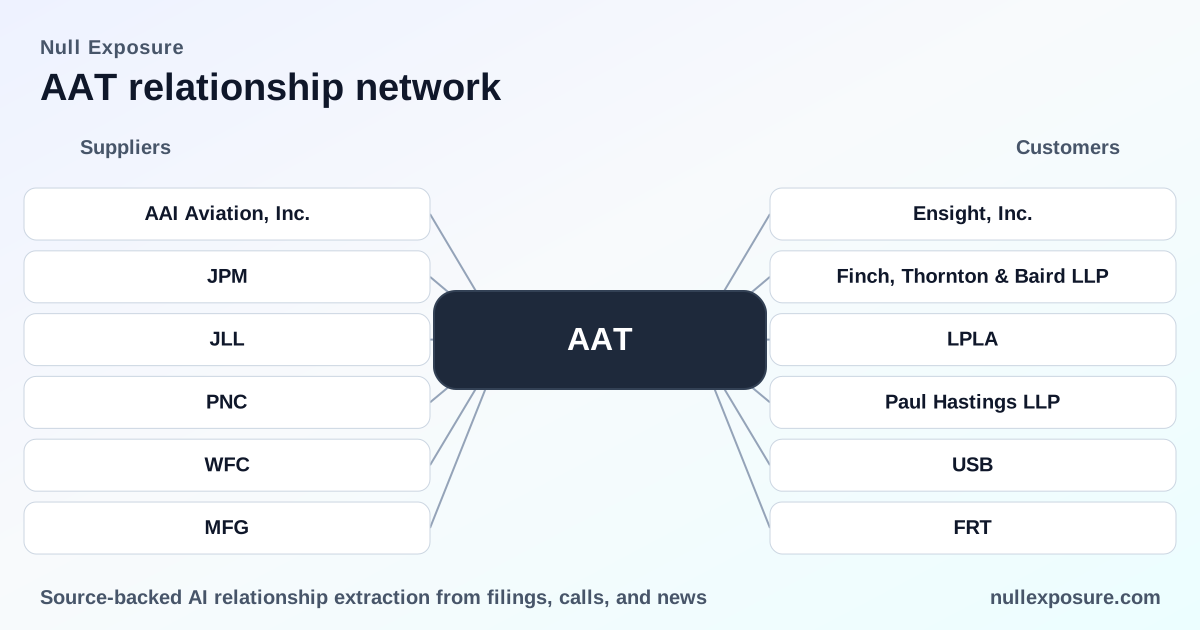
AAT supplier map: who American Assets Trust hires, pays, and partners with
American Assets Trust (AAT) runs a geographically diverse commercial real estate portfolio and monetizes through property operations, asset sales and capital markets access; the company outsources specialized services (hotel management, brokerage, capital markets underwriting and ad hoc aviation services) and finances assets through public offerings led by major banks. For investors this means operational cash flow is tightly coupled to third-party operators and capital markets relationships—inspect long-term brand licenses, variable management fees, and underwriting counterparties when assessing earnings durability and refinancing risk. For a concise supplier index and ongoing updates, see https://nullexposure.com/.
How AAT structures supplier economics and contract posture
AAT’s supplier model combines long-term, lock‑in agreements with usage‑based operating fees, creating a blended risk profile between fixed contractual commitments and variable operating costs. Company filings disclose a 20‑year franchise license to operate an Embassy Suites brand through a wholly owned subsidiary, which is a long‑duration commitment that secures brand value but limits flexibility on that asset. At the same time, hotel and retail management agreements use percentage‑based fees—for example, management fees tied to net revenues or gross operating profit—so operating margins are sensitive to both occupancy and manager incentives.
Company‑level signals also indicate a high degree of reliance on third‑party service providers across functions: hotel managers, retail managers, insurance carriers, cybersecurity consultancies and ad hoc vendors. These are active arrangements: the company explicitly reports ongoing management agreements with Outrigger for its Waikiki property, highlighting current operational dependence on experienced third‑party operators.
Key contract characteristics to carry forward when underwriting:
- Duration concentration: presence of multi‑decade franchise licenses increases asset-level stability but reduces operational optionality.
- Variable cost exposure: usage‑based management fees align operators with revenues but amplify cost volatility in downturns.
- Service dependency: multiple specialty service providers are critical to day‑to‑day operations and regulatory qualification (REIT/TRS considerations).
- Active relationships: filings identify currently active management contracts rather than dormant or terminated agreements.
Counterparty map: counterparties and what they do for AAT
AAI Aviation, Inc.
AAT uses aircraft services provided by AAI Aviation, Inc., an entity owned and controlled by Mr. Rady, on an occasional basis according to the company’s FY2025 10‑K; this is a related‑party operational service that investors should monitor for governance and cost disclosure. (Company FY2025 Form 10‑K)
JPM (JP Morgan / JP Morgan Asset Management)
A ConnectCRE report referencing a FY2019 transaction states JP Morgan Asset Management was the seller of a developed project that AAT interacted with, indicating previous asset disposition activity with JP Morgan’s asset management arm. (ConnectCRE, FY2019)
JP Morgan Asset Management
The same ConnectCRE coverage (FY2019) describes JP Morgan Asset Management as developing and selling the project in question, which reflects AAT’s engagement with large institutional owners and the potential for secondary market trades with major asset managers. (ConnectCRE, FY2019)
JLL
JLL acted on behalf of the seller, American Assets Trust, in at least one disposition cited in fiscal‑period reporting, demonstrating AAT’s use of major brokerage houses for asset marketing and transaction execution. (JLL newsroom coverage, FY2025)
Wells Fargo Securities / WFC
Public reporting tied to a FY2024 offering names Wells Fargo Securities (and the Wells Fargo group) as a joint book‑running manager on a $525 million securities issuance, signaling a funding relationship and capital markets distribution capacity through Wells Fargo. (StockTitan/press coverage of FY2024 offering)
PNC Capital Markets LLC
PNC Capital Markets LLC is named alongside other banks as a joint book‑running manager on the same FY2024 offering, giving AAT access to PNC’s syndicate and institutional investor reach in debt/equity placements. (StockTitan/press coverage of FY2024 offering)
Mizuho
Mizuho participated as a joint book‑running manager on AAT’s FY2024 capital raise, indicating a syndicated capital markets relationship with Japanese banking franchise capacity for underwriting and distribution. (StockTitan/press coverage of FY2024 offering)
(Note: the FY2024 offering reporting lists Wells Fargo Securities, Mizuho and PNC Capital Markets as joint book‑running managers; multiple press items reference the same underwriting group.)
What these relationships imply for investors: risk, runway and governance
The supplier universe visible in filings and press coverage is a mix of transactional capital markets counterparties, ongoing operational managers, and specialty service vendors. Translate that into investment questions:
- Earnings sensitivity to operators: Usage‑based fees (management percentages on revenues or gross operating profit) align operator incentives but increase expense volatility when occupancy falls; evaluate downside scenarios where operator payouts compress NOI.
- Contract duration and optionality: Long‑term franchise licenses (20 years for the Embassy Suites example disclosed in filings) lock brand economics and can support stable cash flows, but they limit asset‑level rebranding or repositioning in a changing market.
- Related‑party operational exposure: Occasional use of aircraft services from an entity owned by management (AAI Aviation, Inc.) is a governance flag; confirm pricing transparency, board oversight and disclosure in proxy/filings.
- Capital markets access: Repeat engagements with large underwriters (Wells Fargo, PNC, Mizuho) indicate continued access to syndicated debt/equity markets; underwriter relationships are a liquidity asset but are contingent on credit markets and AAT’s balance sheet health.
- Brokerage and disposition channels: Use of firms like JLL for sales underscores a professional disposition process that supports liquidity, especially for non‑core assets.
Investors should weigh these attributes together: AAT’s operating model blends stability from long‑term brand arrangements with sensitivity from percentage‑based manager fees and third‑party dependency, while capital markets counterparties supply financing runway.
For a broader supplier map and deeper counterparty analytics, visit https://nullexposure.com/ for regularly updated relationship tracking.
Quick checklist for due diligence
- Confirm disclosure of management fee formulas and annual caps (important for stress testing margins).
- Request transaction‑level detail on related‑party services (frequency, pricing, approvals).
- Review underwriting terms from FY2024 offerings for covenant and maturity structure.
- Assess concentration: how much NOI or transactions flow through each external manager or book‑runner.
Conclusion: AAT’s supplier footprint is conventional for a diversified REIT but carries concentrated governance and variable‑cost risks that materially affect cash flow under stress. Active monitoring of management agreements, franchise terms and underwriting partnerships is essential for a robust investment thesis.