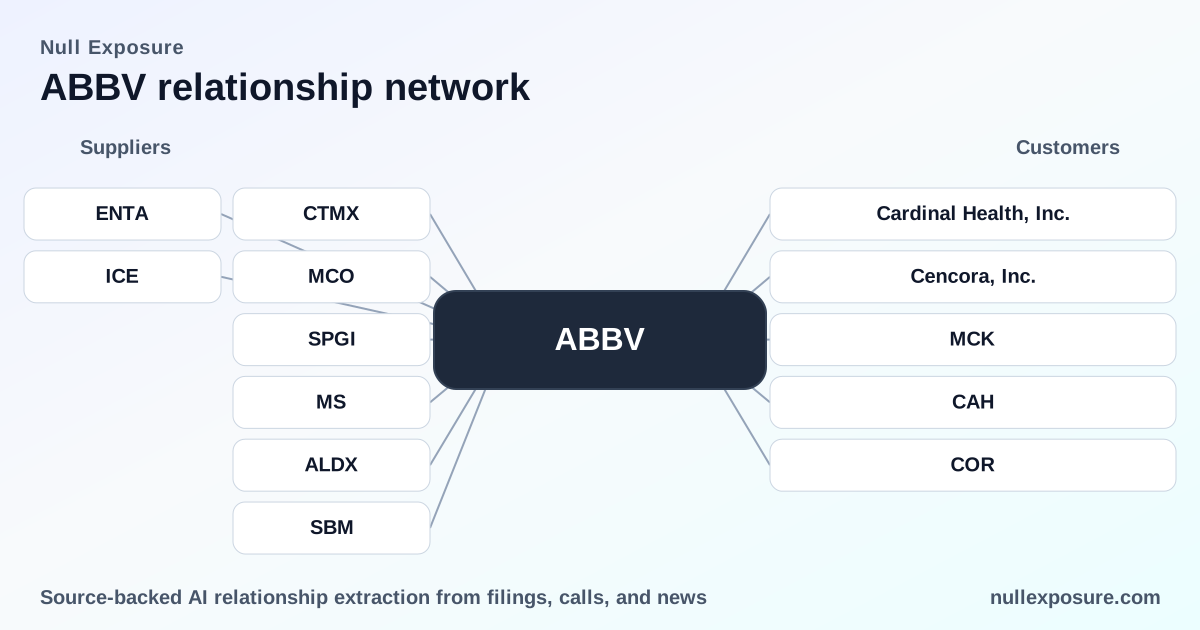
AbbVie’s Supplier Footprint: Commercial partners, milestone economics and what investors should know
AbbVie is a large-cap biopharmaceutical company that monetizes through global product sales, royalties and structured collaborations — often paying upfront, milestone and royalty economics to and receiving milestone‑linked assets from third parties. With trailing revenue of roughly $62.8 billion and a market capitalization near $368 billion, AbbVie’s commercial model combines direct manufacturing and distribution with a steady pipeline of external collaborations that transfer both upside and program execution risk. For investors focused on supplier exposure, the relevant signal is not single-vendor dependency but a broad roster of partners whose payments and milestones flow into or out of AbbVie’s P&L and cash commitments. Learn more at NullExposure.
How AbbVie sources services and why that matters to equity and counterparty risk
AbbVie contracts globally for raw materials, manufacturing and specialized services and classifies most manufacturing and service agreements as immaterial to the business on a per-agreement basis. The company uses third‑party manufacturers and external service providers for process development, analytics and hosting of certain IT systems, and it requires security and data‑use covenants in contracts. That posture produces three practical investor signals:
- Low contract concentration per supplier: AbbVie’s filings describe many relationships rather than reliance on a single counterparty, which limits single‑vendor operational risk.
- Operational criticality is distributed: manufacturing and service roles are important but AbbVie treats individual agreements as immaterial, implying internal capacity to replace or qualify alternates.
- Third‑party maturity and regulatory exposure: the company’s regulatory filings note FDA inspections identify issues at third‑party manufacturers, so supplier quality can create episodic program risk.
A mid‑article note: for a searchable map of these partner exposures, visit NullExposure.
Relationship map — partners, economics and source notes
Below are every company referenced in the supplied relationship results, distilled into one or two clean investor‑focused sentences each with source context.
- CollPlant Biotechnologies (CLGN) — CollPlant holds a development and global commercialization agreement with Allergan (an AbbVie company) for dermal and soft‑tissue fillers and has received milestone payments (including a $10M payment previously and a $2M milestone in 2025). Source: CollPlant filings and press releases (FY2023–FY2026).
- Caris Life Sciences (CAI) — Caris licenses multi‑omic data and molecular profiling outputs to AbbVie for drug discovery; the arrangement is presented as one of many biopharma partnerships that add value to AbbVie’s pipeline decisions. Source: Caris SEC filing (FY2025).
- Enanta Pharmaceuticals (ENTA) — Enanta earns ongoing royalty revenue tied to AbbVie’s MAVYRET/MAVIRET HCV regimen, which contributes materially to Enanta’s top line in FY2025–FY2026. Source: Enanta press releases and earnings commentary (FY2025–FY2026).
- Alector (ALEC) — AbbVie paid Alector an upfront multi‑hundred‑million dollar sum to co‑develop two Alzheimer’s candidates under an exclusive option structure; the relationship proceeded through clinical milestones and later program failures that affected Alector’s staffing and operations. Source: industry reporting (FY2017–FY2024).
- Ironwood Pharmaceuticals (IRWD) — AbbVie is Ironwood’s U.S. partner for LINZESS U.S. net sales and reimburses a portion of Ironwood’s commercial expenses in the U.S., creating collaborative revenue reimbursement for Ironwood. Source: Ironwood press releases and FY2025 guidance (FY2025–FY2026).
- Aldeyra Therapeutics (ALDX) — Aldeyra entered an exclusive option agreement granting AbbVie rights to license and collaborate on reproxalap with potential milestone and profit‑sharing economics. Source: Aldeyra SEC filings and press reporting (FY2026).
- Mustang Bio (MBIO) — Mustang divested certain fixed assets, including furniture and equipment, to an AbbVie Bioresearch Center for approximately $1 million as part of facility and cost restructuring. Source: Mustang/industry news (FY2025–FY2026).
- Xilio Therapeutics (XLO) — Xilio reported collaboration, license and option revenues driven by a 2025 agreement with AbbVie that included upfront consideration (reported at $52M) and milestone recognition tied to program progress. Source: Xilio press releases and financial reports (FY2025–FY2026).
- EvolveImmune Therapeutics — EvolveImmune announced a preclinical milestone in its AbbVie collaboration that triggered an $18M payment, illustrating AbbVie’s use of staged milestones to externalize early‑stage development risk. Source: InvestingNews (FY2026).
- Regenxbio (RGNX) — Regenxbio reported that activation of a pivotal study would trigger a $100M milestone from AbbVie tied to a diabetic retinopathy program, reflecting large, binary milestone structures in AbbVie deals. Source: Regenxbio earnings call transcript (FY2026).
- Caribou Biosciences (CRBU) — Caribou received a $30M upfront payment from AbbVie in an earlier partnership, showing AbbVie’s willingness to invest upfront for platform or therapeutic rights. Source: MedCityNews (FY2021).
- West Pharmaceutical Services (WST) — West’s pending mid‑2026 divestiture of its SmartDose 3.5mL on‑body delivery system to AbbVie introduces transition and integration considerations into the manufacturing and supply chain narrative. Source: 247wallst / Investing.com coverage (FY2026).
- Enveric Biosciences (ENVB) — Reporting indicates AbbVie acquired the asset bretisilocin from Enveric in a transaction valued at up to $1.2 billion, an example of asset purchases that transfer late‑stage development risk to AbbVie. Source: market reports and registries (FY2026).
- Haisco Pharmaceutical — Industry coverage details a licensing deal with AbbVie for a pain medicine, representing AbbVie’s external sourcing of specific therapeutic chemistries. Source: BioSpace reporting (FY2026).
- Kestrel Therapeutics — Kestrel granted AbbVie an exclusive option and warrant structure tied to pan‑KRAS clinical milestones, illustrating acquisition‑style option economics in strategic deals. Source: BioSpace / company release (FY2026).
- Sirona Biochem Corp. (SBM) — Sirona entered a global exclusive licensing agreement with Allergan Aesthetics (AbbVie) to develop and commercialize topical skin products. Source: Sirona press release and investing coverage (FY2026).
- Voyager Therapeutics (VYGR) — Historical references note AbbVie’s prior Alzheimer’s collaboration that was later severed, an example of agreements that can be wound down as strategic priorities shift. Source: BioSpace (FY2021).
- Neurocrine Biosciences (NBIX) — Neurocrine receives royalties from AbbVie on U.S. sales of elagolix‑based products, contributing to Neurocrine’s recurring royalty income. Source: analyst coverage and earnings notes (FY2026).
- Molecular Partners (MOLN) — Molecular Partners has manufacturing experience at commercial scale with Allergan for DARPin therapeutics, reflecting supply arrangements connected to AbbVie’s Allergan unit. Source: Manufacturing‑Today profile (FY2024).
- Royalty Pharma (RPRX) — Royalty Pharma’s portfolio includes royalty interests tied to products sold by AbbVie (for example Imbruvica), showing the secondary‑market monetization of AbbVie‑linked cash flows. Source: Royalty Pharma 10‑K disclosures (FY2025).
- RemeGen (688331.SHH) — AbbVie licensed RemeGen’s PD‑1/VEGF bispecific with $650M upfront and substantial biobucks, illustrating large upfront cash and contingent payments in global licenses. Source: BioSpace coverage (FY2026).
- Morgan Stanley Smith Barney LLC (MS) — Appears in ABBV SEC filings as a listed broker/executor in institutional transaction disclosures. Source: ABBV SEC filing (FY2026).
- Intercontinental Exchange / NYSE / ICE / NYSE references — SEC filings reference trading venues and listing details for AbbVie equity transactions. Source: ABBV SEC filing excerpts (FY2026).
- Moody’s (MCO) and S&P (SPGI) — Credit rating confirmations and related bond market reporting were cited around AbbVie debt issuance, relevant to counterparty financial profile and borrowing costs. Source: market coverage (FY2026).
- CytomX Therapeutics (CTMX) — Historical milestone revenue for CytomX included payments from AbbVie for collaboration programs, an example of milestone‑driven partner income. Source: CytomX disclosures and news archives (FY2020–FY2026).
- AbCellera (ABCL) — AbCellera disclosed a multi‑target, multi‑year oncology collaboration with AbbVie, reflecting long‑lived discovery and R&D partnership structures. Source: AbCellera 10‑K (FY2025).
- Revolution Medicines (RVMD) — Market commentary shows investor sensitivity to speculative AbbVie deal narratives around certain oncology assets, underlining how AbbVie deal flow impacts small‑cap valuations. Source: market commentary (FY2026).
Key investor takeaways and risk checklist
- Diversified partner list reduces single‑supplier concentration risk: AbbVie’s model spreads manufacturing and development across many third parties and uses milestone triggers to time payments.
- Regulatory dependence on third‑party manufacturing is a recurring execution risk: FDA observations tied to third‑party manufacturers are explicitly documented in filings, so product approvals can be delayed for supplier quality issues.
- Milestone and royalty structures align cash flows with program progress: AbbVie often pays upfront and milestones (or acquires assets), shifting early R&D risk onto partners while creating contingent future liabilities.
- Royalty streams create small‑cap funding tails: Several small partners (Enanta, Royalty Pharma interests, etc.) continue to receive material royalties or milestones from AbbVie, which supports their cash flow but creates dependency on AbbVie sales performance.
For a deeper, searchable breakdown of these supplier exposures and their fiscal periods, visit our research portal at NullExposure.
This synthesis pulls directly from company filings, press releases and market reports cited above (FY2020–FY2026) to map how AbbVie contracts across manufacturing, licensing and commercialization — the practical levers that drive counterparties’ revenues and AbbVie’s contingent liabilities.