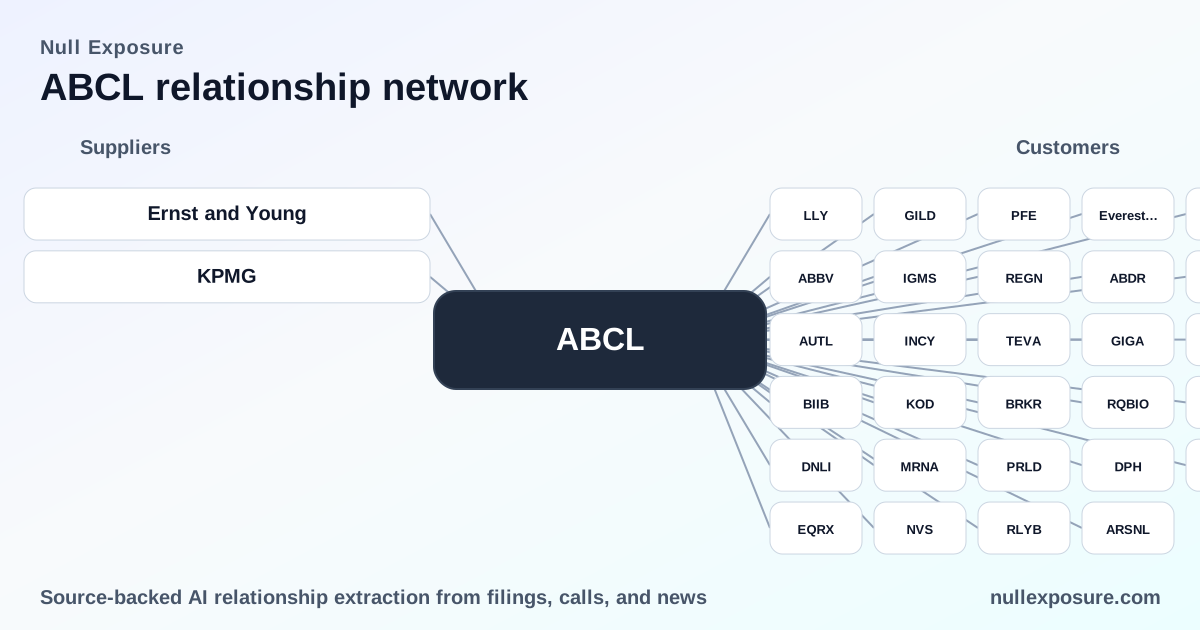
AbCellera Biologics (ABCL): Supplier relationships that shape commercialization risk and upside
AbCellera operates an antibody discovery and early-development platform that monetizes through collaboration agreements, option and license payments, and milestone-triggered fees from biopharma partners. The company outsources most laboratory and manufacturing functions to third parties, and derives near-term cash flow from partner licensing deals rather than product sales. For investors evaluating supplier exposure, ABCL’s model is partner-driven, concentrated around a small set of critical external providers and strategic collaborators. For a practical supplier-risk briefing and continuous monitoring, visit https://nullexposure.com/.
How AbCellera makes money and why suppliers matter
AbCellera converts proprietary discovery capability into licensing revenue: partners pay upfront and license fees, trigger milestones, and fund development work. That structure compresses internal capital needs but amplifies reliance on external collaborators, contract manufacturers, CROs, and reagent suppliers. Supplier performance and contracting posture therefore directly affect revenue realization, program timelines and the company’s ability to scale. The next sections map the concrete relationships disclosed in recent public reporting and news coverage, and translate them into operational and portfolio risk.
Direct partner relationships: Prelude Therapeutics (PRLD)
- Prelude Therapeutics. AbCellera expanded a collaboration with Prelude that generated an additional license payment in October 2025 and broader rights under an amended DAC collaboration permitting Prelude’s degrader payloads to be used on new antibody targets and in licensing to third parties; Prelude also disclosed upfront consideration from option and license agreements that include AbCellera in FY2026 commentary. According to Prelude’s November 12, 2025 press release and Prelude’s FY2025–FY2026 reporting in early May 2026, the amendment broadens payload access and produced near-term license income. (GlobeNewswire, Nov 12, 2025; Prelude FY2025/FY2026 reports, May 2026; TradingView summary, May 3, 2026)
Capital markets and IPO underwriters (historical financing relationships)
- Credit Suisse. Served as one of the underwriters for AbCellera’s IPO, a sign of historical capital-market relationships that supported access to public equity. (MarketBeat instant alert, March 15, 2026)
- Stifel. Participated as an IPO underwriter, indicating distribution relationships within equity markets and sell-side coverage ties. (MarketBeat instant alert, March 15, 2026)
- BMO Capital Markets. Listed among the IPO underwriters, representing Canadian investment banking linkage to the company’s capital formation. (MarketBeat instant alert, March 15, 2026)
- SVB Leerink. Named as an underwriter, reflecting specialized healthcare banking engagement during the IPO process. (MarketBeat instant alert, March 15, 2026)
- Berenberg. Included in the syndicate of underwriters for the IPO, providing additional European distribution and sell-side engagement. (MarketBeat instant alert, March 15, 2026)
These underwriting relationships are historical but relevant: they reflect AbCellera’s ability to access institutional capital and the investment-banking ecosystem that supports follow-on financings and visibility to institutional investors.
Audit and financial controls relationships
- Ernst & Young (EY). The board moved to appoint Ernst & Young as auditor beginning the 2026 fiscal year, representing a major change in financial oversight and external assurance. (SimplyWallSt commentary, March 9, 2026)
- KPMG. The company replaced long-time auditor KPMG with EY for the 2026 fiscal year, indicating a board-level decision on financial reporting partners. (SimplyWallSt commentary, March 9, 2026)
Audit transitions are material operational signals: a change in external auditor affects disclosure processes, audit scope, and potentially investor confidence in reported controls.
What the relationships collectively imply about ABCL’s contracting posture and concentration
- Outsourced, partner-led commercialization. Contract language and disclosures repeatedly show AbCellera outsources manufacturing and depends on partners to deploy payloads and carry programs forward; this produces a distributive contracting posture where AbCellera licenses IP and relies on counterparty execution to realize revenue.
- Concentration in critical supplier categories. The company identifies a limited set of suppliers for laboratory equipment, reagents and third‑party manufacturers; these relationships are critical to ongoing operations and program timelines rather than peripheral services.
- Regulatory and contractual frictions. U.S. manufacturing-preference clauses and local regulatory regimes constrain global supplier selection and can force additional contracting costs or limit partner choices in some programs.
- Financial-market ties for liquidity and credibility. Underwriter and auditor relationships show institutional pathways for capital and governance but do not reduce operational supplier concentration.
Constraints and risk factors that investors must weigh
Treat the following as company-level signals (not tied to any single named supplier unless explicitly stated in disclosures):
- Government counterparty exposure. AbCellera operates in environments where hospitals and officials are government-affiliated; this raises compliance obligations under FCPA-style frameworks and increases procurement complexity in certain geographies.
- Geographic footprint. Facilities and leases span Vancouver, Montreal, Sydney and Boston, indicating North America and APAC operational footprints that create multi‑jurisdictional supplier and regulatory complexity.
- Critical supplier dependency. The company cites a limited pool of third‑party manufacturers and specialized suppliers for reagents and equipment; shortages or price volatility in these inputs can delay trials and partnerships.
- Manufacturing outsourcing. AbCellera currently outsources all manufacturing to third parties and acknowledges that third-party compliance with regulations is a single point of failure that can cause supply interruptions or clinical holds.
- Relationship roles include distributor, manufacturer and service provider. The company anticipates engaging distributors for commercialization and relies on CROs and clinical sites as critical service providers.
- Program termination and regulatory stoppages. Trials or supplier contracts can be suspended or terminated by regulators, IRBs or trial sites, creating stoppage risk that directly affects partner milestone payments.
Practical implications for investors and operators
- Revenue sensitivity. Licensing and option payments (e.g., Prelude collaboration amendments) deliver episodic revenue spikes tied to partner milestones rather than steady product sales; supplier disruptions therefore translate to near-term cash-flow volatility.
- Operational leverage. A small number of critical suppliers for reagents and contract manufacturing create high operational leverage: replacements are feasible but time-consuming and expensive.
- Compliance and regional constraints. The U.S. manufacturing preference and government-counterparty exposure increase costs and narrow supplier choice for certain programs, particularly those with U.S. government funding or IP encumbrances.
For investors seeking continuous monitoring of these supplier signals and public-source relationship updates, explore enhanced coverage at https://nullexposure.com/.
Bottom line: where ABCL stands from a supplier-risk perspective
AbCellera’s commercial strength is its discovery engine and partner network; its primary vulnerability is supplier concentration and outsourced manufacturing that is both critical and material to revenue realization. The Prelude collaboration demonstrates the upside of partner licensing, while auditor and underwriter changes reflect governance and capital-market maturity. For investors and operators, the correct posture is active monitoring of partner milestone realization, supplier substitution timelines, and regulatory constraints that affect manufacturing locations.
Key action: prioritize diligence on contract terms for manufacturing and reagent supply, and maintain scenario models for revenue recognition tied to partner milestones rather than product sales.