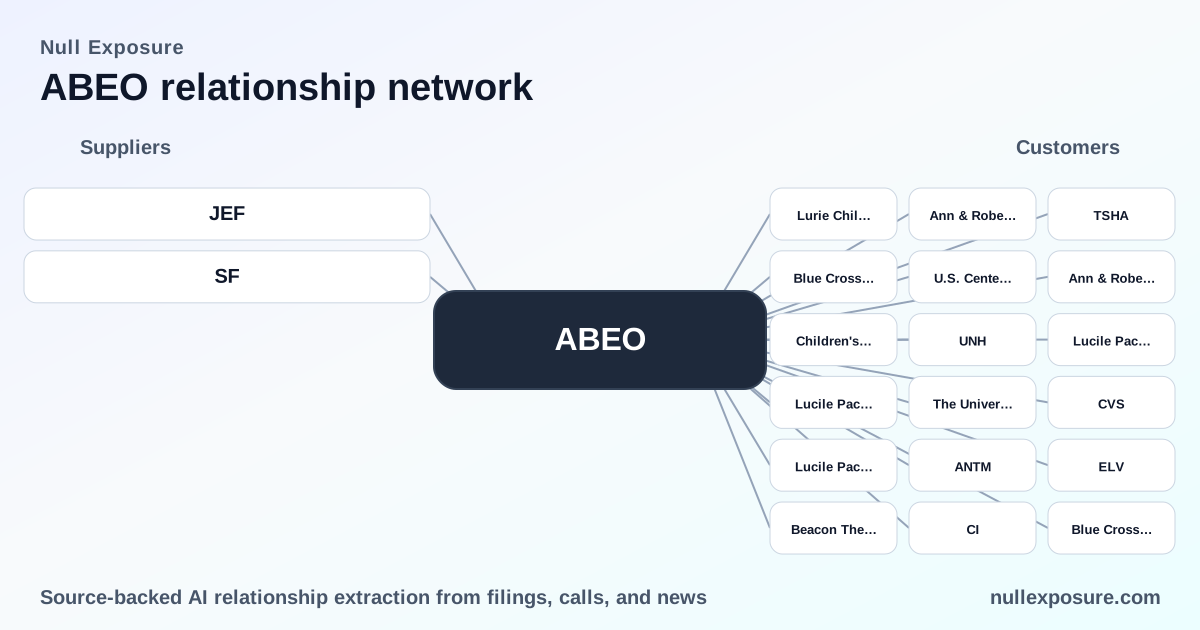
What ABEO’s supplier map tells investors about operational leverage and risk
Abeona Therapeutics (ABEO) operates as a clinical-stage biopharma that monetizes through milestone and asset transactions, licensing and capital markets activity while relying heavily on third-party suppliers for audit, transfer-agent services, compensation benchmarking and capital markets executions. For investors, the supplier footprint is a concentrated mix of professional services and financial advisors that support corporate governance, liquidity events and clinical manufacturing/outsourcing, with near-term cash and contract maturities shaping strategic options. For a quick company overview and supplier insights, visit NullExposure.
How the company’s contracting posture and supplier constraints shape valuation
ABEO’s public disclosures reveal a mix of long-term financial commitments and active third‑party service relationships that materially affect near-term liquidity and operational continuity. The company’s Loan Agreement (senior secured term loans with maturity July 1, 2027) signals multi-year financing obligations that influence capital allocation and counterparty negotiation leverage. ABEO also runs open-market equity programs and licensing arrangements that function as ongoing frameworks for capital and IP management. These are not theoretical risks — they are active contract types that will dictate fundraising cadence, dilution risk, and supplier selection going forward.
- Contracting posture: Evidence of long-term debt (maturing 2027) plus an active at-the-market (ATM) sales agreement establishes both fixed obligations and flexible equity issuance capacity.
- Concentration & criticality: The supplier roster skews toward high-impact governance and financial services (auditors, transfer agents, financial advisors), reflecting concentration in mission‑critical third‑party roles rather than broad vendor diversification.
- Maturity & stage: Multiple relationships are active in FY2025–FY2026 filings, consistent with a company in an execution phase (asset monetization, clinical development) rather than steady-state commercial operations.
- Operational implication: The company’s reliance on third-party manufacturers and service providers for clinical material and regulatory filings introduces execution risk and potential timeline sensitivity that translate directly into valuation and financing needs.
Supplier map: the relationships investors should audit
Below I list every supplier relationship referenced in ABEO’s filings and press reports in the provided results. Each entry has a concise plain-English summary and a source cue.
Deloitte & Touche LLP
ABEO’s Audit Committee appointed Deloitte & Touche LLP as the independent registered public accounting firm for the fiscal year ending December 31, 2026, with ratification to be submitted to shareholders at the Annual Meeting. This makes Deloitte the primary external auditor supporting ABEO’s financial reporting in FY2026. Source: ABEO definitive proxy statement (DEF 14A), FY2026 (filed May 2, 2026) — see the proxy disclosures.
Whitley Penn LLP
Whitley Penn LLP was dismissed following an evaluation and replaced by Deloitte, a change disclosed in prior Form 8‑K and reiterated in FY2026 proxy materials. This history reflects an audit rotation and committee-driven vendor selection process. Source: ABEO preliminary and definitive proxy statements (PRE 14A / DEF 14A), FY2026 (references to Form 8‑K from Oct 18, 2023).
Stifel Nicolaus & Company Inc.
Stifel is named as the broker handling 2,000 Restricted Stock Units tied to equity compensation (dated March 15, 2026), indicating Stifel’s role in equity administration and capital markets execution for employee awards. Source: ABEO SEC filing (Form 144 mention), FY2026 (filed May 2, 2026).
Odyssey Transfer and Trust Company
Odyssey serves as the transfer agent for ABEO’s registered common stock, the entity that records registered stockholders and handles shareholder services for shares held directly in name. Source: ABEO preliminary and definitive proxy statements (PRE 14A / DEF 14A), FY2026 (filed May 2, 2026).
Broadridge
Broadridge is the vote processing and proxy services provider for ABEO’s Annual Meeting, handling proxy cards and vote tabulation logistics. This places Broadridge at the center of shareholder communications and meeting execution. Source: ABEO preliminary and definitive proxy statements (PRE 14A / DEF 14A), FY2026 (filed May 2, 2026).
Radford (a unit of Aon plc)
Radford, an Aon unit, was engaged by the Compensation Committee as an independent compensation consultant for 2025, supporting executive and director pay benchmarking and incentive design. This implicates Radford in governance and retention programs. Source: ABEO preliminary and definitive proxy statements (PRE 14A / DEF 14A), FY2026 (disclosing 2025 engagement).
Jefferies (Jefferies LLC / JEF)
Jefferies is cited both as financial advisor on a material transaction and as the counterparty in an ATM Agreement historically; recent reporting lists Jefferies as a financial advisor on the sale of a Priority Review Voucher for $155 million. Jefferies’ roles span capital-raising execution and strategic advisory. Source: Quiver Quant news on the Priority Review Voucher transaction (March 2026) and ABEO ATM Agreement disclosure (historical ATM language).
Stifel / SF (alternate mentions)
Stifel appears multiple times across filings and news: named as lead financial advisor on the $155 million Priority Review Voucher transaction and referenced as the broker for equity compensation. The duplicate mentions under the tickers “SF” and “Stifel” reflect the firm’s dual roles in advising and broker services. Source: Quiver Quant news (March 2026) and ABEO Form 144 / proxy filings, FY2025–FY2026.
What these supplier ties mean for credit, liquidity and execution
- Short-term liquidity and strategic optionality are directly tied to financial advisors and capital markets programs. The ATM agreement (Jefferies) and the FY2024–2027 loan facility establish two parallel financing channels: equity flexibility and committed debt. Those arrangements determine dilution risk and refinancing timing.
- Governance services are concentrated among large incumbents (Deloitte, Broadridge, Odyssey). That reduces vendor risk on reporting and shareholder administration, but also centralizes operational dependency.
- Compensation and advisory functions are outsourced to recognized specialists (Radford, Jefferies, Stifel). This supports disciplined executive pay and transaction execution but increases spend concentration in mid‑to‑large service firms (consistent with the company’s FY2026 filings).
- Operational execution on clinical manufacturing is a company-level constraint. Filings state ABEO relies on contract manufacturers and lacks backup suppliers for certain clinical materials — a structural operational risk that is separate from the governance/financial services roster.
Strategic takeaways for operators and investors
- Governance-focused supplier set reduces basic reporting risk but concentrates counterparty exposure in a handful of professional services firms; watch audit continuity and transfer-agent arrangements through proxy and 8‑K filings.
- Capital structure flexibility is actively managed via ATM capacity and advisor-led asset sales, making financial advisors (Jefferies, Stifel) central to near-term valuation realization. Investors should model both debt maturities (including the July 1, 2027 loan maturity) and potential equity issuance when stress-testing dilution.
- Clinical supply chain vulnerability is an execution risk that translates into timeline and regulatory uncertainty. That operational fragility is a company-level signal in filings and deserves focused diligence from acquirers or strategic partners.
For a structured supplier intelligence view and to monitor future filings that will update these relationships, visit NullExposure.
Bottom line
ABEO’s supplier universe is small, concentrated and tilted toward high‑impact financial and governance partners plus necessary external providers for clinical development. Investors should treat those relationships as value multipliers—capable of enabling transactions and supporting reporting—but also as single points of failure for execution and liquidity. Monitor upcoming proxy statements, Form 8‑Ks, and transaction press releases to track any vendor changes that would meaningfully change capital or operational risk profiles.