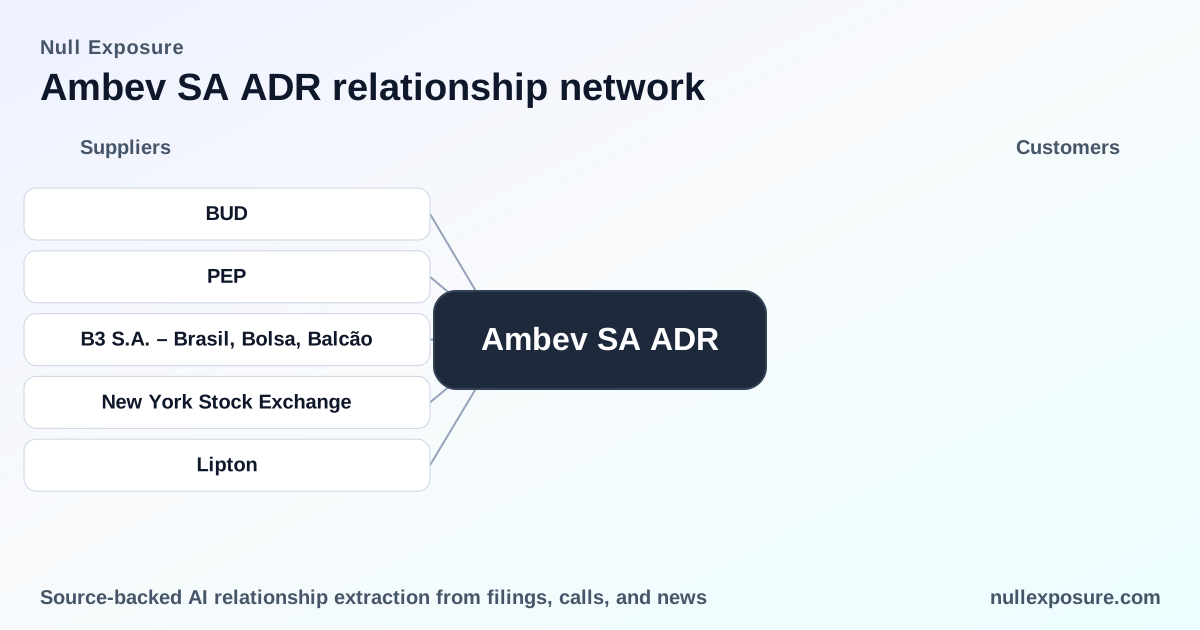
Ambev (ABEV) — supplier relationships that shape distribution, digital commerce and market access
Ambev monetizes a global beverage platform by producing, marketing and distributing beer and non‑alcoholic beverages across the Americas, capturing margin through branded product sales, route‑to‑market control and scale in logistics and packaging. Revenue comes from retail and institutional channel sales, licensing of international brands and increasingly from digital B2B commerce (BEES), while listed market access on B3 and the NYSE supports capital flexibility and investor liquidity. For investors and operators, the supplier landscape around Ambev is as much about strategic control of distribution channels as it is about brand partnerships.
If you want a consolidated view of Ambev’s third‑party and related‑party suppliers, see our portal at https://nullexposure.com/ for sortable relationship data and trend tracking.
How Ambev uses supplier relationships to run the business
Ambev’s supplier relationships operate on three practical planes: product and brand alliances that expand assortment; digital and logistics platforms that deliver product to customers; and capital‑market infrastructure that supports investor access. The BEES B2B platform and the company’s portfolio of global brands are the twin levers that convert production into recurring retail income. These relationships are operationally critical — they influence pricing power, working capital needs and distribution economics.
The BEES arrangement with the controlling shareholder — strategic distribution control
Ambev has a related‑party agreement with its controlling shareholder, Anheuser‑Busch InBev, to continue using and operating the BEES B2B digital commerce platform. This confirms direct operational integration with the BEES channel, reinforcing Ambev’s digital route‑to‑market and reducing the need to build a parallel B2B stack internally. (Digital Commerce 360, Dec. 23, 2025: https://www.digitalcommerce360.com/2025/12/23/ambev-deal-ab-inbev-bees-b2b-marketplace-platform/amp/)
Brand partnerships that extend product assortment — PepsiCo and Lipton
PepsiCo: Ambev markets products under multiple global brand names, and PepsiCo is listed among those brand relationships, indicating co‑distribution or licensing arrangements that expand Ambev’s soft‑drink portfolio alongside its beer franchise. This broadens shelf space and supports cross‑channel promotions. (Earnings summary reporting Q4 2025, Intellectia; first seen Mar. 2026: https://intellectia.ai/news/stock/ambev-reports-q4-2025-earnings-with-mixed-results)
Lipton: The company also markets Lipton as part of its non‑alcoholic beverage mix, demonstrating continuation of third‑party brand distribution that diversifies margin sources beyond beer and strengthens grocery and on‑premise penetration. (Earnings summary reporting Q4 2025, Intellectia; first seen Mar. 2026: https://intellectia.ai/news/stock/ambev-reports-q4-2025-earnings-with-mixed-results)
Market listings that underpin capital and investor access — NYSE and B3
New York Stock Exchange: Ambev’s listing on the NYSE ensures international investor access and liquidity for its ADR class, which supports valuation transparency and cross‑border capital flows. (Company press release noted in The Globe and Mail, FY2026: https://www.theglobeandmail.com/investing/markets/stocks/ABEV/pressreleases/203343/ambev-sets-april-payment-date-for-first-2026-interest-on-capital-tranche/)
B3 S.A. – Brasil, Bolsa, Balcão: Domestic listing on B3 maintains local capital market access and institutional participation in Brazil, which is important for local currency funding, dividend distribution mechanics and regulatory compliance. (Company press release noted in The Globe and Mail, FY2026: https://www.theglobeandmail.com/investing/markets/stocks/ABEV/pressreleases/203343/ambev-sets-april-payment-date-for-first-2026-interest-on-capital-tranche/)
If you want the underlying documents and a clickable relationship map—for portfolio monitoring and counterparty scoring—visit https://nullexposure.com/.
What these relationships tell investors about Ambev’s operating model
- Contracting posture: Evidence points to long‑term, strategic commercial arrangements rather than short‑term spot contracts. The related‑party BEES agreement is structured to preserve a core digital distribution channel rather than leaving B2B sales to fragmented third parties.
- Concentration: Control is concentrated. ABEV’s operational ties to Anheuser‑Busch InBev (the controlling shareholder) create a consolidated commercial posture that centralizes decision rights and distribution architecture.
- Criticality: Several suppliers/platforms are mission‑critical. The BEES platform functions as a core distribution channel; listings on B3 and the NYSE are critical to capital access. Brand relationships like PepsiCo and Lipton are important for portfolio breadth but are operationally replaceable over time.
- Maturity: Ambev is a mature, scale specialty beverage operator. The company’s reported figures — Revenue TTM ~US$88.2bn, EBITDA ~US$27.2bn, gross profit margin and stable dividend policy — reflect a business with established cash generation and predictable working capital cycles.
These are company‑level signals derived from relationship data and public reporting rather than contractual excerpts. There are no explicit third‑party constraint notices in the available relationship feed that reassign or limit supplier scope today.
Key risks investors should monitor
- Related‑party governance risk. The BEES agreement with the controlling shareholder increases the importance of governance oversight; investors should track transaction terms, transfer pricing and service fees disclosed in filings.
- Distribution concentration. Overreliance on BEES for B2B sales could create single‑channel exposure; monitor channel mix and any revenue concentration metrics management discloses.
- Brand dependency and co‑marketing economics. Third‑party brands (PepsiCo, Lipton) enhance assortment but also compress margins if terms are distributor‑favorable; watch for changes in licensing or distribution fees.
- Capital market sensitivity. Listings on both B3 and the NYSE provide liquidity but also expose the company to regulatory and currency volatility across jurisdictions.
Ambev’s underlying fundamentals are robust — market cap ~US$45.2bn, operating margin ~28.2%, and a dividend yield near 9.5% as reported — but these strengths coexist with governance and channel concentration considerations that require active monitoring.
Bottom line for investors and operators
Ambev’s supplier relationships combine strategic control (BEES and the AB InBev connection), diversified product sourcing (PepsiCo, Lipton) and market‑facing infrastructure (B3, NYSE). This configuration favors scale returns and distribution efficiency, but it elevates governance and single‑channel execution risk. For investors, the tradeoff is a stable cash generator with concentrated operational levers; for operators, the imperative is to optimize digital commerce economics while preserving flexibility in brand sourcing.
For a deeper dive on counterparty exposure and to track future disclosures affecting these relationships, explore our full relationship analysis at https://nullexposure.com/.