ABM Industries: a facilities services platform monetizing scale, contracts, and integrations
ABM Industries operates as an integrated facilities services provider, selling recurring and project-based contracts that bundle janitorial, engineering, energy, EV charging, and specialized infrastructure services to large commercial, transportation and public-sector clients. The company monetizes through long-duration service agreements, add-on energy and technology deployments, and high-utilization labor networks, generating roughly $8.87 billion in trailing revenue with EBITDA of $428.6 million (TTM, FY2026 data). For investors evaluating supplier risk and opportunity, ABM is a cash-generative, service-led platform whose returns depend on contract scale, operational execution, and successful cross-sell of energy and mobility solutions. Learn more at the NullExposure research hub: https://nullexposure.com/
How ABM’s commercial model translates to cash flow and exposure
ABM’s revenue per share and margins reflect a low-margin, high-volume services model: Revenue TTM $8.87B, Profit margin ~1.78%, and Operating margin ~3.49%. The firm’s monetization levers are (1) recurring cleaning and facility management contracts, (2) project and capital-backed energy and EV charging deployments, and (3) strategic partnerships that accelerate specialty service adoption. These characteristics drive predictable cash flow if contract retention and labor supply are stable, but they also create exposure to labor cost inflation, contract renewal cycles and concentrated operational failures at large client sites.
Operational constraints that matter to counterparties and investors
- Contracting posture: ABM signs long-term service agreements and also relies on subcontractors and joint-venture partners for work ABM cannot self-perform; this is an explicit company-level disclosure and signals a hybrid in-house / subcontractor delivery model reported by the company.
- Concentration and criticality: While revenue is highly diversified across sectors, a handful of large, infrastructure-heavy contracts (transit depots, stadiums, public fleets) are operationally critical—any delivery issue would have outsized reputational and financial impact.
- Maturity and market position: ABM is a mature, publicly listed firm (NYSE: ABM) with institutional ownership and scale advantages that support nationwide deployments of energy and mobility services.
- Contract delivery risk: Reliance on subcontractors increases execution risk and shifts some performance and compliance responsibilities outside direct ABM control, which is a meaningful supplier-risk signal for large institutional customers.
Relationship roll call: partners, clients and service links investors should track
Below are every named relationship pulled from recent reporting, with a concise plain-English takeaway and a source reference for further reading.
-
KPMG LLP — Shareholders ratified KPMG as ABM’s independent registered public accounting firm for fiscal 2026, confirming the firm’s external audit relationship going forward. According to ABM disclosures reported in May 2026, the appointment was ratified at the annual meeting (SEC 8‑K and press coverage, May 2026).
Source: SEC 8‑K filing reported via StockTitan and contemporaneous press coverage (The Globe and Mail / Investing.com), May 2026. -
HYLN (Hyliion) — Hyliion announced a strategic partnership with ABM to support deployment of integrated distributed energy solutions, signaling ABM’s push into electrification and distributed energy service bundles. The partnership was disclosed on Hyliion’s 2025 Q4 earnings call (March 2026).
Source: Hyliion 2025 Q4 earnings call transcript, March 2026. -
CLNE (Clean Energy Fuels) — Clean Energy signed service agreements with ABM Facility Services to maintain three Phoenix bus depots, supporting RNG fueling and ongoing station maintenance for a large transit fleet. Reporting indicates ABM will handle maintenance of fueling stations that supply RNG to hundreds of buses (May 2026 coverage).
Source: MobilityPlaza and industry reporting on Clean Energy / ABM agreement, May 2026. -
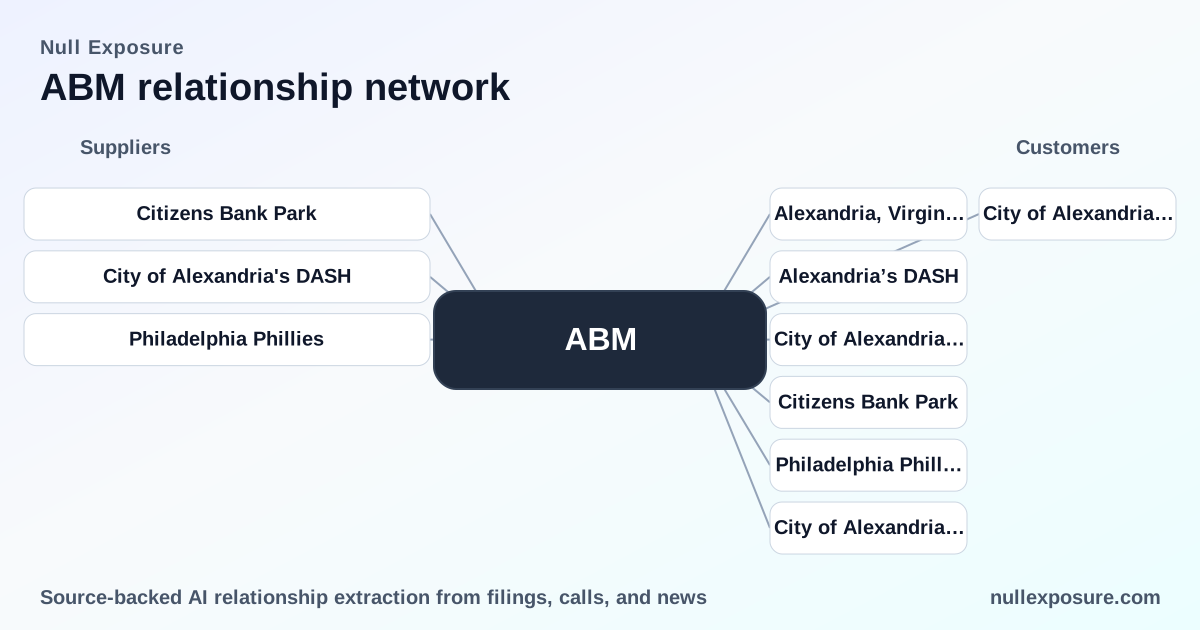
City of Alexandria’s DASH — DASH partnered with ABM to support EV bus charging infrastructure, a direct example of ABM delivering electrification and charging services to municipal transit operators. The engagement was referenced in March 2026 market commentary on ABM.
Source: Analyst and media coverage summarizing ABM’s Q3 commentary and client wins, March 2026. -
Philadelphia Phillies — ABM announced a multi-service partnership with the Philadelphia Phillies to provide comprehensive facility services at Citizens Bank Park, reflecting ABM’s stadium and live-venue footprint. This public‑facing partnership was disclosed in March 2026 press coverage.
Source: March 2026 press reports and analyst notes on ABM’s multi-service partnership with the Phillies. -
Citizens Bank Park — As the venue for the Phillies agreement, Citizens Bank Park is the locus of ABM’s multi-service contract that spans cleaning, operations support, and other facility services for the stadium. The engagement was reported alongside the Phillies partnership in March 2026 coverage.
Source: March 2026 media coverage and analyst write-ups on ABM’s stadium services. -
XOS — Xos reported that ABM is an early adopter of the new generation of its Xos Hub, signaling ABM’s use of EV fleet charging and depot management solutions to accelerate clients’ electric vehicle deployments. Xos’s disclosure was made in a March 28, 2025 press release highlighting customer adoption.
Source: Xos press release via GlobeNewswire, March 28, 2025.
What these relationships reveal about ABM’s strategic trajectory
- Energy and EV services are core growth vectors. Multiple relationships—Hyliion, Xos, Clean Energy and municipal transit work—demonstrate ABM is shifting from pure janitorial/facilities toward integrated electrification and energy services, where ABM captures recurring maintenance and installation margin.
- Large venue and transit contracts increase operational criticality. Partnerships with stadiums and transit operators create dependency on flawless operational execution; these wins boost revenue visibility but increase downside if delivery lapses occur.
- Audit continuity reduces corporate governance uncertainty. Ratification of KPMG for FY2026 is a governance positive that supports financial statement reliability for investors.
Key risks and monitoring checklist for investors and procurement teams
- Execution risk via subcontractors: ABM’s stated reliance on subcontractors for work it cannot self-perform is a structural delivery risk—monitor contractor oversight, insurance, and compliance practices.
- Margin pressure from labor and energy costs: Low operating margins mean labor inflation or project cost overruns rapidly compress profitability; track quarterly margin trends and backlog composition.
- Contract renewal and concentration: Watch renewal outcomes for large public-sector and venue contracts; a lost major account would be meaningful to near-term revenue.
- Integration risk on new energy services: Partnerships with Hyliion, Xos and Clean Energy accelerate capability but require capital and operational integration to convert wins into stable cash flow.
Bottom line for operators and investors
ABM is a scale-dependent, service-led operator with growing exposure to energy and electrification solutions. The company’s business model yields predictable, recurring revenue but also concentrates execution risk in large, infrastructure-critical contracts and third-party delivery channels. For investors and procurement officers, the priority is tracking contract renewals, margin trends, subcontractor controls, and the pace at which energy and EV engagements convert from project revenue into steady service streams.
For a deeper supplier risk profile and ongoing relationship monitoring, visit NullExposure: https://nullexposure.com/