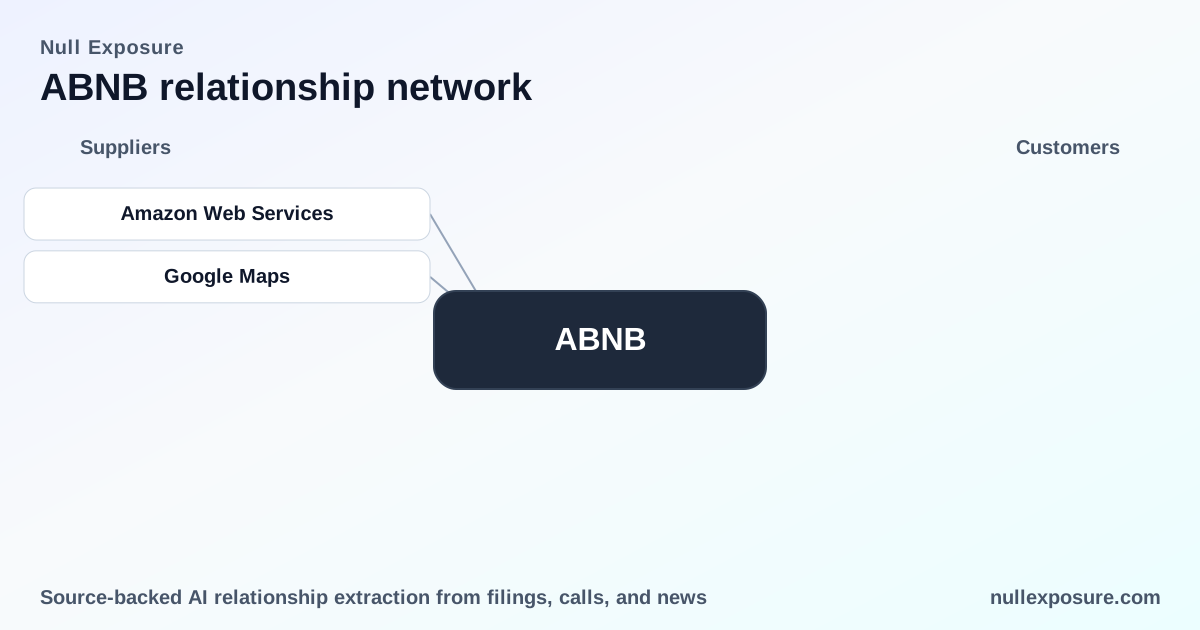
Airbnb (ABNB) — Supplier map and what it means for investors
Airbnb operates a two-sided online marketplace that monetizes primarily through transaction fees charged to hosts and guests and fees for experiences and platform services, supported by a high-margin software and network business with material scale (Revenue TTM $12.24B, Profit Margin 20.5%). Its proposition depends on third-party infrastructure and enterprise relationships to deliver the customer experience at scale, which creates concentrated operational dependencies that directly affect uptime, product features, and unit economics. For supplier intelligence and relationship tracking, see NullExposure for source-level detail: https://nullexposure.com/.
The supplier roll call that matters to valuation and risk
Below I list each supplier relationship disclosed in the compiled results and summarize the commercial reality and relevance.
Amazon Web Services — hosting backbone for the platform
Airbnb discloses that it relies primarily on Amazon Web Services (AWS) in the United States and abroad to host and deliver its platform, making AWS a central technology partner for production workloads and global delivery. According to Airbnb’s 2025 Form 10‑K, this hosting relationship underpins platform availability and scale. (Source: Airbnb 2025 Form 10‑K)
Google Maps — core location and routing functionality
Airbnb states it uses Google Maps and other third‑party services for maps and location data that are core to platform functionality, meaning maps, search accuracy, and local discovery depend on external geodata providers. This is disclosed in the 2025 Form 10‑K. (Source: Airbnb 2025 Form 10‑K)
BofA Securities — underwriting and capital markets counterparty
Media coverage of recent financing activity notes an underwriting agreement involving BofA Securities in a multi‑bank senior notes issuance, indicating BofA served as an arranger/underwriter in Airbnb’s debt transactions. (Source: Investing.com report on insider transactions and related financing, May 2026)
Goldman Sachs — capital markets execution partner
Goldman Sachs is named alongside peers as an underwriter on recent senior notes, confirming Goldman’s role in Airbnb’s debt placement and capital markets execution. (Source: Investing.com report on underwriter syndicate, May 2026)
Morgan Stanley — debt underwriting participation
Morgan Stanley is listed with other banks as an underwriter in the multi‑tranche senior notes issuance, positioning Morgan Stanley as part of Airbnb’s financing syndicate. (Source: Investing.com report on underwriter syndicate, May 2026)
FIG (Figma) — design tooling used across the company
A 2022 industry report cites Figma as a widely used web‑based design platform among tech firms, including Airbnb, implying Figma is part of Airbnb’s design and product workflow rather than a direct commercial supplier for operations. (Source: Business Today profile of the Adobe–Figma transaction, Sept 2022)
PAYO — enterprise ecosystem partnership mention
PAYO’s Q4 2025 earnings call lists Airbnb among enterprise relationships that were strengthened and expanded, suggesting Airbnb participates in broader fintech and commerce ecosystems that vendors target for enterprise products and integrations. (Source: PAYO Q4 2025 earnings call transcript)
What the disclosures reveal about Airbnb’s supplier posture
Airbnb’s filings and vendor disclosures create a coherent profile of supplier risk and contracting behavior:
-
Long‑term contracting and sizeable committed spend. The company discloses a commercial agreement with a data hosting services provider that includes purchase commitments of at least $1.7 billion through 2031, signaling multi‑year vendor commitments and predictable infrastructure spend. (Company disclosure excerpt)
-
Third‑party providers are operationally critical. Airbnb acknowledges reliance on third‑party service providers to host and deliver "a significant portion" of the platform and warns that interruptions could materially affect operations and results, establishing suppliers as critical nodes in service delivery. (Company disclosure excerpt)
-
Service‑provider orientation and infrastructure dependence. Disclosures characterize suppliers principally as service providers across infrastructure and operational support, including cloud computing and community support functions, reflecting a hub‑and‑spoke IT posture where core platform delivery sits on external infrastructure and outsourced labor pools. (Company disclosure excerpts)
-
Meaningful spend concentration. The combination of a named primary host (AWS) and explicit multi‑hundred‑million to billion‑dollar commitments places supplier spend in the >$100M band, concentrating procurement exposure into a small set of strategic vendors. (Company disclosure excerpt)
Collectively, these company‑level signals indicate high criticality, concentrated vendor spend, and long‑dated contractual commitments that translate directly into both operational leverage and vendor negotiation constraints.
Investment and operational implications
-
Operational continuity is a valuation lever. Given the centrality of external hosting and geolocation services, uptime, incident recovery, and cloud cost control feed directly into gross margins and guest/host satisfaction metrics. Any prolonged provider disruption or cost trajectory shift will have immediate P&L and reputational consequences.
-
Negotiation leverage is asymmetric. Significant committed spend creates predictability for vendors but constrains Airbnb’s immediate switching flexibility; this elevates the importance of contractual terms (SLAs, pricing floors, exit ramps) and scenario planning for failover or multi‑cloud strategies.
-
Capital markets relationships speak to balance sheet strategy. The presence of BofA, Goldman Sachs, and Morgan Stanley in underwriting activity signals a conventional, bank‑led capital markets approach to debt financing and liquidity management that complements equity market access. (Source: Investing.com coverage, May 2026)
-
Ecosystem partnerships matter for product expansion. Mentions of PAYO and common adoption of tools like Figma reflect Airbnb’s integration into fintech and design ecosystems that influence product velocity and partner monetization opportunities. (Sources: PAYO earnings call, Business Today article)
For deeper source‑level supplier intelligence and scenario modeling, visit NullExposure to review the underlying filings and news references: https://nullexposure.com/.
Bottom line — what investors should watch next
Airbnb runs a software-enabled marketplace that is materially dependent on a small set of external providers for infrastructure, mapping, and enterprise services. Key risks are vendor concentration and long-dated spend commitments, while strategic opportunities include negotiating better commercial terms, investing in multi‑vendor resiliency, and leveraging capital markets relationships to fund product and margin initiatives. Monitor cloud SLAs, mapping data costs and licensing, and debt issuance activity from the named underwriting banks as leading indicators of cost, resilience, and capital strategy.