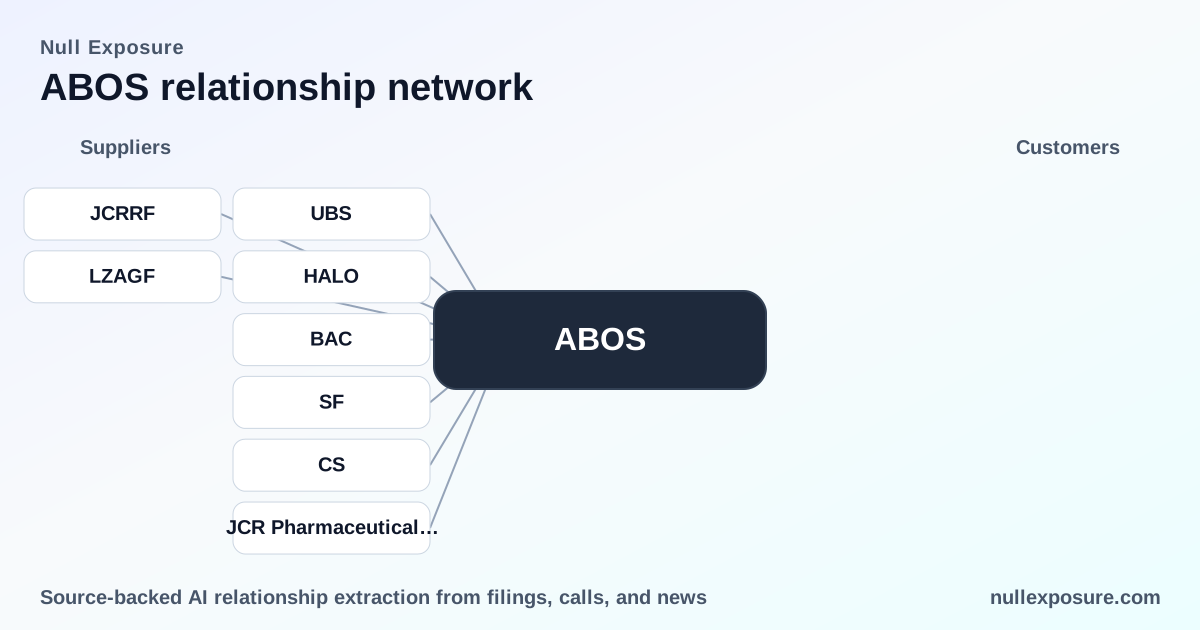
Acumen Pharmaceuticals (ABOS): supplier relationships that define sabirnetug’s path to market
Acumen Pharmaceuticals is a clinical‑stage biopharma building commercial optionality around sabirnetug — a monoclonal antibody targeting toxic Aβ oligomers for Alzheimer’s disease. The company monetizes through a combination of licensing/collaboration deals that include upfronts, option exercise and milestone payments, and ultimately through product sales if regulatory approval and commercialization succeed; in the interim Acumen funds development with equity and ATM shelf financing. For investors the supplier and advisory map is the operational backbone: third‑party manufacturers, delivery‑technology partners and capital markets counterparties are the levers that convert science into revenue.
If you want the complete supplier rundown and primary sources, visit https://nullexposure.com/ for our research portal.
What the supplier footprint reveals about the business model
Acumen operates a lean, outsourcing‑first model. Manufacturing and clinical operations are handled primarily by third parties under a mix of framework master agreements and shorter, cancellable work orders, which concentrates operational risk while preserving balance‑sheet flexibility. The company shows both long‑dated commitments (office leases, a term loan maturing in 2027 with an extension option) and transactional relationships (CRO/CMO contracts without minimum purchase commitments). That hybrid posture reduces fixed cost burden but creates executional dependency on a small set of partners, which investors should treat as a material operational risk.
Key operational signals:
- Contracting posture: combination of long‑term leases and loan covenants with short‑notice, cancellable CRO/CMO work orders and master services frameworks.
- Concentration and criticality: reliance on a limited number of CMOs and delivery partners is a high‑impact point of failure for timelines and regulatory filings.
- Spend profile: clinical CRO costs are already material — the company disclosed a $35.6 million increase tied to ALTITUDE‑AD — consistent with a $10m–$100m supplier spend band.
- Relationship stage: most manufacturing and delivery relationships are active; some CRO engagements remain prospective as trials scale.
Relationship-by-relationship: who does what (concise, sourced)
-
Ernst & Young LLP — Acumen’s independent registered public accounting firm since 2021; Ernst & Young audited the company’s 2025 financial statements and its appointment for FY2026 was put forward for shareholder ratification. Source: Acumen proxy and S‑3 filings via StockTitan (FY2026).
-
JCR Pharmaceuticals Co., Ltd. — Strategic collaborator for Enhanced Brain Delivery (EBD™); Acumen entered a collaboration, option and license in July 2025 to combine Acumen’s AβO‑selective antibodies with JCR’s J‑Brain Cargo blood‑brain‑barrier technology, including upfront consideration and a $9.25M option exercise payment for up to two candidates. Source: Acumen 10‑K and 424B3 prospectus (filed 2026) via StockTitan.
-
Merck & Co., Inc. — Historical collaborator and IP source: surviving provisions of a prior collaboration gave Acumen an exclusive, perpetual, royalty‑free license to Merck’s ADDL patents and know‑how relevant to sabirnetug. Source: Acumen 10‑K and 8‑K filings (FY2026) via StockTitan.
-
Halozyme / Halozyme Therapeutics — Delivery technology and supplier: Acumen has a non‑exclusive license with Halozyme to use ENHANZE® for a subcutaneous formulation and Halozyme will be the exclusive supplier of PH20 active ingredient for that program. Source: Acumen 10‑K, press releases and investor materials (FY2025–FY2026) via StockTitan and Globenewswire.
-
BofA Securities, Inc. (BofA) — Sales agent under an at‑the‑market (ATM) equity program enabling up to $50.0M of sales; BofA was also an IPO underwriter. Source: Acumen prospectus and IPO press (FY2021 & FY2026) via StockTitan and RTT News.
-
Stifel, Nicolaus & Company, Incorporated — Co‑sales agent for the ATM program and an original IPO underwriter. Source: Acumen prospectus and 10‑K (FY2021 & FY2026) via StockTitan and RTT News.
-
BTIG, LLC — Added as a sales agent to the amended Sales Agreement (ATM) to broaden placement channels. Source: Acumen S‑3 and 10‑K (FY2026) via StockTitan.
-
UBS Securities LLC — Named among the IPO underwriters in historical disclosures. Source: IPO coverage and RTT News (FY2021).
-
Credit Suisse Securities (USA) LLC — Listed as an IPO underwriter alongside other banks. Source: IPO coverage and RTT News (FY2021).
-
Aon — Engaged by Acumen’s Compensation Committee as its compensation consultant for 2025. Source: Acumen definitive proxy statement (FY2026) via StockTitan.
-
Lonza Sales AG — Provider of a glutamine synthetase (GS) expression system license for manufacturing sabirnetug; the November 2022 license grants Acumen non‑exclusive rights to use Lonza’s GS system to produce and commercialize the product. Source: Acumen 10‑K (FY2026) via StockTitan.
-
Northwestern University — Holds licensed intellectual property that Acumen uses; the company may owe low single‑digit royalties under that license if agreements remain in place. Source: Acumen 10‑K (FY2026) via StockTitan.
-
Ropes Gray LLP — Outside counsel; the firm provided legal opinions on the validity of securities issued under registration statements. Source: Acumen prospectus (424B3) filings (FY2026) via StockTitan.
-
Equiniti Trust Company, LLC — Transfer agent for registered stockholders as referenced in the proxy materials. Source: Acumen definitive proxy (FY2026) via StockTitan.
-
UBS / BAC / SF / LZAGF / JCRRF tickers — These ticker references in filings and press reflect the market identifiers for underwriters and partners (UBS, Bank of America (BAC), Stifel (SF), Lonza (LZAGF), and JCR (JCRRF)) used by market reporting outlets; primary transactional relationships are with the parent entities listed above. Source: IPO coverage and trading press (FY2021–FY2026) via RTT News, Globe and Market press.
How constraints translate into investment risk and operational levers
-
Contracting posture: Acumen balances fixed obligations (short‑term leases, a 38‑month Newton office lease) and financing maturities (term loan due Nov 1, 2027 with an extension option) against flexible supplier arrangements. This structure preserves runway but concentrates execution risk in vendors. Evidence: lease and loan language in filings (FY2026).
-
Frameworks and master agreements: Manufacturing operations run on master services agreements with work orders that set timelines and quality specifications, which supports scale but creates dependency on the counterparty’s compliance to timelines and regulatory standards. Evidence: master service program excerpts in 10‑K (FY2026).
-
Criticality of CMOs and delivery partners: The company explicitly states loss or failure of a CMO could materially delay development; Halozyme and Lonza are singled out in filings and press as key manufacturing/delivery collaborators, elevating single‑point risk. Evidence: materiality and manufacturer excerpts in 10‑K (FY2026).
-
Spend concentration: Clinical CROs drove a $35.6M increase in costs tied to ALTITUDE‑AD, placing supplier spend squarely in the $10M–$100M band and making cash management and ATM flexibility operationally important. Evidence: financial commentary in filings (FY2026).
Investment implications and next steps
Acumen’s supplier map is the operational constraint for valuation: success requires flawless coordination between licensors (Merck, Northwestern), delivery partners (JCR, Halozyme), CMOs (Lonza and other contract manufacturers) and capital markets counterparties that fund the run rate. For investors, the two clearest levers are clinical progress on EBD and sabirnetug plus the company’s ability to execute manufacturing scale‑up without interruption.
For a deeper feed of supplier‑level documents and time‑series relationship signals, visit our research hub at https://nullexposure.com/.
Bold operational facts above are drawn directly from Acumen’s regulatory filings and contemporaneous press sourced in May 2026; treat the supplier map as the single biggest operational dependency behind any valuation assigned to ABOS.