Arbor Realty Trust (ABR): Supplier relationships that power a loan-finance platform
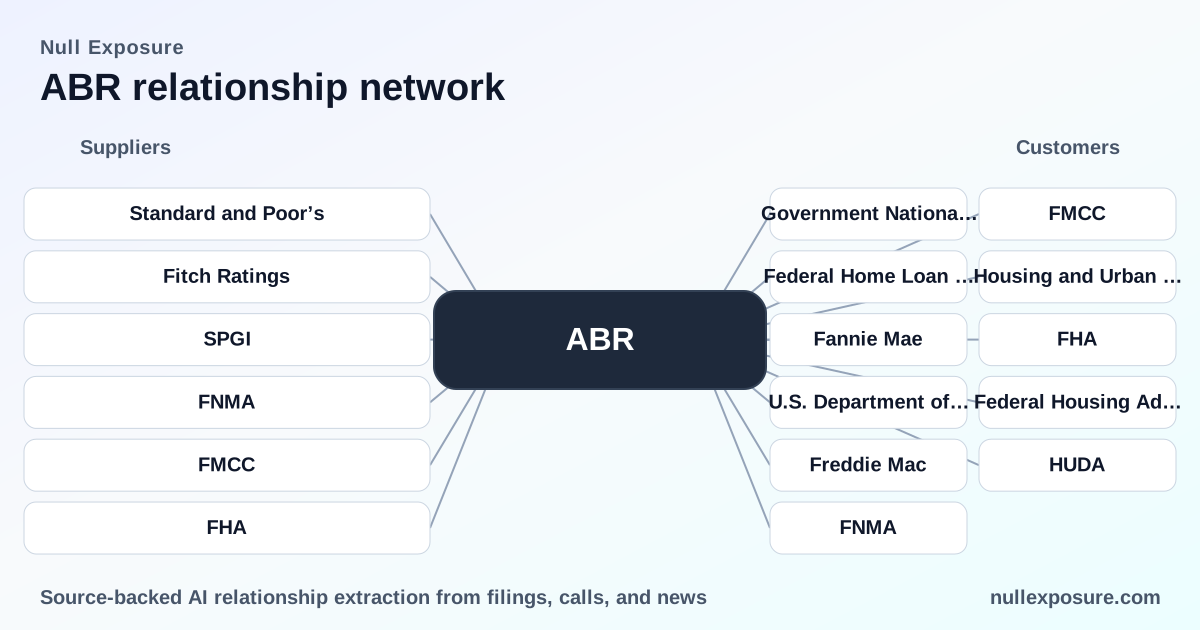
Arbor Realty Trust operates as a diversified mortgage REIT that originates, finances and securitizes commercial and multifamily loans, monetizing through originations fees, net interest income on financed loans, and structured securitizations including CLO platforms and agency conduit sales. The company leverages a mix of short-term warehouse funding for agency originations and multi‑hundred‑million repurchase and CLO facilities to scale lending — a model that converts balance-sheet leverage into fee and spread income. For relationship-level diligence and counterparty risk, the supplier map below identifies the trustees, servicers, rating agencies, banks and agency counterparties that underpin Arbor’s capital markets plumbing. For a consolidated view of supplier exposures, visit https://nullexposure.com/.
What the counterparty map tells investors about Arbor’s operating posture
Arbor runs a dual funding model. Its Agency Business uses short-term committed and uncommitted warehouse facilities to finance loans that are sold into agencies, while its Structured Business runs longer‑dated CLO and repurchase facilities to finance held or securitized collateral. The firm’s counterparties therefore split into two functional groups: agency channels (Fannie Mae, Freddie Mac, FHA) that absorb originations quickly, and capital markets providers (trustees, rating agencies, banks, placement agents) that enable securitization, credit enhancement and term financing.
- Contracting posture: evidence shows both short-term warehouse lines for agency originations and longer-term repurchase/CLO facilities with multi‑hundred‑million commitments.
- Concentration and criticality: Arbor relies on a relatively small set of trustees, rating agencies and lead managers for primary securitizations; these suppliers are operationally critical for issuing notes and transferring risk.
- Maturity profile: financing includes near-term facilities that turn over within 60 days and repurchase/CLO facilities that are multi-year, reflecting a managed maturity ladder.
- Spend scale: disclosed facilities and shared repurchase capacity imply hundreds of millions to billions of committed financing capacity supporting the business.
Relationship roll call — every counterparty reported (plain-English takeaways)
-
Computershare Trust Company — Acts as a named trustee on Arbor’s CRE‑CLO issuance, a conventional role to hold securities and administer payments. Source: TradingView coverage of the CRE‑CLO closing (May 2, 2026): https://www.tradingview.com/news/tradingview:66e0f3d4d05f2:0-arbor-realty-trust-closes-763m-cre-clo-issues-notes-at-sofr-1-73-maturing-2043/
-
Arbor Realty Collateral Management — The internal collateral manager tied to Arbor’s structured vehicles and CLOs that sources and manages the loan pool for securitizations. Source: TradingView CRE‑CLO report (May 2, 2026): https://www.tradingview.com/news/tradingview:66e0f3d4d05f2:0-arbor-realty-trust-closes-763m-cre-clo-issues-notes-at-sofr-1-73-maturing-2043/
-
Wilmington Trust — Listed as a counterparty/trustee on the CLO transaction, Wilmington performs standard trustee and administrative functions for the securitization stack. Source: TradingView CRE‑CLO coverage (May 2, 2026): https://www.tradingview.com/news/tradingview:66e0f3d4d05f2:0-arbor-realty-trust-closes-763m-cre-clo-issues-notes-at-sofr-1-73-maturing-2043/
-
Arbor Multifamily Lending — The agency business unit that originates multifamily loans for sale to agencies or securitization; it supplies the origination flow that fuels both agency trading and structured pools. Source: TradingView CRE‑CLO article (May 2, 2026): https://www.tradingview.com/news/tradingview:66e0f3d4d05f2:0-arbor-realty-trust-closes-763m-cre-clo-issues-notes-at-sofr-1-73-maturing-2043/
-
Midland Loan Services — Appointed as the non‑affiliated special servicer on the Arbor 2026‑FL1 CLO, responsible for workout and special servicing functions on troubled assets. Source: TradingView reporting (May 2, 2026): https://www.tradingview.com/news/tradingview:66e0f3d4d05f2:0-arbor-realty-trust-closes-763m-cre-clo-issues-notes-at-sofr-1-73-maturing-2043/
-
ABR‑P‑E (preferred security) — Company filings and press releases list ABR‑P‑E as part of the capital structure and discuss Arbor’s status as a Fannie Mae DUS and Freddie Mac Optigo seller/servicer, indicating agency channel access tied to its capital plan. Source: GlobeNewswire press release on executive appointment (Feb 17, 2026): https://www.globenewswire.com/news-release/2026/02/17/3239294/0/en/arbor-realty-trust-inc-announces-the-appointment-of-yoni-goodman-as-its-executive-vice-president-and-chief-operating-officer.html
-
Fitch Ratings / Fitch Ratings, Inc. — Rated certain classes of notes issued in Arbor’s CLO and securitizations, providing external credit assessment that determines investor demand and pricing. Source: GlobeNewswire CLO closing release (Mar 23, 2026): https://www.globenewswire.com/news-release/2026/03/23/3260844/0/en/Arbor-Realty-Trust-Closes-a-762-6-Million-Collateralized-Loan-Obligation-Securitization.html
-
Kroll Bond Rating Agency, LLC — Assigned ratings to most notes (excluding the most subordinate tranche) for the recent CLO, supporting market placement. Source: StockTitan coverage of the CLO closing (May 2, 2026): https://www.stocktitan.net/news/ABR/arbor-realty-trust-closes-a-762-6-million-collateralized-loan-8u4hkbrhh7tk.html
-
Standard & Poor’s (SPGI) — Cited as a rating agency on Arbor’s rating stack in multiple press releases and investor communications, contributing to credit spreads on issued notes. Source: SahmCapital and related press coverage of earnings and appointments (Feb–Mar 2026): https://www.sahmcapital.com/news/content/arbor-realty-trust-schedules-fourth-quarter-2025earnings-conference-call-2026-02-07
-
UMB Bank, N.A. — Acts as indenture trustee on certain note offerings and facilities, a conventional trustee role referenced in investor commentary. Source: Investing.com company news (May 2026): https://www.investing.com/news/company-news/arbor-realty-trust-stock-hits-52week-low-at-719-93CH-4524790
-
Fannie Mae (FNMA) — Arbor is an approved Fannie Mae DUS lender; Fannie provides the agency conduit for a portion of Arbor’s originations and fee income. Source: GlobeNewswire executive appointment release describing agency lending platform (Feb 17, 2026): https://www.globenewswire.com/news-release/2026/02/17/3239306/0/en/Arbor-Realty-Trust-Inc-Announces-the-Appointment-of-Jeff-Lee-as-its-Executive-Vice-President-and-Head-of-Agency-Lending.html
-
Freddie Mac (FMCC) — Arbor is a Freddie Mac Optigo seller/servicer and uses Freddie channels to sell or securitize loans originated in its agency business. Source: GlobeNewswire executive appointment release (Feb 17, 2026): https://www.globenewswire.com/news-release/2026/02/17/3239306/0/en/Arbor-Realty-Trust-Inc-Announces-the-Appointment-of-Jeff-Lee-as-its-Executive-Vice-President-and-Head-of-Agency-Lending.html
-
FHA — Arbor is an approved FHA MAP multifamily lender, adding a government-insured channel for certain originations that influences credit profile and business mix. Source: GlobeNewswire executive announcement (Feb 17, 2026): https://www.globenewswire.com/news-release/2026/02/17/3239306/0/en/Arbor-Realty-Trust-Inc-Announces-the-Appointment-of-Jeff-Lee-as-its-Executive-Vice-President-and-Head-of-Agency-Lending.html
-
J.P. Morgan (JPM) — Served as a joint book‑running manager on offerings and shelf registrations that facilitate primary capital raises and placements. Source: StockTitan syndicate disclosure (May 2026): https://www.stocktitan.net/news/ABR/page-14.html
-
JMP Securities — Named as a joint book‑running manager on an offering, contributing distribution and placement capacity. Source: StockTitan offering notice (May 2026): https://www.stocktitan.net/news/ABR/page-14.html
-
Raymond James (RJF) — Served as a joint book‑running manager on a shelf offering, supporting public capital market access. Source: StockTitan offering disclosure (May 2026): https://www.stocktitan.net/news/ABR/page-14.html
-
Piper Sandler & Co. (PIPR) — Acted as a placement agent on an equity or debt offering, assisting in raising capital for balance‑sheet or growth needs. Source: StockTitan offering details (May 2026): https://www.stocktitan.net/news/ABR/page-14.html
-
DBRS — Participated as a ratings provider on investment‑grade components of offerings, supporting investor due diligence and secondary liquidity. Source: StockTitan offering coverage (May 2026): https://www.stocktitan.net/news/ABR/page-14.html
Operational and financial implications for investors
- Funding flexibility is the company’s core competitive asset. The combination of short-term warehouse capacity and long-term repurchase/CLO facilities lets Arbor scale originations while controlling timing of securitizations and sales.
- Counterparty concentration is meaningful. A small set of trustees, rating agencies and bookrunners are operationally critical to Arbor’s securitization cadence, creating idiosyncratic operational risk if a key relationship is disrupted.
- Funding size is material. Documented joint repurchase and repurchase facilities in the hundreds of millions to billions confirm a high spend band and capital intensity for the business.
Key risks and what to watch next
- Monitor rating agency actions by Fitch, Kroll and S&P; changes will directly affect Arbormap pricing and investor appetite for issued notes.
- Track the maturity and extension decisions on repurchase facilities and the $2.0 billion shared facility that underwrites the Structured and Agency businesses.
- Watch servicing and special servicing arrangements — appointments like Midland Loan Services are central for loss mitigation and secondary-market valuation.
For a concise supplier-risk dashboard and ongoing updates to Arbor’s counterparty map, explore our coverage at https://nullexposure.com/.
Conclusion: Arbor’s supplier network shows a balanced but concentrated capital‑markets architecture — efficient for scaling originations and securitizations, but sensitive to trustee, ratings, and warehouse counterparty dynamics. Investors should price the tradeoff between yield and counterparty dependency into valuation and scenario stress tests.